
On the low carbon track
Train to Paris
About Train to Paris
From Copenhagen 2009 to Paris 2015! Let’s continue our journey! The UIC co-ordinated campaign “Train to Paris” will bring delegates including national governments, NGOs, decision-makers and journalists from across Europe and Asia by train to Paris for the COP21 United Nations Conference on Climate Change to be held end of 2015 in Paris. Train to Paris campaign will climax at its main event on 28 November. Together let’s build a more sustainable future! Together, let’s take the Train to Paris!
The trains to Paris
Video
Check your emissions
Check the emissions of your travel and the travel of the products you buy in the best possible way! EcoPassenger and EcoTransIT are two user-friendly internet tools to compare the energy consumption, CO2- and exhaust atmospheric emissions for planes, cars and trains (and trucks) in Europe. With “the best possible way” we mean the most fair and comprehensive way. The methodology behind the calculations are sound scientific, focusing on a life cycle approach to the energy involved, and approved by the European Environment Agency.
Presentation & Programme

- Programme
What is « Train to Paris »?
“Train to Paris” is a synchronized network of trains planned to arrive in Paris from across Asia and Europe, with some trains originating from Mongolia, Russia & China.
The aim of this Worldwide Campaign is to raise awareness of the important role of sustainable transport, and low carbon rail transport, in the solution to both climate change mitigation and adaptation.
A series of high-level and media events are scheduled to take place end of November 2015 in Paris, including a symbolic welcome of delegations on arrival in Paris and discussions during a high-level Round Table.
When?
November 28th 2015 but some trains and/or delegations will depart on the 27th - and even on the 18th of November from Beijing.
More info
Twitter: @trainCOP21
Instagram: traintocop21
Facebook: Train to Paris
Where?
Paris, France – host city of the United Nations Conference on Climate Change “COP21”.
Trains will arrive in Paris in Gare de l’Est and Gare du Nord (subject to change depending on various requirements).
Who?
The trains will bring delegates including representatives from national governments, NGOs, but also decision-makers and journalists. Trains can be boarded by invitation only but they will anyway be on their regular service with delegations related to the “Train to Paris” Campaign on board.
Objectives and target audience?
Promote freight and passenger rail as a sustainable, low carbon solution to climate change.
Share with the general public that railway is really one of the backbones to fight climate change.
Secure positive references to rail transport in COP21 documents, negotiations & press coverage.
Encourage decision makers to adopt long term credible & consistent policy in support of rail.
Cooperation
Follow UNFCCC here:
- Website: http://www.unfccc.int
- Twitter: https://twitter.com/UNFCCC
- Chistiana Figueres Twitter: https://twitter.com/CFigueres
- Facebook: https://www.facebook.com/UNclimatechange
The United Nations Framework Convention on Climate Change, with Secretariat in Bonn, Germany is an international treaty agreed on during the United Nations Conference on Environment and Development (UNCED) in Rio de Janeiro in June 1992. The head of the secretariat has been Christiana Figueres, from Costa Rica, since 2010.
The purpose of the Convention is to “stabilise greenhouse gas concentrations in the atmosphere at a level that will prevent dangerous human interference with the climate system." And that "such a level should be achieved within a time-frame sufficient to allow ecosystems to adapt naturally to climate change, to ensure that food production is not threatened, and to enable economic development to proceed in a sustainable manner."
UNFCCC Convention was signed by 194 countries, proving the universal consensus that actions are required to fight climate change.
Follow UNEP here:
- Website: http://www.unep.org
- UNEP Twitter: https://twitter.com/unep
- Achim Steiner Twitter: https://twitter.com/asteiner
- UNEP Facebook: https://www.facebook.com/unep.org
- UNEP Instagram: https://instagram.com/unenvironment/
UNEP partnership with UIC has always been strong and during COP15, Achim Steiner even took the “Train to Copenhagen”.
The United Nations Environment Programme, with headquarters in Nairobi, Kenya, is an international agency created in June 1972, aiming to carry out environmental best practices in the following fields: atmosphere, ecosystems both marine and on Earth, governance and green economy. The present Executive Director of UNEP is Achim Steiner.
The United Nations Environment Programme (UNEP) is the voice for the environment in the United Nations system. It is an advocate, educator, catalyst and facilitator, promoting the wise use of the planet’s natural assets for sustainable development. The mission of UNEP is to provide leadership and encourage partnership in caring for the environment by inspiring, informing and enabling nations and peoples to improve their quality of life without compromising that of future generations. UNEP strongly supports sustainable transport initiatives that contribute to a cleaner, greener future.
Follow RATP here:
- Website: http://www.ratp.fr
- RATP Group Twitter: https://twitter.com/GroupeRATP
The RATP is associated with the ‘Train to Paris’ event, since it is the natural link between the conventional rail system and the city. We are proud, therefore, to have been in a position to transport large numbers of guests between mainline stations in Paris and the UIC headquarters using ‘clean’ modes of transport, including our electrically-powered and hybrid buses. These are testament to the ambitious plan of the RATP to operate a 100% ecological fleet of buses by 2025.
Since 2014, the RATP has been committed to major technological and ecological evolution, with the ultimate objective of converting most of its fleet of 4,500 buses to electric power by 2025: this is the Bus2025 Plan. This ambitious project reflects the desire of the Syndicat des Transports d’Île-de-France (STIF) to remove diesel-powered buses from the Île-de-France region.
The Bus2025 Plan is aimed at creating a fleet of buses with 80% of them being electrically powered and 20% of them being powered by biogas. This arrangement will enable the RATP to eliminate 80% of greenhouse gas emissions from the bus network and 50% of its carbon footprint, thus becoming the world leader in ‘clean’ buses.
Electrical energy is also the power source for our Metro and RER trains and for many years the RATP has been making strenuous efforts to modernise its fleet. Progressive renewal of rolling stock is a fundamental factor in our policy of reducing electrical power consumption, since the energy performance of these vehicles is far in advance of earlier generation equipment. A few facts about electrically-operated braking: in 2015, 77% of lines are using regenerative braking and 81% of trains are fitted with regenerative braking systems, the ultimate objective being to ensure that 100% of the Metro fleet is equipped with regenerative braking. To go further, the RATP is employing eco-driving on its automated Metro lines: on Line 14, modification of the automatic train operating system and integration into the control software of energy conservation objectives has yielded a reduction of 16% per year of the electrical energy consumed by the 25 trains in the fleet.
In addition to vehicles, the RATP is aiming to be an exemplary company in the sustainable city concept. In fact, the RATP is pursuing a voluntary and innovative environmental policy in order to improve its environmental performance. As part of this policy, transport areas will all be equipped with LED lighting by 2016, which will cut electrical energy consumption by 50%. Technical, industrial and service industry buildings are also subject to a policy of energy efficiency and waste management.
FAQ
What is the Paris climate change summit (COP21)?
From November 30 to December 11, 2015 high level representatives including Ministers and State Leaders will meet in Paris for the United Nations Climate Conference COP21. The talks are the latest in an annual series of UN meetings that trace their origins to the 1992 Earth Summit in Rio, which aimed at coordinating international action against climate change.
COP21 will be a crucial conference; it is expected to agree a new landmark legal agreement on the climate, applicable to all countries, with the aim of keeping global warming below 2°C. France will therefore be playing a leading international role to ensure points of view converge and to facilitate the search for consensus by the United Nations, as well as within the European Union, which has a major role in climate negotiations. (Source: http://www.cop21.gouv.fr/)
What is climate change?
Climate change is a long-term significant change in weather patterns, including an increase in average temperature and more frequent occurrence of extreme weather events. This is happening due to a large increase in Green House Gas (GHG)-emissions from human activity. These gasses accumulate in the atmosphere, which forms a protective layer around the earth (including different types of air and gasses) and provides a climate that makes it possible for people, animals and plants to live.
What does "COP21" stand for?
"COP21" is the official name of the Paris climate change summit — the 21st Conference of the Parties (COP) under the United Nations Framework Convention on Climate Change (UNFCCC). The COP is the highest body of the UNFCCC and consists of Ministers who meet once a year to discuss developments in the Convention.
Which countries are taking part in the climate change summit, and how many people will be there?
196 countries have signed the United Nations Climate Change Convention. More than 40’000 Officials, Diplomats, Advisers and journalists are expected to attend COP21, joined by Ministers together with Heads of State and Governments.
What does the Summit hope to achieve?
The aim is to reach, for the first time, a worldwide, legally binding agreement that will enable involved actors to combat climate change effectively and provide a turning point to enable future climate resilient & low-carbon development.(Source: http://www.cop21.gouv.fr/)
What progress have we seen on global agreement so far?
In 1992, Governments met in Rio de Janeiro and forged the United Nations Framework Convention on Climate Change. That agreement, still in force, bound governments to take action to avoid dangerous climate change, but did not specify detailed actions. Over the following five years, governments wrangled over what each should do, and what should be the role of developed countries versus emerging economies. Those years of argument produced the 1997 Kyoto protocol requiring cuts in emissions of about 5% by 2012 compared to 1990. Each developed country was allotted a target on emissions reductions. However no targets were set for emerging economies such as China, South Korea and Mexico and there was no limits for international aviation or maritime shipping. Further, the protocol was not ratified by the United States of America.
The Copenhagen climate talks in 2009 were meant to deliver a new legally binding, global deal to replace the Kyoto protocol. Instead, they resulted in a "political agreement" called the Copenhagen Accord. The accord "recognised" the need for countries to tackle climate change, and set the deadline to review existing agreements by the end of 2015.
Why is transportation important in regards to addressing climate change?
Transport alone is causing about one quarter of the global CO2-emissions, and the projections made by international bodies for see a tremendous increase in emissions over the coming decades, particularly in China, India, Russia and other emerging economies.
It is not possible to achieve the "climate change 2 degrees scenario" without action to reduce transport emissions.
How can rail transport make a difference?
Rail is one of the most energy efficient transport modes and thus provides transportation that causes fewer emissions than other transport modes. Travelling by rail is on average 3-10 times less CO2 intensive compared with road or air transport.
Rail transport is responsible for 9% of global transport activity but generates just 3% of transport GHG emissions. However, the rail sector is not resting at its laurels and is working hard to further improve its performance in terms of both energy efficiency and reduced GHG emissions.
In order to tackle climate change and reduce transport emissions it is necessary to "shift" people and goods from road and air transport to rail. Even if road vehicles improve their environmental performance, the projected growth for cars, vans and trucks in the world is so high that a serious modal shift to rail is necessary in order to achieve the climate change 2 degrees scenario.
How are the railways involved with climate change?
UIC, the International Union of Railways, grouping together 240 in the 5 continents and representing the railway sector at the worldwide level, is dedicated to promote rail and develop more sustainable transport systems as part of the solution to climate change. UIC, together with its Members, is daily working to further improve the environmental and sustainability performance of the rail sector, including mitigation and adaptation to tackle the cause and the effects of climate change.
Mitigation actions are concerned with reducing emissions or preventing the causes of climate change. This includes increasing energy efficiency and reducing reliance on carbon intensive technology.
Adaptation includes taking action to cope with the impacts of climate change. For railways this includes making the railway system more resilient to extreme weather events - to operate and survive in a more challenging environment. Adaptation involves actions that can be taken immediately. Read more about UIC’s work on this under Adapting to climate change.
UIC has developed the "Low Carbon Rail Transport Challenge" with official CO2 reduction targets for the world ra
Pressroom
Train to Paris
-
- TRAIN TO PARIS UIC Press release 37 November 2015
-
- TRANSSIBERIAN UIC Press release 25 November 2015
-
- TRAIN TO PARIS UIC Press release 18 November 2015
-
- Train to Paris Brochure
-
- Train to Paris FAQ
-
- Postcard
-
- Carte Postale
-
- Train to Paris - Key Messages
-
- Train to Paris - Policy recommendations
-
- Speaker biographies
UIC and the environment
-
- UIC factsheet
-
- Railway Climate Responsibility Pledge
-
- UIC EcoTools Press kit Ecopassenger and Ecotransit
Voice of the Supply industry
-
- Interview
- Alstom - Mr. Henry Poupard Lafarge
-
- Biography
- Alstom - Mr. Henry Poupart Lafarge
-
- Interview
- Bombardier Transportation - Dr. Lutz Bertling
-
- Biography
- Bombardier Transportation - Dr. Lutz Bertling
-
- Interview
- Siemens - Dr. Jochen Eickholt
-
- Biography
- Siemens - Dr. Jochen Eickholt
Voice of the UIC members
Logos / Map

Interviews
Jean-Pierre Loubinoux, UIC Director General
- Jean-Pierre Loubinoux [1/3]
- Jean-Pierre Loubinoux [2/3]
- Jean-Pierre Loubinoux [3/3]
José Viégas, Secretary General of the International Transport Forum ITF / OECD
- José Viégas [1/2]
- José Viégas [2/2]
Sabiha Derbel, President Director General of SNCFT (Tunisian Railways)
- Sabiha Derbel
Luc Lallemand, Chief Executive Officer of Infrabel (Belgium Infrastructure Manager)
- Luc Lallemand [1/3]
- Luc Lallemand [2/3]
- Luc Lallemand [3/3]
Manuel Queiró, President of CP (Portuguese Railways)
- Manuel Queiró [1/4]
- Manuel Queiró [2/4]
- Manuel Queiró [3/4]
Partners
With the support of the climate institutions and the rail sector.
Campaign partners


With the support of
Best practices
Commitments of Deutsche Bahn to become an eco-pioneer
Climate protection is a key element of Deutsche Bahn’s success
As an international provider of mobility and logistics services and one of Germany’s largest employers, the DB Group has a special responsibility to its customers, employees, society and the environment. To embrace this responsibility, DB has set out to become a profitable market leader, one of Germany’s top ten employers and an eco-pioneer by 2020 as part of its DB2020 strategy. On its mission to become an eco-pioneer, it has committed itself to many different areas through a wide range of measures, aimed in particular at reducing its CO2 emissions.
Ambitious climate protection goals
DB has already cut specific CO2 emissions from rail traffic in Germany by about 60 per cent since 1990. But since DB also offers road, air and ocean transports, it has set a global Group target. It aims to reduce its specific Group-wide CO2 emissions by 20 per cent of the 2006 levels by the year 2020. It has already reached this target six years earlier, with 22.7 per cent less specific CO2 emissions in 2014. A variety of measures have been realized, such as modernizing the company fleet and further increasing the percentage of renewable energy sources in the traction current mix. In 2014, the share of CO2-free energy already amounted to 39.6 per cent, so that the DB Group target of increasing that share to 35 per cent by 2020 has also been achieved ahead of time. DB has set itself the goal of achieving rail transport that is CO2-free and powered entirely by renewable energy sources by 2050. DB already offers many customers travel and transport services with 100 per cent renewable energy sources.
Travelling with 100 % green energy
Since April 2013, BahnCard and fixed-route season ticket holders as well as bahn.corporate customers have automatically travelled with 100 % green energy on DB long-distance trains. As green energy meanwhile makes up 75% of total current consumption, DB long-distance trains significantly outperform all other transport modes in this respect. On average, customers travelling inside Germany generate only 11 g CO₂ per person and kilometre. Even customers who are not using one of the CO₂-free offers can still travel without generating carbon emissions by purchasing an “Umwelt-Plus”-Ticket for a surcharge of EUR 1. Thanks to the use of renewable energy, the Deutsche Bahn long-distance sector improved its carbon footprint by more than 1,600,000 tons of CO2 in 2014.
Modal shift for freight
Dedicated Freight Corridor - Decoupling Energy Consumption from Indian Railways’ Growth
India’s economy has seen unprecedented growth during the last three decades, averaging 7-8% per annum. While this has created a great deal of opportunities to industry and her people, the resulting surplus income in the hands of industry and middle class consumers in India has created additional demand of transport for movement of passenger and freight. The passenger and freight traffic on Indian Railways are expected to grow from 3635 billion passenger kilometers and 961 billion ton kilometers respectively in 2005 to 19,427 billion passenger kilometers and 6677 billion ton kilometers respectively by 2030.
Although, rail as a mode of transport has less specific energy consumption than road for passenger and freight movement, road sector has witnessed steady rise in its share in India, at the cost of rail sector. The share of road in freight movement in expected to rise from about 57 percent in 2005 to nearly 68 percent in 2030. In business-as-usual scenario, it posed huge challenge for India energy security and her intention to decarbonize economic growth.
These were concerns, besides saturation of capacity of Indian Railways on the Golden Quadrilateral that weighed heavily in the mind of Indian policy makers while taking decision to construct dedicated freight corridors (DFC). It envisages linking the four metropolitan cities of Delhi, Mumbai, Chennai and Kolkata, along with its two diagonals (Delhi-Chennai and Mumbai-Kolkata). In the first phase, the Government of India took decision to construct only two corridors-the Western DFC (1520 route km) and Eastern DFC (Estimated 1856 route km).
The construction of DFC would enable Indian Railways to meet the growing demand for freight transport and induce modal shift of freight traffic from road to rail. It would also help achieving global target, agreed during Climate Summit 2014, to achieve rail freight activity equal to that of road by 2030. Since the entire corridor is planned to have superior asset standards – 25 tonne axle load, 75 KMPH average speed and more efficient locos powered by electric traction, the completion of project would lead to higher operational efficiency resulting in substantial energy saving and significant reduction of GHG emissions. The resulting saving in energy consumption as a result of DFCC would dwarf energy saving as a result of other measures undertaken by Indian Railways to reduce energy consumption in traction and non-traction uses.
According to an study undertaken by IIM, Ahmedabad (supported by UNEP Risø Centre on Energy, Climate and Sustainable Development) in 2012, the specific fuel consumption for electric traction in DFC scenario would be 30% lower than No-DFC scenario, reflecting the energy efficiency gains due to operational efficiency, regenerative braking systems in locomotives and other energy saving technologies. Further Ernst & Young study undertaken in 2011 estimates that cumulative GHG emissions over the 30 years period, after completion of project, in the No-DFC and DFC scenario would be 582 million ton CO2 and 124.5 million ton CO2 respectively. This demonstrates that implementation of DFC project would reduce cumulative GHG emission over 30-years period for freight transportation in the Eastern and Western Corridor to approximately less than one-fourth.
Therefore, early completion of DFCC project would be critical not only to sustain current rate of economic growth but also to decouple economic growth from increase in GHG emission from transport sector as a whole.
Developing a sustainable societyDeveloping a sustainable society
In pursuit of green energy
JR East has decided to install a wind turbine generator system in its own railway shelterbelt. This is the first time the company enters the wind turbine generation business. They plan to start construction this coming autumn and operation in the autumn of next year. The expected output and annual energy production of the above-mentioned wind turbine generator system is to be 2MW and 5800MWh, respectively. The electricity generated will be sold using the Feed-in Tariff (FiT). JR East has decided to invest in the new company and plans to develop a community-based business with local companies as partners. The aim is to achieve a power generation of 100MW by 2020 around the northern Tohoku region.
With regards to biomass power generation, JR East has established a joint enterprise with Sumitomo Group, which aims to be in operation from December 2017. The expected power generation capacity and annual energy production is to be 12MW and 85GWh, respectively. Timber from southern Aomori prefecture forest thinning and from the railroad shelterbelt will be used for its fuel. By taking advantage of the location that is close to the Hachinohe port, imported palm kernel shells from Southeast Asia will also be used.
In addition, JR East has begun to excavate a well for an investigatory study into geothermal power generation in the northern Tohoku region, in cooperation with Obayashi Corporation and Kawasaki Heavy Industries, Ltd. With the grant from the Survey Project Expense for Geothermal Resource Development Subsidy Program by Japan Oil, Gas and Metals National Corporation (JOGMEC), there will be an excavation of a well approximately 2,000 m in length in a national forest in Aomori city by the end of October. Keeping in mind a possibility of a geothermal power plant operation in this region, a study of topography, quantity of water, water temperature, geological structure and so on will be carried out. Together with this excavation, biological research, ecosystem survey and monitoring survey on the neighboring hot springs are also planned.
JR East has already started developing photovoltaic power generation projects in 5 places, since February last year. JR West has also started the operation of the largest photovoltaic power plant in the Japan Railways Group (JR Group) since March. Power generation scale and the quantity of annual generation are 5MW and 5100MWk, respectively. All generated electricity will be sold to the local power company, with expected annual revenue of approximately 1.4 million euros.
Energy-saving action
For the first time in the world, Railway Technical Research Institute (RTRI) has succeeded in running a test train on a commercial line, using a superconductive feeder cable. In this experiment, a superconductive feeder cable was installed to provide electricity in a substation of Izuhakone Railway, and one test train was operated in both directions. The main aim of this running test was to verify the fundamental technology of the connection of superconductive feeder cable to the actual commercial line facilities, system validation and so on for actual implementation. In the test, a 6m long superconductive feeder cable with a current carrying capacity of 2,080A was installed in a substation and incorporated into a feeder circuit. The transmission cable was cooled down to -200℃ with liquid nitrogen. Running test will continue on the commercial line for further development.
JR Kyushu has started operating a new commuter train specific for 1.5kV dc electrification section on the Chikuho line. The train has been designed with energy saving and a lower maintenance in mind and is considered to be a model train of the future. Damped wheels, where a rubber ring is sandwiched between the wheels to absorb vibration, a closed-type motor to reduce wind noise, as well as a rotary compressor have been adopted to achieve high noise reduction in the carriage. For environment reasons, LED lamps have been used for internal light and it is equipped with a permanent magnet synchronous motor to reduce the consumption of electricity. When compared to the 2 types of last generation train models, energy is saved by 43% and 15%, respectively. With regards to making it lower maintenance, as the motor is a closed-type, it prevents dust from entering and thus it is possible to be cleaned easily and only exchanging expendable supplies, such as bearings, is necessary. This can cut 90% of maintenance-related work in comparison to the last generation train models. JR Kyushu has a lot of non-electrification sections and updating the diesel trains is next on the list. There are plans to introduce battery trains (currently under development) for the urban areas with short distance lines, hybrid trains for areas with flat and long distance lines, and diesel-electric trains for areas with long distance lines with ascent and descent.
Freight initiatives
Why rail freight transport makes sense in the fight against climate change? In the frame of COP21, UIC Members coordinating the "Train to Paris" Campaign promote passenger solutions and freight transport by rail as this activity also faces the key challenge of sustainability. The following videos provided by Members of UIC, display projects initiated by organizations concerned by sustainable development throughout the world. The rail sector has committed itself to several voluntary targets for the 2 degree scenario: limiting the global increase in temperature to 2°C. One of these targets is that rail share of freight land transport (tonne-km) should be equal with road by 2030 and 50% greater than road by 2050.
Press Partners
Documents
Events
- 02 July 2021Prospective study on the strategy for railway development in Africa: first ad hoc committee workshop held on 30 June
- 28 June 2021Modus at Agency Research Team (ART) workshop on passenger-centred mobility
- 08 June 202110th UIC Railway Noise Workshop to be held on 15 March 2016
- 08 June 202110th UIC Railway Noise Workshop, 15 March 2016 in Paris
- 08 June 202111th UIC Noise Workshop held in Paris on 14 November 2017
- 08 June 202111th UIC Noise Workshop held in Paris on 14 November 2017
- 08 June 202111th UIC Railway Noise Workshop to be held on 14 November 2017
- 08 June 202111th UIC Railway Noise Workshop to be held on 14 November 2017
- 08 June 202112th UIC Workshop on Noise and Vibrations held on 19 March 2019 in Paris
- 08 June 202113th UIC Sustainability Conference held from 12 – 14 October 2016 in Vienna
- 08 June 202113th UIC Sustainability Conference to be held in Vienna from 12 – 14 October 2016
- 08 June 202113th UIC Sustainability Conference to be held in Vienna on 12, 13 & 14 October 2016
- 08 June 202113th UIC Sustainability Conference – focus on the Awards
- 08 June 202113th UIC Sustainability Conference – Vienna 12-13-14 October 2016
- 08 June 20211st South East Environment Workshop
- 08 June 20211st South East Environment Workshop (29-30 September 2011, Belgrade, Serbia)
- 08 June 20213rd International Conference on Standardisation
- 08 June 20213rd International Conference on Standardisation
- 08 June 20213rd International Conference on Standardisation
- 08 June 20213rd International Conference on Standardisation
- 08 June 20213rd International Conference on Standardisation
- 08 June 20213rd International Conference on Standardisation
- 08 June 20213rd International Railway Standardisation Conference
- 08 June 20216th Global Rail Freight Conference in Genoa addressed the main challenges in global logistics
- 08 June 20219th Noise Workshop
- 08 June 2021Announcement of 10th UIC Noise Workshop
- 08 June 2021Announcement of the 8th UIC Railway Noise Workshop
- 08 June 2021CleanER-D Sustainability and Innovation workshop held successfully in Turin, 5 June 2013
- 08 June 2021Conference on “Low carbon mobility: making modal shift desirable” to be held on 13 February 2020 in Brussels
- 08 June 2021Conference on “Low carbon mobility: making modal shift desirable” to be held on 13 February 2020 in Brussels
- 08 June 2021Conference on “Low carbon mobility: making modal shift desirable” to be held on 13 February 2020 in Brussels
- 08 June 2021Conference on “Low carbon mobility: making modal shift desirable” to be held on 13 February 2020 in Brussels
- 08 June 2021Conference on “Low carbon mobility: making modal shift desirable” to be held on 13 February 2020 in Brussels
- 08 June 2021Conference on “Low carbon mobility: making modal shift desirable” to be held on 13 February 2020 in Brussels
- 08 June 2021Conference on “Low carbon mobility: making modal shift desirable” to be held on 13 February 2020 in Brussels
- 08 June 2021Conference on “Low carbon mobility: making modal shift desirable” to be held on 13 February 2020 in Brussels
- 08 June 2021Conference on “Low carbon mobility: making modal shift desirable” to be held on 13 February 2020 in Brussels
- 08 June 2021Conference on “Low carbon mobility: making modal shift desirable” to be held on 13 February 2020 in Brussels
- 08 June 2021Conference on “Low carbon mobility: making modal shift desirable” to be held on 13 February 2020 in Brussels
- 08 June 2021Conference on “Low carbon mobility: making modal shift desirable” to be held on 13 February 2020 in Brussels
- 08 June 2021Conference on “Low carbon mobility: making modal shift desirable” to be held on 13 February 2020 in Brussels
- 08 June 2021Conference on “Low carbon mobility: making modal shift desirable” to be held on 13 February 2020 in Brussels
- 08 June 2021Conference on “Low carbon mobility: making modal shift desirable” to be held on 13 February 2020 in Brussels
- 08 June 2021Conference on “Low carbon mobility: making modal shift desirable” to be held on 13 February 2020 in Brussels
- 08 June 2021Conference on “Low carbon mobility: making modal shift desirable” to be held on 13 February 2020 in Brussels
- 08 June 2021Conference on “Low carbon mobility: making modal shift desirable” to be held on 13 February 2020 in Brussels
- 08 June 2021Conference on “Low carbon mobility: making modal shift desirable” to be held on 13 February 2020 in Brussels
- 08 June 2021Conference on “Low carbon mobility: making modal shift desirable” to be held on 13 February 2020 in Brussels
- 08 June 2021Conference on “Low carbon mobility: making modal shift desirable” to be held on 13 February 2020 in Brussels
- 08 June 2021Energy Efficiency Time Tabling Workshop to be held on 20 February 2018 in Brussels
- 26 May 2021UIC participates in the European Ministers of Transport, Health and Environment event to discuss the future of healthy and sustainable mobility (17-18 May)
- 01 April 2021UIC and UNCRD joint event on sustainable railways in Asia-Pacific held on 17 March
- 23 March 2021Online workshop on work train decarbonisation held on 18 March
- 02 March 2021Programme for the third International Railway Standardisation Conference
- 11 February 2021Xborder workshop to be held on 23 February
- 14 December 2020ITF organised the event “Decarbonising Transport in Europe – Project results, scenarios feasibility and policy implications” on 10 and 11 December 2020
- 25 November 2020UIC participates in sixth annual railway workshop: creating successful cross-border railway services
- 20 October 2020World Customs Organization holds online workshop on rail
- 16 June 2020UIC Asia-Pacific Workshop on Projects held on 4 and 11 June 2020
- 16 June 2020UIC Asia-Pacific Workshop on Projects held on 4 and 11 June 2020
- 16 June 2020UIC Asia-Pacific Workshop on Projects held on 4 and 11 June 2020
- 16 June 2020UIC Asia-Pacific Workshop on Projects held on 4 and 11 June 2020
- 16 June 2020UIC Asia-Pacific Workshop on Projects held on 4 and 11 June 2020
- 25 February 2020UIC is organising a workshop to discuss the KPIs for its Ecoscoring tool between early April and end of May at its headquarters in Paris
- 25 February 2020UIC is organising a workshop to discuss the KPIs for its Ecoscoring tool between early April and end of May at its headquarters in Paris
- 25 February 2020UIC is organising a workshop to discuss the KPIs for its Ecoscoring tool between early April and end of May at its headquarters in Paris
- 25 February 2020UIC is organising a workshop to discuss the KPIs for its Ecoscoring tool between early April and end of May at its headquarters in Paris
- 25 February 2020UIC is organising a workshop to discuss the KPIs for its Ecoscoring tool between early April and end of May at its headquarters in Paris
- 18 February 2020Successful UIC Conference on “Low carbon mobility: making modal shift desirable” held on 13 February 2020 in Brussels
- 18 February 2020Successful UIC Conference on “Low carbon mobility: making modal shift desirable” held on 13 February 2020 in Brussels
- 18 February 2020Successful UIC Conference on “Low carbon mobility: making modal shift desirable” held on 13 February 2020 in Brussels
- 18 February 2020Successful UIC Conference on “Low carbon mobility: making modal shift desirable” held on 13 February 2020 in Brussels
- 18 February 2020Successful UIC Conference on “Low carbon mobility: making modal shift desirable” held on 13 February 2020 in Brussels
- 10 December 2019UIC participated in the 25th Conference of the Parties (COP) in Madrid, Spain
- 10 December 2019UIC participated in the 25th Conference of the Parties (COP) in Madrid, Spain
- 10 December 2019UIC participated in the 25th Conference of the Parties (COP) in Madrid, Spain
- 10 December 2019UIC participated in the 25th Conference of the Parties (COP) in Madrid, Spain
- 10 December 2019UIC participated in the 25th Conference of the Parties (COP) in Madrid, Spain
- 03 December 2019UIC is participating in the 25th Conference of the Parties (COP) in Madrid, Spain
- 03 December 2019UIC is participating in the 25th Conference of the Parties (COP) in Madrid, Spain
- 03 December 2019UIC is participating in the 25th Conference of the Parties (COP) in Madrid, Spain
- 03 December 2019UIC is participating in the 25th Conference of the Parties (COP) in Madrid, Spain
- 03 December 2019UIC is participating in the 25th Conference of the Parties (COP) in Madrid, Spain
- 27 November 2019UIC is participating in the 25th Conference of the Parties (COP) in Madrid, Spain
- 27 November 2019UIC is participating in the 25th Conference of the Parties (COP) in Madrid, Spain
- 27 November 2019UIC is participating in the 25th Conference of the Parties (COP) in Madrid, Spain
- 27 November 2019UIC is participating in the 25th Conference of the Parties (COP) in Madrid, Spain
- 27 November 2019UIC is participating in the 25th Conference of the Parties (COP) in Madrid, Spain
- 29 October 2019Invitation to workshop entitled « The End of Fossil Fuels » to be held on 13 November 2019 in Zürich
- 29 October 2019Invitation to workshop entitled « The End of Fossil Fuels » to be held on 13 November 2019 in Zürich
- 29 October 2019Invitation to workshop entitled « The End of Fossil Fuels » to be held on 13 November 2019 in Zürich
- 29 October 2019Invitation to workshop entitled « The End of Fossil Fuels » to be held on 13 November 2019 in Zürich
- 08 October 2019Invitation to workshop entitled “The End of Fossil Fuels” to be held on 13 November 2019 in Zürich
- 02 July 2019UIC co-organised a side event with UITP as part of the UN Climate Change Conference on 26 June 2019 in Bonn
- 11 June 2019Postponed: 2nd UIC Door-to-Door Solutions Workshop in Rome
- 04 June 2019UIC 2nd Door-to Door Solutions Workshop to be held from 26 – 27 June 2019 in Rome
- 07 May 2019UIC 2nd Door-to Door Solutions Workshop to be held from 26 – 27 June 2019 in Rome
- 26 February 2019The UIC Energy Efficiency and CO2 Emissions Experts Network successfully held “The role of Infrastructure Managers (IMs) in Traction Energy Transition” workshop on 11 February 2…
- 05 February 2019Workshop on Energy Efficiency to be held on 11 February 2019 in Rotterdam
- 29 January 2019Workshop on Energy Efficiency to be held on 11 February 2019 in Rotterdam
- 22 January 2019Workshop on Energy Efficiency to be held on 11 February 2019 in Rotterdam
- 11 December 2018UIC at the 24th Conference of Parties in Katowice, Poland
- 11 December 2018UIC will hold the 12th UIC Workshop on Railway Noise & Vibrations in Paris on 19 March 2019, at its Headquarters
- 04 December 2018UIC is participating in the 24th Conference of the Parties – COP – in Katowice, Poland
- 27 November 2018UIC will participate in the 24th Conference of the Parties – COP – in Katowice, Poland
- 20 November 2018UIC 1st Door-to-Door Solutions Workshop held on 14 November 2018 in Warsaw, Poland
- 20 November 2018UIC IRS 90930-90940 Stakeholder Workshops held on 5 and 6 November 2018
- 06 November 2018UIC 1st door-to-door solutions workshop: Business-to-business opportunities for a sustainable urban mobility
- 30 October 2018UIC 1st door-to-door solutions workshop: Business-to-business opportunities for a sustainable urban mobility
- 16 October 2018UIC 1st door-to-door solutions workshop: Business-to-business opportunities for a sustainable urban mobility
- 09 October 2018UIC IRS 90930-90940 Stakeholder Workshops to be held on 5 and 6 November 2018 at Paris UIC headquarters
- 02 October 2018Global Rail and Energy Workshop jointly held by the IEA and UIC on 24 September 2018 in Paris
- 02 October 2018UIC 1st door-to-door solutions workshop: Business-to-business opportunities for a sustainable urban mobility
- 11 September 2018UIC 1st door-to-door solutions workshop: Business-to-business opportunities for a sustainable urban mobility
- 04 September 2018Global Rail and Energy Workshop to be held on 24 September 2018 at UIC Paris headquarters
- 04 September 2018UIC 1st door-to-door solutions workshop: Business-to-business opportunities for a sustainable urban mobility
- 07 August 2018Global Rail and Energy Workshop to be held on 24 September 2018 at UIC Paris headquarters
- 24 July 2018UIC will hold the 12th UIC Workshop on Railway Noise & Vibrations in Paris on 19 March 2019, at its Headquarters
- 17 July 2018Global Rail and Energy Workshop to be held on 24 September 2018 at UIC in Paris headquarters
- 03 July 2018Global Rail and Energy Workshop to be held on 24 September 2018 at UIC in Paris headquarters
- 03 July 2018UIC, together with Italian Railways (FS Italiane) organised the 6th Global Rail Freight Conference GRFC in Genoa, Italy
- 03 July 2018Workshop on "Energy Efficient Infrastructure” held on 2 July 2018 in Paris
- 12 June 2018Only three weeks until the Workshop on “Energy Efficient Rail Infrastructures” to be held on 2 July 2018 in Paris
- 22 May 2018Workshop on “Energy Efficient Rail Infrastructures” to be held on 2 July 2018 in Paris
- 02 May 2018UIC in Bonn for UN Climate Change Conference
- 12 December 2017Unlocking finance for railways: UIC’s first international workshop on rail financing held on 6 December 2017 in Paris
- 15 November 2017Heading to Climate Conference COP23 – UIC took the “Train to Bonn”
- 15 November 2017UIC Environment Events & Publications
- 14 November 2017UIC actively participated in the COP23 UN Climate Conference events in Bonn
- 07 November 2017Heading to Climate Conference COP23 – UIC took the “Train to Bonn”
- 07 November 2017Heading to Climate Conference COP23 – UIC took the “Train to Bonn”
- 31 October 2017Reminder: 11th UIC Noise Workshop to be held on 14 November 2017 at Paris UIC Headquarters
- 31 October 2017Reminder: 11th UIC Noise Workshop to be held on 14 November 2017 at Paris UIC Headquarters
- 10 October 2017TOPRAIL 3rd Workshop on Sustainable Tourism by Rail held in Paris
- 10 October 2017TOPRAIL 3rd Workshop on Sustainable Tourism by Rail held in Paris
- 19 September 2017UIC participates in Climate Chance Summit and the Second World Forum of Alliances and Coalitions Workshops in Agadir
- 19 September 2017UIC participates in Climate Chance Summit and the Second World Forum of Alliances and Coalitions Workshops in Agadir
- 25 July 2017UIC workshop on “Energy efficiency of future trains” to be held on 4 October 2017 in Rome
- 25 July 2017UIC workshop on “Energy efficiency of future trains” to be held on 4 October 2017 in Rome
- 20 June 2017RailAdapt Workshop held on 19 and 20 June 2017 in Beijing
- 20 June 2017RailAdapt Workshop held on 19 and 20 June 2017 in Beijing
- 30 May 2017Save the Date: 11th UIC Noise Workshop to be held on 14 November 2017 at Paris UIC Headquarters
- 09 May 2017UIC RailAdapt Workshop held from 27 – 28 April 2017 in London
- 25 April 2017UIC Director General Jean-Pierre Loubinoux highlights actions taken by the rail sector to reduce noise at the DG ENV high-level event Noise in Europe
- 28 March 2017UIC participated in the United Nations High-Level Action Event Climate Change and the Sustainable Development Agenda, 23 March 2017
- 21 March 2017RailAdapt Workshop to be held from 27 – 28 April 2017 in London
- 07 March 2017Partnership formed with Copernicus Climate Change Service and Secteur project for RailAdapt Workshops to be held in London
- 07 March 2017Workshop on Connected-DAS and Meeting of the UIC Experts Network on Energy Efficiency and CO2 Emissions
- 21 February 2017RailAdapt Workshop to be held from 19 – 20 June 2017 in Beijing
- 14 February 2017RailAdapt Workshop to be held from 27 – 28 April 2017 in London
- 07 February 2017RailAdapt Workshops to be held in London and Beijing
- 29 November 2016UIC Director General participates in Global Sustainable Transport Conference organised by the United Nations from 26 – 27 November 2016 in Ashgabat, Turkmenistan
- 15 November 2016UIC addresses the question of adaptation challenges during the United Nations Conference on Climate change COP22 in Morocco
- 08 November 2016UIC participates in the “Assises de la mobilité” Sustainability Conference
- 25 October 2016TopRail: Workshop on Sustainable Tourism in the Railways held during the 13th UIC Sustainability Conference in October 2016 in Vienna
- 21 June 2016Workshop and Meeting between UIC-KRRI on Railway Environment on 13 and 15 June 2016 in South Korea
- 14 June 2016Save the Date: 13th UIC Sustainability Conference in Vienna, 12, 13 & 14 October 2016
- 14 June 2016Workshop and Meeting of the UIC Experts Network on Energy Efficiency and CO2 Emissions from 8 – 9 June in Haarlem, Netherlands
- 10 May 2016Workshop on Energy Efficiency of Parked Trains and Refurbishment of Rolling Stock to be held on 8 June 2016 in the Netherlands
- 19 April 2016Workshop on Sustainable Mobility and Network Meeting to be held on 27 April 2016 at UIC Headquarters in Paris
- 12 April 2016Save the Date for the 13th UIC Sustainability Conference to be held on 12, 13 & 14 October 2016 in Vienna
- 12 April 2016Workshop on Energy Efficiency of Parked Trains and Refurbishment of Rolling Stock to be held on 8 June 2016 in the Netherlands
- 16 February 2016Workshop on DAS/ATO and energy efficiency held on 10 February 2016 at UIC HQ
- 19 January 2016Workshop on DAS/ATO and Energy Efficiency to be held on 10 February 2016 at UIC Headquarters
- 08 December 2015Workshop on DAS/ATO and energy efficiency to be held on 10 February 2016 at UIC
- 03 November 2015UIC organised the second workshop on the new G4 Guidelines of the Global Reporting Initiative (GRI) for rail companies in Paris on 27 October 2015
- 06 October 2015Sustainability Workshops to be held on 27 and 29 October
- 06 October 2015Workshop on Energy Recovery held on 29 September 2015 in Madrid
- 29 September 2015UN Secretary-General’s Advisory Group on Sustainable Transport welcomes new Sustainable Development Agenda
- 08 September 2015Workshop on Energy Recovery to be held on 29 September 2015 in Madrid
- 28 July 2015In October, UIC will board the “Climate Train”, the first event in France to reach out to different audiences in the lead up to COP21
- 28 July 2015Workshop on Energy Recovery to be held on 29 September 2015 in Madrid
- 16 June 2015UIC holds Workshop on Standards and Guidelines for Energy Efficiency
- 28 April 2015Workshop on the new Guidelines G4 of the Global Reporting Initiative (GRI) for rail companies – 23 April 2015, Paris
- 27 January 2015UIC Zero Carbon Project cited as an example of best practice at the World Resources Institute & World Business Council for Sustainable Development Workshop ‘Transforming energy:…
- 16 September 2014UIC co-organises with partners a High-Level Event in support of the UN Climate Change Summit (22 September 2014, New York)
- 12 August 2014UIC co-organises with partners a High-Level Event in support of the UN Climate Change Summit (22 September 2014, New York)
- 24 June 2014The MERLIN project held its Mid-Term Conference on 17 June 2014 in Antwerp
- 17 June 2014Successful MERLIN Mid-Term Conference hosted by the 5th “UIC Energy Efficiency Days” (EED 2014) 2014 in Antwerp
- 13 May 2014REMINDER – The MERLIN Project is holding its mid-term conference in Antwerp on 17 June 2014!
- 03 December 2013Results of the RIVAS Project: Final Conference “Vibrations – Ways out of the annoyance” held in Brussels
- 28 May 2013Workshop on “RIVAS” project: Railway Induced Vibration Abatement Solutions
- 15 November 2012The second South East Environment Workshop will be held in Belgrade, Serbia on 6-7 December 2012
- 30 October 2012UIC Sustainability Awards 2012: winners announced at the 12th Sustainability Conference in Venice
- 29 May 2012Workshop on non-traction energy consumption and related CO2 emissions from the European railway sector
- 11 August 2011UIC-coordinated “EuropeTrain” test campaign: successful launch of seventh run for second French loop including route sections in the Netherlands and Belgium.
- 08 November 2010The UIC and the InfraGuidER partners announce the InfraGuidER Final Conference
- 02 November 2010Reminder - 6th annual UIC workshop on Railway Freight Noise Reduction “Bringing things together” (Paris, 23 November 2010)
- 02 November 2010UIC present at the North American 2010 Railroad Environmental Conference (RREC)
News
- 08 June 202110th UIC Noise Workshop to be held on 15 March 2016 at Paris UIC Headquarters
- 08 June 202110th UIC Railway Noise Workshop to be held on 15 March 2016
- 08 June 202110th UIC Railway Noise Workshop, 15 March 2016 in Paris
- 08 June 202111th UIC Noise Workshop held in Paris on 14 November 2017
- 08 June 202111th UIC Noise Workshop held in Paris on 14 November 2017
- 08 June 202111th UIC Railway Noise Workshop to be held on 14 November 2017
- 08 June 202111th UIC Railway Noise Workshop to be held on 14 November 2017
- 08 June 202112th UIC Workshop on Noise and Vibrations held on 19 March 2019 in Paris
- 08 June 202113th UIC Sustainability Conference held from 12 – 14 October 2016 in Vienna
- 08 June 202113th UIC Sustainability Conference to be held in Vienna from 12 – 14 October 2016
- 08 June 202113th UIC Sustainability Conference to be held in Vienna on 12, 13 & 14 October 2016
- 08 June 202113th UIC Sustainability Conference – focus on the Awards
- 08 June 202113th UIC Sustainability Conference – Vienna 12-13-14 October 2016
- 08 June 20211st South East Environment Workshop
- 08 June 20211st South East Environment Workshop (29-30 September 2011, Belgrade, Serbia)
- 08 June 20213rd International Conference on Standardisation
- 08 June 20213rd International Conference on Standardisation
- 08 June 20213rd International Conference on Standardisation
- 08 June 20213rd International Conference on Standardisation
- 08 June 20213rd International Conference on Standardisation
- 08 June 20213rd International Conference on Standardisation
- 08 June 20213rd International Railway Standardisation Conference
- 08 June 20216th Global Rail Freight Conference in Genoa addressed the main challenges in global logistics
- 08 June 20219th Noise Workshop
- 08 June 2021Announcement of 10th UIC Noise Workshop
- 08 June 2021Announcement of the 8th UIC Railway Noise Workshop
- 08 June 2021CleanER-D Sustainability and Innovation workshop held successfully in Turin, 5 June 2013
- 08 June 2021Conference on “Low carbon mobility: making modal shift desirable” to be held on 13 February 2020 in Brussels
- 08 June 2021Conference on “Low carbon mobility: making modal shift desirable” to be held on 13 February 2020 in Brussels
- 08 June 2021Conference on “Low carbon mobility: making modal shift desirable” to be held on 13 February 2020 in Brussels
- 08 June 2021Conference on “Low carbon mobility: making modal shift desirable” to be held on 13 February 2020 in Brussels
- 08 June 2021Conference on “Low carbon mobility: making modal shift desirable” to be held on 13 February 2020 in Brussels
- 08 June 2021Conference on “Low carbon mobility: making modal shift desirable” to be held on 13 February 2020 in Brussels
- 08 June 2021Conference on “Low carbon mobility: making modal shift desirable” to be held on 13 February 2020 in Brussels
- 08 June 2021Conference on “Low carbon mobility: making modal shift desirable” to be held on 13 February 2020 in Brussels
- 08 June 2021Conference on “Low carbon mobility: making modal shift desirable” to be held on 13 February 2020 in Brussels
- 08 June 2021Conference on “Low carbon mobility: making modal shift desirable” to be held on 13 February 2020 in Brussels
- 08 June 2021Conference on “Low carbon mobility: making modal shift desirable” to be held on 13 February 2020 in Brussels
- 08 June 2021Conference on “Low carbon mobility: making modal shift desirable” to be held on 13 February 2020 in Brussels
- 08 June 2021Conference on “Low carbon mobility: making modal shift desirable” to be held on 13 February 2020 in Brussels
- 08 June 2021Conference on “Low carbon mobility: making modal shift desirable” to be held on 13 February 2020 in Brussels
- 08 June 2021Conference on “Low carbon mobility: making modal shift desirable” to be held on 13 February 2020 in Brussels
- 08 June 2021Conference on “Low carbon mobility: making modal shift desirable” to be held on 13 February 2020 in Brussels
- 08 June 2021Conference on “Low carbon mobility: making modal shift desirable” to be held on 13 February 2020 in Brussels
- 08 June 2021Conference on “Low carbon mobility: making modal shift desirable” to be held on 13 February 2020 in Brussels
- 08 June 2021Conference on “Low carbon mobility: making modal shift desirable” to be held on 13 February 2020 in Brussels
- 08 June 2021Conference on “Low carbon mobility: making modal shift desirable” to be held on 13 February 2020 in Brussels
- 08 June 2021Conference on “Low carbon mobility: making modal shift desirable” to be held on 13 February 2020 in Brussels
- 08 June 2021Energy Efficiency Time Tabling Workshop to be held on 20 February 2018 in Brussels
- 08 June 2021“On Track for Clean and Green Transport”:
Videos
- 08 June 202112th UIC Workshop on Noise and Vibrations held on 19 March 2019 in Paris
- 08 June 2021“On Track for Clean and Green Transport”:
- 09 May 2017UIC RailAdapt Workshop held from 27 – 28 April 2017 in London
- 15 November 2016UIC addresses the question of adaptation challenges during the United Nations Conference on Climate change COP22 in Morocco
“Train to Paris” campaign – focus on trains
On 28 November, UIC coordinated on behalf of its Members the worldwide campaign “Train to Paris”.
The UIC “Train to Paris” team would like to pay tribute to all the actors of this project and would like to highlight the very powerful contribution of Members involved in this campaign during the one year preparation.
Saying that, the UIC team would like to warmly thank UIC Members and partners which contributed, through their action and coordination, to make this campaign a unique experience of cooperation and a unique opportunity to demonstrate that rail can be considered a solution to combat climate change.
Please find below some links illustrating some of these actions held on board several trains involved in the “Train to Paris” campaign:
DB: https://www.youtube.com/watch?v=12CLcBjsZQc
Video made by the German Ministry: https://www.youtube.com/watch?v=3EqXOoJlIp8
Thalys: http://deredactie.be/cm/vrtnieuws/videozone/programmas/journaal/2.41928?video=1.2509313
http://www.rtbf.be/video/detail_la-delegation-belge-en-route-pour-la-cop21?id=2063440
NS: https://www.youtube.com/watch?v=1uC1yrv7rXk
http://pt.rfi.fr/franca/20151201-de-comboio-ate-cop21-de-paris
On “Train to Paris” website, you will also find several interviews: http://traintoparis.org/interviews
Interviews were conducted on 28 November 2015 during the “Train to Paris” High Level Event organised by UIC with Yolaine de la Bigne, print and radio journalist (France Inter, RTL, France Info, Europe 1).
Author of several books, Yolaine de la Bigne was one of the first “urban-rural” journalists continuing to work in Paris, whilst still living in the French countryside. Already sensitised to nature through her collaborations with Nicolas Hulot for the Ushuaia issue, she became aware of the urgency to act and embarked on various actions to defend the environment.
She founded the Néoplanète website www.neoplanete.fr, and the first web-radio mixing music 24/7 and information on the defence of the planet.
“Train to Paris” campaign: D-117 before 28 November 2015!
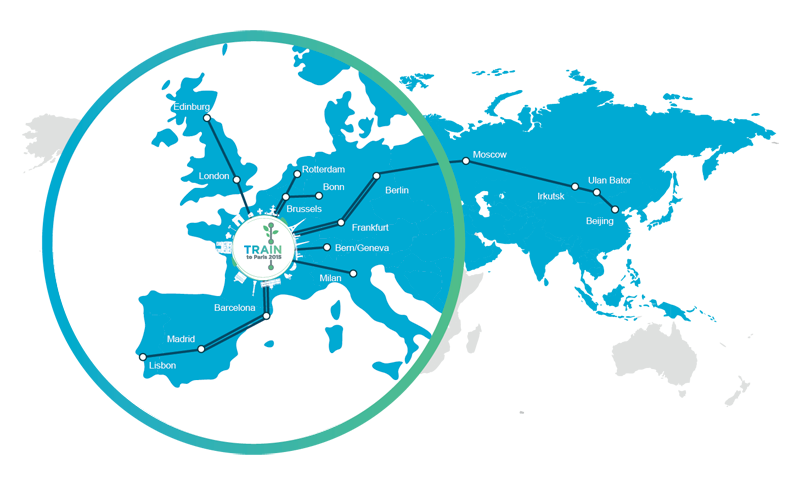
Are you wondering what the actual routes of the Trains to Paris will be? Just take a look at the map created for the campaign.
As trains converge from the Northern and the Eastern parts of Europe, Russia and Asia, Southern Europe will also take a symbolic journey to the high-level event to be held in Paris on the evening of 28 November.
Trains will depart from Rotterdam, Bonn, Brussels, Berlin and Frankfurt, and the train crossing Asia will depart from Beijing on 18 November with main stops in Ulan Bator, Irkutsk and Moscow, before heading to Paris. An incredible journey that we cannot wait to share!
In the run-up to COP21, we want to share how railways connect people to the world. To do so, the “Train to Paris” team has created an Instagram account to post pictures of the campaign online.
Do not hesitate to follow and tag #traintocop21 when you post pictures of trains and railways in your everyday life, on your way to work or during your holidays – even more so if your pictures show a sustainable touch!
For more information on this campaign, please contact Marie-Luz Philippe, the Event Coordinator: philippe at uic.org
Follow us on Twitter @trainCOP21 and on Instagram @traintocop21
Keywords: Train to Paris, COP21, sustainable development, climate change
“Train to Paris” campaign: share with us your best practices!
130 days to go before the arrival of the international network of trains to Paris, just 48 hours before the beginning of COP 21! We are confident this international event will reinforce rail transport as one of the backbones to combating climate change and draw the attention of decision-makers.
The first steps were taken during the UIC General Assembly and the 9th World Congress on High Speed Rail, both held in Tokyo from 6 – 10 July. Those two major UIC events were the occasion to promote the Train to Paris campaign and give this project unique international coverage. Mr Ban Ki Moon, Secretary-General of the United Nations, addressed a powerful message to members to launch the general assembly, highlighting the importance of railways for a low carbon future! Needless to say that Train to Paris is already working in that direction, positioning UIC on the world stage for a sustainable outlook.
Jean-Pierre Loubinoux, UIC Director General, said:
28 November at UIC will be a special day for the contribution of railways with new sustainable efforts. Just one day before the kick-off of Cop 21, it will highlight the important role of transport and rail in particular towards climate change.
As UIC represents the railway sector within international and UN-related organisations such as the High-Level Advisory Group on Sustainable Transport to the UN Secretary General, the Train to Paris team is now be more than interested to know how all UIC members promote their best practices or their innovations in sustainable development, low carbon emissions, etc.
Share with us the best practices you believe we could publish on the dedicated website traintoparis.org and on social media, to give the world an overview of how railways around the globe are heading towards a greener future for railways.
For more information on this campaign and to share content please contact Marie-Luz Philippe, Event Coordinator: philippe at uic.org
Follow us on Twitter @trainCOP21
“Train to Paris” video campaign
The “Train to Paris” coordination team is happy to announce the launch of the video promoting the campaign!
This short video using flat design presents in a colourful and fun way how railways can be considered as one of the backbones to fight climate change. Developed in the frame of COP21, the video also displays the commitments of UIC and its members in favour of a more sustainable future as the Climate Summit is now getting closer!
Enjoy viewing this video!
For more information on this campaign or if you would like to publish information about the campaign internally or externally in dedicated newsletters, board magazines, etc. please contact Marie-Luz Philippe, Event Coordinator: philippe at uic.org
Follow us:
Train to Paris website: http://traintoparis.org/
Twitter: @trainCOP21
Instagram: @traintocop21
Facebook: Train to Paris
UIC: www.uic.org
10th UIC Noise Workshop to be held on 15 March 2016 at Paris UIC Headquarters
The International Railway Association, UIC, will hold the 10th UIC Noise Workshop in Paris on 15 March 2016.
This event will focus on the latest issues at European level for the management of railway noise. Topics will include the recently published Staff Working Document (SWD) on rail freight noise reduction, REFIT of the Environmental Noise Directive, forthcoming guidance on noise from the World Health Organisation (WHO) in addition to communication and managing relationships with residents living close to railway lines.
As in previous years, speakers will be invited to represent the major stakeholders, including UIC, CER, European Commission (DG MOV & DG ENV), WHO working groups, noise specialists from other transport sectors, experts in communication and managing relationships with residents groups in addition to representatives of residents groups.
Opportunities will be provided for participants to ask questions directly to European Commission policy officers and other key stakeholders as well as to discuss the current issues.
There is no charge for participation; however places are limited and will be allocated on a first come first served basis. To reserve your place please complete the form in the link below:
http://uic.org/events/spip.php?article3434
Confirmed speakers include:
Moderator: Jakob Oertli, Chairman of the UIC Noise Expert Network & SBB
- Jean-Pierre Loubinoux, Director-General UIC
- Libor Lochman, Executive Director Community of European Railways
- Marco Paviotti, Policy Officer DG ENV
- Marcin Wojcik, Policy Officer DG MOV
- Stephen Stansfeld, Queen Mary University London & Chair of the working group for the WHO Environmental Noise Guidelines for the European Region
- Richard Greer, Director of Acoustics ARUP
- Peter Ettler, President Swiss Noise Organisation (Schweizer Lärm Liga)
- Dominique Bidou, Chairman CIBD
- Nick Craven, Sustainable Development Manager UIC
- Marina Bylinsky, Environmental Strategy & Intermodality Airports Council International
For further information please contact Nick Craven: craven at uic.org
10th UIC Railway Noise Workshop to be held on 15 March 2016
Please find below the reminder for the UIC Railway Noise Workshop which will be held at UIC Headquarters on 15 March 2016.
To register for the event please consult the dedicated UIC page:
http://events.uic.org/10th-uic-noise-workshop
We hope to see you in Paris!
For further information please contact Nick Craven, Manager of the Sustainable Development Unit: craven at uic.org
10th UIC Railway Noise Workshop, 15 March 2016 in Paris
Around 90 people attended the 10th UIC Railway Noise Workshop, held on 15 March 2016 in Paris. The workshop was designed to bring a wide range of stakeholders together in order to facilitate an open, inclusive and constructive discussion regarding the current situation, challenges and possible solutions for managing environmental noise from the rail sector.
In his welcoming address, Jean-Pierre Loubinoux, Director General of UIC, observed that ‘whilst rail has the lowest environmental impact of any major mode of transport – in Europe at least, noise remains a critical issue. We must work together to ensure greater acceptance of rail transport if we are to increase rail modal share and through this to improve the sustainability of the transport sector.’ He also emphasized the need to move beyond completion between transport modes and collaborate on optimizing inter-modality.
The first sessions focused on noise policy in Europe, with interventions by Mr. Marcin Wójcik from the European Commission, Directorate General MOVE (Mobility and Transport) discussion the recent Staff Working Document concerning rail fright noise. This was followed by Ms. Ivana Juraga of European Commission DG ENV (Environment) who presented an update on the REFIT of the Environmental Noise Directive (END). The session concluded with an intervention by Mr. Ethem Pekin concerning the rail freight noise strategy of the Community of European Railways (CER).
The second session opened with Prof. Stephen Stansfeld of Queen Mary University London is a leading expert on the impact of noise on humans. He addressed the development, by the World Health Organisation, of new environmental noise guidelines for the European region. This was followed by a look at the approach adopted by different transport modes, starting with Mr Nick Craven who presented the recently published report Railway Noise in Europe – State of the Art. This was followed by Mr. Patrick Malléjacq, the incoming Secretary General of PIARC, the World Road Association (a non-political, non-profit association with the aim to promote international cooperation on issues related to roads and road transport) and concluded with Mrs. Marina Bylinsky, Manager Environmental Strategy & Intermodality ACI (professional association of airport operators, joining 500 airports in 45 countries) who presented the State of the Art on Airport Noise Management.
The final session considered differ perspectives regarding communication with residents. This opened with Mr. Dominique Bidou is chairman of the French Noise Information and Documentation Center (CIDB) who presented a case study from the Éole project to the west of Paris. This was followed by Mr. Richard Greer, Director of Acoustics at consulting company Arup, with an introduction to SoundLab auralisation offered by Arup as an alternative to classical ways to inform the public about large infrastructural projects. The next speaker presented the perspective of the residents, Mr. Peter Ettler, president of the Noise League Switzerland (Schweizer Lärm Liga), discussed their lobbying actions and input to the Swiss Railway Noise Improvement Act of 2000. The final speakers presented approached sued by rail and road projects, this included Mrs. Maria Röjvall works for Stockholm City Council, Mr Günther Dinhobl (ÖBB) of the Austrian Railway ÖBB and finally Mrs. Lene Nøhr Michelsen of the Danish Road Administration and Mr. Allen Jensen of consulting company Ramboll.
In the concluding remarks, the workshop moderator Jakob Oertli, Chairman of the UIC Noise Expert Network & SBB, thanked all speakers and participants and observed that the workshop provided a wide variety of perspectives, both in modalities and countries. It was clear that there is a need to maintain a proper balance between environmental performance of the railways on the one side and loss of market share on the other. With respect to the residents, the railways should strive to avoid or minimize health risks. Above all, it is important that all stakeholders will agree to settle for a compromise instead of insisting on their own position.
- A more detailed report on the workshop can be found at this link: http://events.uic.org/IMG/pdf/repor...
- Presentations from the workshop can be downloaded at this link: http://events.uic.org/10th-uic-nois...
- The UIC Railway Noise State of the Art Report can be downloaded at this link: http://www.uic.org/railway-noise-in...
- The speech given by Mr Jean-Pierre Loubinoux during this Noise Workshop is available here: http://uic.org/com/IMG/pdf/15_march_noise_workshop-speech.pdf
11th International Railway Summit to debate innovation for people, planet and prosperity
The 11th International Railway Summit, a unique networking event for the global rail sector, will take place from 15-17 February 2022 in Berlin, Germany.
The International Railway Summit features a bespoke programme of pre-arranged one-to-one business meetings, a two-day conference programme delivered by global mobility leaders, and technical visits to local rail facilities showcasing the latest innovations. In addition, delegates will be able to expand their networks and build friendships over coffee, lunches and dinners.
The one-to-one meeting programme provides an opportunity for operators, infrastructure owners, rolling stock manufacturers and governments to learn about cutting-edge solutions matching their project requirements.
The theme of the summit will be“Innovating rail for people, planet and prosperity”. The conference will tackle the social, environmental and economic aspects of sustainability, with plenary and breakout sessions debating how rail can transform itself and help change the world. Looking back on the European Union Year of Rail and the ongoing recovery from the pandemic, the summit will help plot the course through uncharted territory to a kinder, greener and wealthier future.
Leading figures addressing the summit will include Josef Doppelbauer, Executive Director, EU Agency for Railways, Rolf Härdi, Chief Technology Officer, Deutsche Bahn, Philippe Citroën, Director General, Association of the European Rail Industry (UNIFE), and Conor Feighan, Secretary General of the European Rail Freight Association (ERFA).
Proudly partnered with the International Union of Railways (UIC) since 2017, the International Railway Summit has built a reputation for attracting major established organisations, exciting and disruptive ideas and niche solution providers. UIC’s Simon Fletcher, Director Europe, and Lucie Anderton, Head of Sustainability, will act as Chair and Co-Chair, respectively, of the conference programme.
The safety of delegates is of paramount importance to the summit organisers. All possible efforts will be made to ensure a safe and enjoyable environment for delegates in addition to adherence to local regulations. Delegates will be required to show proof of Covid-19 vaccination or negative tests.
Organisations and individuals interested in learning more about the International Railway Summit and how they can participate in the event can visit https://www.irits.org or contact the organiser, IRITS Events.
For further information, please contact Lucie Anderton, Head of Sustainable Development Unit, at anderton at uic.org; Simon Fletcher, UIC Director Europe at fletcher at uic.org
or Stephen Russell-Gebbett, Editor-in-Chief, IRITS Events Ltd at stephen.russell-gebbett at irits.org
11th UIC Noise Workshop held in Paris on 14 November 2017
The International Railway Organisation, UIC, is holding the 11th UIC Noise Workshop in Paris on 14 November 2017. Around 80 participants are gathered today at UIC for this annual event.
This event is focusing on the latest issues at European level for the management of railway noise and vibration. Topics will include application of the Noise TSI to existing wagons & ‘silent sections’, funding and progress for retrofitting, REFIT of the Environmental Noise Directive & forthcoming guidance on noise from the World Health Organisation (WHO) & appropriate noise metrics in addition to the new UIC State of the Art report for the Management of Railway Vibration.
As in previous years, speakers are invited to represent the major stakeholders, including UIC, CER, European Commission (DG MOV & DG ENV), WHO working groups. External views from outside the railway noise world will also be sought.
Opportunities are provided for participants to ask questions directly to European Commission policy officers and other key stakeholders as well as to discuss the current issues.
Here are the main themes developed throughout the day as well as the speakers taking the floor:
EU rail noise policy with Marcin Wojcik, Policy Officer DG MOV, Marco Paviotti Policy Officer DG ENV, Kamil Pravdík Project Officer ERA, Libor Lochman, Executive Director CER.
Impact of quieter routes to the business: Operators reflection with Michael Müller, Euro Fleet Mang. DB Cargo.
Noise assessment with Martin van den Berg, Chiaramonte Noise and Transport Consult & WHO noise working group, Paul de Vos, Satis, Pierre Etienne Gautier, Systra.
Research and development with Alf Ekblad, Trafikverket and chair of the UIC Vibration Expert Network, Paul de Vos, Satis, Baldrik Faure, SNCF, Professor Bas Haring, Leiden University, Nick Craven, UIC, Jakob Oertli, Chairman Noise Expert Network & SBB.
Consult the Railway Induced Vibration Report: https://uic.org/noise
For further information please contact Marie-Luz Philippe, Advisor for Sustainable Development and UIC African Region:
philippe at uic.org
11th UIC Railway Noise Workshop to be held on 14 November 2017
This event will focus on the latest issues at European level for the management of railway noise and vibration. Topics will include application of the Noise TSI to existing wagons and ‘silent sections’, funding and progress for retrofitting, REFIT of the Environmental Noise Directive & forthcoming guidance on noise from the World Health Organisation (WHO) and appropriate noise metrics in addition to the new UIC State of the Art report for the Management of Railway Vibration.
As in previous years, speakers will be invited to represent the major stakeholders, including UIC, CER, European Commission (DG MOV & DG ENV), WHO working groups. External views from outside the railway noise world will also be sought. Opportunities will be provided for participants to ask questions directly to European Commission policy officers and other key stakeholders as well as to discuss the current issues.
There is no charge for participation; however places are limited and will be allocated on a first come first served basis. To reserve your place please click here:
http://events.uic.org/11th-uic-noise-workshop
Please find below the programme of this workshop:
Moderator: Jakob Oertli Chairman of the UIC Noise Expert Network & SBB
08.30 Registration & coffee
09.00 Welcome remarks: Jean-Pierre Loubinoux, Director General UIC
09.10 Introduction: Jakob Oertli, Chairman UIC Noise Expert Network & SBB
EU rail noise policy
Rail freight noise policy - Marcin Wojcik, Policy Officer DG MOV
Environmental Noise Directive - Marco Paviotti Policy Officer DG ENV
TSI revision - Kamil Pravdík Project Officer ERA
Freight CEO task force - speaker tbc
The view from CER - Libor Lochman, Executive Director CER
Noise assessment
WHO guidelines for noise Stephen Stansfeld, Queen Mary University London & Chair WHO noise working group (invited)
Rail noise, Leq or Lmax? Paul de Vos, Satis
UIC Track Train Interaction acoustics Pierre Etienne Gautier, Systra
Research and development
Vibration State of the Art Report- Paul de Vos, Satis
How much is enough? Professor Bas Haring, Leiden University
Reflections on noise management – Nick Craven, UIC
Conclusion – Jakob Oertli, Chairman Noise Expert Network & SBB
The Shift2Rail projects Fine1 & Destinate will be presented as poster sessions during the breaks.
For further information please contact Nick Craven, Head of the Sustainable Unit:
craven at uic.org
12th UIC Workshop on Noise and Vibrations held on 19 March 2019 in Paris
UIC held the 12th UIC Noise Workshop in Paris on 19 March 2019. Around 100 participants met at UIC HQ for this annual event. The workshop was designed to bring together a wide range of railway stakeholders in order to facilitate an open, inclusive and constructive discussion regarding the current situation, challenges and possible solutions for managing environmental noise from the rail sector.
Mr Francois Davenne, Deputy Director General of UIC, reminded the meeting that “whilst rail has the lowest environmental impact of any major mode of transport – in Europe at least, noise remains a critical issue. We all have to work together to ensure greater acceptance of rail transport if we are to increase rail modal share and through this to improve the sustainability of the transport sector.” He also emphasised the need to move beyond completion between transport modes and collaborate on optimising inter-modality.
The first session focused on the latest issues at European level for the management of railway noise and vibration. The first presentation aimed to explain the noise policy in Europe, with presentations by Mr Nino Zambara from the European Commission, Directorate General MOVE (Mobility and Transport). The discussion addressed rail freight noise reduction, the revised TSI noise and the application of the charging for the cost of noise effects. This was followed by Mr Marco Paviotti of the European Commission DG ENV (Environment) who presented an Environmental Noise Directive (END) and common noise assessment methods for Europe. The session concluded with a presentation by Mr Ethem Pekin concerning the rail freight noise strategy of the Community of European Railways (CER). During the first session, opportunities were provided for participants to ask questions directly to European Commission policy officers and other key stakeholders as well as to discuss the current issues.
The second session opened with Mrs Sabine Janssen from the Ministry of Infrastructure and Water Management, the Netherlands who was also part of the Guideline Development Group of the WHO Noise Guidelines. She addressed the development, by the World Health Organisation, of new environmental noise guidelines for the European region. In conclusion to her presentation, she reminded the meeting that the WHO provides guidelines which are not noise exposure limit values for European legislation and recommended to perform the cost-benefit analysis to find what is feasible at national level. This was followed by a look at the approach of the Shift2Rail project about Cross Cutting Activities, with Mrs Judit Sandor and Mrs Siv Leth who presented the objectives of S2R and some examples from funded projects. This was followed by Till Bunsen from the International Energy Agency (IEA) who presented the report on the “Future of Rail” (https://www.iea.org/futureofrail/), which reflects the cooperation between UIC and IEA. He emphasised that rail remains the most energy efficient transport mode, integrated policies for all modes needed to reach climate objectives. The second session concluded with Mr Alf Ekblad, Chairman of the UIC Vibration Expert Network & Trafikverket, who presented current issues on vibrations in the railways.
The final session considered the various requirements on the noise and vibration mitigation management of railway transport. It was planned as short talks – five minute presentations. This opened with Mr Günter Dinhobl from ÖBB, Austria and was followed by Mr Ward Verhelst (Belgium/Infrabel), Mrs Lenka Vaňková (Czech Republic/SZDC), Mrs Lisette Mortensen (Denmark/Banedanmark), Mr Jean-Philippe Regairaz (France/SNCF), Mrs Martina Fleckenstein (Germany/ DB), Mr Nils Ijntema (Netherlands/Prorail/NS), Mr Trygve Aasen (Norway/Bane NOR), Mrs Joanna Salawa (Poland/PKP Cargo S.A), Mrs Karin Blidberg (Sweden/ Trafikverket) and Mr Jakob Oertli (Switzerland/SBB).
In the concluding remarks, the workshop’s moderator Mr Jakob Oertli, Chairman of the UIC Noise Expert Network & SBB, thanked all speakers and participants and observed that the workshop provided a wide variety of perspectives, both in modalities and countries. At the closure of the workshop, the video of the UIC Network Noise and Vibration Working Group was presented and is now available on UIC’s YouTube channel which can be seen here:
- Presentations from the workshop can be downloaded via this link: https://events.uic.org/12th-uic-workshop-on-railway-noise-vibrations
- The speech given by Mr François Davenne during this Noise Workshop is available here:
For further information please contact Pınar Yılmazer, Senior Advisor for the Sustainable Development Unit:
13th UIC Sustainability Conference – focus on the Awards
The UIC Sustainability Awards Ceremony was held during the 13th edition of the Sustainability Conference organised by the International Union of Railways (UIC) and the Austrian Railways (ÖBB) from 12 – 14 October 2016.
This world tour of railways was a unique opportunity to illustrate the commitment of companies and best practices with a global audience.
The international panel of judges was composed of Jerzy Wisniewski, UIC, Willy Bontinck, SNCB, and Johann Pluy, ÖBB Infra.
Prizes were awarded to:
1st Prize – SBB, for “Sleep Well, My Train”
2nd Prize – DB, “Train simulator”
3rd Prize – DFCCIL, Indian Railways, for Railway Project “Saksham”
These were all the projects presented:
DB
DB has created an App called DB Train Simulator. The goal is to simulate an energy efficient ride and to demonstrate that each driver has the opportunity to push the climate performance of the train even further. The game is based on the training programme that teaches train drivers an efficient use of energy […]
Thalys
Thalys integrated the Science Based Target programme. […] There is a business opportunity here. As we decarbonise, we also become more attractive to customers. Having this target also gives us a stronger voice and more credibility in the debate on climate change and on the role the transport sector has to play in reducing emissions.
Korea Railroad Research Institute (KRRI)
1. GHG inventory for railway operation
2. Carbon footprint calculation for infrastructure construction of high-speed rail
3. Domestic carbon footprint labelling through life-cycle railway operation service for a target route
4. Tier 3 GHG emission factor for diesel-electric locomotive
5. Development of energy metering system for electric railcars
Network Rail
[…] Provide a strategic route linking key centres of economic activity between Oxford, Milton Keynes, Aylesbury and Bedford by re-opening, reconstructing and upgrading the partially-disused routes. A significant part of the case for EWR is modal shift and positively tackling climate change by providing a more sustainable means of meeting travel demands. […]
ÖBB
Ethical Investment became a strong growing sector […] ESG Rating agencies like oekom research in Munich, are providing an essential service for those investors as they are publishing sustainability ratings, as an independent party.
Oekom research has been rating the transport infrastructure sector two times already: ÖBB-Infrastruktur AG turned out to be “best in the class” among over 40 other transport infrastructure companies all over the world.
SBB
[…] A project with a huge impact is the recently developed system of sending all vehicles their effective service timetables (“fahrplanbasierte Bereitstellungszeit – timetable-based preparation time”). Based on this information, the vehicle decides on its own which operational mode it should stay in and for how long, and what preparation is necessary when, depending on the outside temperature and its own thermal behaviour. […]
Infrabel
The first “sail” train ran on wind power on 24 October 2015 following the activation of the first seven wind turbines in the Greensky park. This wind farm is located alongside the high-speed Leuven-Liège railway line and the E40 motorway. […] Annual production is estimated to be nearly 5,000 MWh of electricity with an annual reduction in CO2 of 15,000 tonnes.
Dfcc.co.in
[…] In 2015, DFCCIL launched a project titled “Saksham” to provide skills based training to the youth of displaced families, ensuring employment to beneficiaries to restore their livelihood.
The project was spread over different field units. Of the 1012 persons trained in different trades in year 2015, about 750 persons from project-affected areas obtained employment […]
Via Rail Canada
[…] We are especially proud of our innovative intermodal partnership program that is helping to increase the modal share of rail, reduce the transportation sector’s contribution to climate change and smog, improve economic activity and congestion, and promote quality of life for our society by connecting people and communities.
All presentations can be found on the dedicated website: http://uic-environment.org/uic-sustainability-champion-award
For further information please contact Nick Craven: craven at uic.org
Or Marie-Luz Philippe: philippe at uic.org
13th UIC Sustainability Conference – Vienna 12-13-14 October 2016
Plans are now well progressed for the 13th UIC Sustainability Conference, jointly organised by the International Union of Railways (UIC) and Austrian Federal Railways ÖBB. The conference will take place in the glorious Imperial city of Vienna at the famous Hofburg International Congress and Event Centre on 12, 13 & 14 October 2016.
This programme will examine both the contribution that rail can make towards delivering the 2030 sustainable development agenda and also how sustainability can give rail a competitive advantage. The latest programme is enclosed, please consult http://uic-environment.org/ for updates.
Confirmed speakers include:
- Andreas Matthä OBB CEO
- Franz Seiser, OBB INFRA CEO
- Jean-Pierre Loubinoux, UIC CEO
- Canadian Railways, Yves Desjardins-Siciliano, Via Rail Canada
- Michail Stahlhut, CEO SBB Cargo International AG
- Kamel Ben Naceur, Director of Sustainable Energy Policy and Technology, International Energy Agency
- Rajesh Sethi UNFCCC
- Gireesh Shrimali, Climate Policy Initiative
- Johann Pluy, OBB Infra
Workshops
The conference will include a number of dedicated workshops dressing key sustainability issues, including:
- Carbon footprint in railways: integrated scope and innovative tools
- Weather resilience and climate change adaptation
- Emissions and air quality: which framework?
- Digital communication and energy efficiency in railways: driving, metering, and billing
- Energy efficiency projects: potential improvements for mid and long term
- GRI G4 reporting: challenges for rail sector
- Railway noise in the common noise assessment method CNOSSOS
- Sustainable procurement in the rail sector: taking larger strides and leapfrogging along the sustainability path
- Door to door business solutions
- Sustainable and smart stations and infrastructures
- Sustainable tourism (Toprail)
- Biodiversity: preventing decline & benefits of effective stakeholders management
- Environmental management for maintenance activities
- Recyclability of rolling stocks
For more details please refer to the website http://uic-environment.org/workshops
14th of October: technical and cultural visits
The technical visit will take place in the new Rail Freight Centre South Vienna. Click here for more information
Participants are also welcome to join a visit of the cultural highlights of Vienna.
More information will be given shortly.
Only registered participants can attend and should send an email to philippe at uic.org to confirm their presence on the 14th.
Sustainability Champion
The first day of the UIC Sustainability Conference will allow UIC members to highlight recent achievements in the field railway sustainability. This session will take the form of a world tour of railways, with each given 3 minutes and one slide to describe the impact on environmental, social and economic sustainability. This is a unique opportunity to illustrate the engagement of your company in Sustainability issues and share best practice with a global audience. Apply on line http://uic-environment.org/uic-sust...
Sponsorship
There are a number of interesting Sponsorship opportunities, for more details please contact Marie Luz Philippe at philippe at uic.org
13th UIC Sustainability Conference held from 12 – 14 October 2016 in Vienna


<!—>
The 13th UIC Sustainability Conference, jointly organised by UIC and the Austrian Federal Railways (ÖBB) with the title “Railways: efficient power towards Sustainability” was successfully held in Vienna at the Hofburg International Congress from 12 to14 October 2016.
This conference follows a successful edition held in October 2012 in Venice.
The Conference featured speakers from leading international organisations and European institutions, such as United Nations’ UNFCCC and UNECE, International Energy Agency IEA, European Commission, European Investment Bank EIB, the Austrian Energy Agency and representatives from the rail sector including Jean-Pierre Loubinoux, UIC Director General, Yves Desjardins-Siciliano, President of VIA Rail Canada, Chairman of UIC North American Region, Mr Michael Stahlhut, the CEO of SBB Cargo, Switzerland, etc.
330 delegates from 25 countries attended and participated in the debate focused on a sustainable future for the railway sector. The conference aimed to examine the key issues of how sustainability can give rail a competitive advantage, attract investment whilst reducing costs and risks.
Mr Jean-Pierre Loubinoux, UIC Director General, opened the conference giving a message from Mr Ban Ki-Moon, Secretary General of the United Nations: “I am pleased to convey my greetings to all those gathered for the 13th Railway Sustainability Conference.
Sustainable transport is an important part of our common efforts to tackle climate change and build a cleaner, greener world.”
“…. The transport sector can play a vital role in achieving the 2030 Agenda and its Sustainable Development Goals. I count on the commitment of the global railway community to make transport more sustainable – and your gathering is especially timely coming within weeks of the entry into force of the Paris Agreement on Climate Change.”
He also delivered a message on behalf of Mr Oleg Belozerov, UIC Chairman & Russian Railways RZD President, addressing the participants:
“Sustainability is among the priorities of UIC. Its members consistently put measures in place that are aimed at improving the mobility of the population and the experience that passengers have with railway services.”
The UIC Environment, Energy and Sustainability Platform (…) set priorities for UIC activities aimed at environmental protection and sharing of best practices.”
Mr Johann Pluy, Division Manager of “Railway Systems”, ÖBB Infra, declared that climate change is a reality. Natural disasters influence the reliability of railways and are costly. As Austria is an industrial country, powerful freight corridors are important. There are opportunities to improve the efficiency of the rail sector.
ÖBB is investing a significant amount in advertising to inform customers about sustainability. The company supports the climate strategy of the government and encourages innovative solutions.
Mr Jean-Pierre Loubinoux highlighted that: “Sustainability is embedded in the core functions of UIC. Our mission statement is to develop rail transport to meet the needs of sustainable mobility.”
Rail is the backbone of sustainable transport, which in turn is an enabler of sustainable development. Our contribution to society has impacts that reach far beyond the transport of people and goods…”
“…We have now published our first report on progress against these targets, ready for the United Nations Climate Change conference COP 22 to be held in Marrakesh next month. These data and analysis have been collected, analyzed and published in partnership with the International Energy Agency.”
Mr Rajesh Sethi, Manager Sustainable Development and Mechanisms Programme, UNFCCC, gave a quote from the UNFCCC Executive Secretary, Mrs Patricia Espinosa:
The 13th UIC Sustainability Conference in Vienna provides a forum for the rail sector to identify the key actions that railways can take to deliver action that increases global ambition to meet the climate change challenge.“
To go more in depth, this event covered three main sessions: The Global 2030 Agenda & COP21 Paris Agreement, Rail and Sustainable development in Europe, and Railway delivering sustainable developments
13th UIC Sustainability Conference to be held in Vienna from 12 – 14 October 2016
The 13th UIC Sustainability Conference, jointly organised by the International Union of Railways (UIC) and Austrian Federal Railways ÖBB, will take place in exactly one week in Vienna at the famous Hofburg International Congress and Event Centre on 12, 13 & 14 October 2016.
This programme will examine both the contribution that rail can make towards delivering the 2030 sustainable development agenda and also how sustainability can give rail a competitive advantage. The latest programme is enclosed, please consult http://uic-environment.org/ for updates.
Strategy day
The first day will be composed of three main sessions:
I - The Global 2030 Agenda & COP21 Paris Agreement
II - Rail and sustainable development in Europe: Panel Session Co-organised by CER
III - Railways delivering sustainable development goals
Technical day
The conference will include a number of dedicated workshops dressing key sustainability issues, including:
- Carbon footprint in railways: integrated scope and innovative tools
- Weather resilience and climate change adaptation
- Emissions and air quality: which framework?
- Digital communication and energy efficiency in railways: driving, metering, and billing
- Energy efficiency projects: potential improvements for mid and long term
- GRI G4 reporting: challenges for rail sector
- Railway noise in the common noise assessment method CNOSSOS
- Sustainable procurement in the rail sector: taking larger strides and leapfrogging along the sustainability path
- Door to door business solutions
- Sustainable and smart stations and infrastructures
- Sustainable tourism (Toprail)
- Biodiversity: preventing decline & benefits of effective stakeholders management
- Environmental management for maintenance activities
- Recyclability of rolling stocks
For more details please refer to the website http://uic-environment.org/workshops
Technical and cultural visits
The technical visit will take place in the new Rail Freight Centre South Vienna on 14 October.
Participants are also welcome to join a visit of the cultural highlights of Vienna.
Sustainability Champion
The first day of the UIC Sustainability Conference will allow UIC members to highlight recent achievements in the field railway sustainability. This session will take the form of a world tour of railways, with each given 3 minutes and one slide to describe the impact on environmental, social and economic sustainability.
Contact: Marie Luz Philippe at philippe at uic.org
13th UIC Sustainability Conference to be held in Vienna on 12, 13 & 14 October 2016
Be a Sustainability champion ! – Apply now
Following the success of previous editions, the first day of the UIC Sustainability Conference will allow UIC members to highlight recent achievements in the field of railway sustainability.
This session will take the form of a world tour of railways, with each given three minutes and one slide to describe the impact on environmental, social and economic sustainability.
This is a unique opportunity to illustrate the engagement of your company in Sustainability issues and share best practice with a global audience.
To be a Sustainability Champion and reserve your time on stage please complete application form here and return it to environment at uic.org before 12 September 2016.
Technical day programme
Thursday 13 October will be the occasion for participants to attend numerous parallel sessions focusing on key sustainability issues affecting the rail sector including energy, noise, carbon, sustainability reporting, climate change adaptation, sustainable mobility, recycling and sustainable procurement, sustainability for maintenance activities.
You can download the details of those workshops here. Do not hesitate to check the website for regular updates.
Registration – free of charge – is possible here.
Website: http://uic-environment.org/
For further information please contact Nick Craven, Head of the UIC Sustainable Development Unit:
15th Meeting of UIC Sustainable Land Use Network
On 16 November 2017 the 15th Meeting of UIC network Sustainable Land Use was held at the SNCF offices at Paris Gare du Nord. After Andrea Braschi, Advisor at UIC, gave news from working groups and general activities of UIC, Ethem Pekin from CER provided the CER political update and the discussion currently happening in Brussels. All participants then participated in a round table on the more newsworthy than ever topic of glyphosate. Companies discussed a response to a possible ban and updated the network on the political situation in their country and the envisaged strategy for the next few years. Throughout the day various members of the Network took the floor: Roland Nolte (IZT) presented the Herbie assessment report and the next steps for the final vegetation guidelines. Micheal Below (DB) and the audience conversed on the content of the Herbie project, its content, the priorities timeline and the deliverables of the project. The day finished with a session on projects for 2019. The Herbie is expected to be delivered in the first Semester of 2018. New projects are expected to be approved by the Next EES Platform in April 2018. Members are of course encouraged to bring ideas for new projects for the Expert group. To receive more information or for any enquiries, please contact Andrea Braschi, UIC Advisor: braschi at uic.org
1st South East Environment Workshop
The first South East workshop, jointly held by Serbian Railways and UIC in Belgrade on 29 and 30 September, brought together environmental specialists from railways in the South East Europe region, to share best practice, start a regional network, and improve links with the environmental working groups of UIC.
There was excellent representation from the region, with presentations from Serbia, Croatia, Bulgaria, Montenegro and Slovakia. Other railways represented at the workshop included Poland and Romania. Presentations were also delivered by specialist consultants working in remediation of polluted soil from both Serbia itself and the Netherlands. Deutsche Bahn also presented the way they manage their environmental and sustainable development activities. In total around 40 specialists attended over the two days.
Following on from the success of the workshop, all participants have been invited to join the newly-formed UIC Expert Network on Sustainable Land Use which will explore issues around soil pollution, vegetation control, biodiversity protection and so on. The first meeting will be on 15 November at UIC headquarters.
In related news, Serbian Railways are organising a conference on Energy Efficiency in Belgrade on 17 & 18 November, and a 2nd South East Europe Environment Workshop will be planned for September 2012.
For more information please contact Alex Veitch: veitch at uic.org
1st South East Environment Workshop (29-30 September 2011, Belgrade, Serbia)
UIC and Serbian Railways are jointly organising the 1st South East Environment Workshop in Belgrade. The workshop will present railway experts of the South-East Europe region with practical solutions for their key environmental issues, enable exchange of best practice, and create a network among experts of the region.
For details and online registration please click here: http://www.uic.org/spip.php?article2806
1st UIC Forum on Tourism Opportunities for Railways successfully held on 20 April 2018 in Barcelona
The 1st UIC TopRail Forum, jointly organised by UIC (International Union of Railways) and FGC (Ferrocarrils de la Generalitat de Catalunya) under the theme “The Business of Rail Tourism”, was held at the Fira de Barcelona congress centre as part of the B-Travel Trade Fair.
The TopRail project is an initiative of the International Union of Railways (UIC) dedicated to Rail Tourism at international level. Its primary objective is to bring together rail and tourist-related stakeholders – from the railway industry (operators, manufacturers) and the tourism industry (tour operators, wholesalers) to international, national and regional policy makers, international organisations and academia, to the final customer – to discuss the business opportunities in the rail and tourism sectors.
The Forum was created with the aim of establishing itself as the ultimate benchmark for sector professionals and is intended to be the meeting point of all the stakeholders involved. The approach is very broad encompassing different areas: train-cruises, panoramic trains, railway heritage, etc.
This first edition, attended by around 60 participants from 15 different countries (from Ecuador to USA and Russia to most of the countries in Europe), consisted of single intense day of morning and afternoon sessions, complemented by a technical visit on the following day to the new Railway Museum of Catalonia in Vilanova (near Barcelona).
The Forum was opened on 20 April by Mr Pere Calvet, Director General of FGC and President of UITP, Mr Jean-Pierre Loubinoux, UIC Director General, and Mr Enric Ticó i Buxadós, President of FGC.
Pere Calvet expressed his gratitude on behalf of UITP (International Union of Public Transport) for having been invited to open the first TopRail. He said: “UIC and the UITP share many common goals and have to deal with similar technical, social and regulatory issues and we are working to strengthen this links and develop common working schemas … the business-oriented approach, customer satisfaction, modal transfer, ticketing, are part of TopRail and also part of the daily challenges for urban public transport providers all over the world.
In a world with an increasing urban population, public transport has a key role to play. Without an efficient public transport system, it would be impossible to achieve liveable and sustainable cities.”
Jean-Pierre Loubinoux began by thanking Pere Calvet, the team at FGC and Carles Casas, Chairman of TopRail, for their commitment to the project from the very beginning.
He said: “Tourism and transport are inherently and historically linked. TopRail is a commitment to address the challenge of facing the future of railways not only from a nostalgic point of view that special trains can provide, but also to support tourist experiences on railways as a strategic framework for ensuring an attractive and positive image of the railways in the generations to come.”
Enric Ticó i Buxadós said it was a pleasure and honour to welcome everyone to Barcelona on behalf of FGC. He added: “I wanted to start by thanking the UIC for choosing Barcelona to celebrate the First TopRail Forum because it not only gives us the opportunity to express and strengthen our commitment with TopRail group, but it will give you the opportunity to experience, first hand, our wide range of services.
We are responsible for a wide range of tourist-related services going from rail services to mountain resorts … so tourism for us is not just an exotic traveller that randomly appears on our lines but is part of our core business, and we want to keep it this way.
This approach goes all over the company and we are continuously looking for ways to attract the tourist market to our services, all of them.”
Three panel sessions then addressed the issues of railways in relation to sustainable tourism, regional development and the preservation of heritage. Participants discussed how the railway industry can contribute to fostering well managed tourism, sustainable development, job creation and trade by looking at issues such as:
- The impact of increasing tourism on current infrastructure
- How rail tourism can contribute to sustainability
- Examples of good practices in rail tourism
- How to make the most of rail heritage and to make it an income generator
Highlights included presentations by the following guest speakers, among others:
Peter Haxton, Policy Analyst, OECD
Tim Fairhurst, Director of Policy, ETOA
Supinder Singh, President, Palace Tours
Jordi Tresserras, Director, LABPATC, Barcelona University and Advisor for UNESCO
Urs Wieser, Sales Manager, Stadler Rail
Partners and sponsors included: Renfe; Stadler; OECD; ETOA; OBB; Rodalies; Fundación de Ferrocarriles Españoles.
Renfe, as the company sponsoring the event, gave a presentation that was delivered by Amador Robles as representative in Toprail of the General Directorate of Development and Strategy. The presentation consisted of a general explanation of all the tourist trains operated by Renfe, but with special attention paid to the historical ones: the Strawberry Train and the future potential of the Historic Steam Train.
The closing session was delivered by Marc Guigon, Director of the UIC Passenger Department. He said that UIC started TopRail to meet the demand for sustainable tourism. On behalf of UIC, he was pleased to co-host this event with FGC, and thanked them for their excellent organisation. He thanked the panellists, moderators and participants for the interesting discussions, and extended a special thanks to Vanessa Perez for her efforts in making the event a success.
During the second day of the First TopRail Forum, the participants enjoyed a visit to the Railway Museum of Villanova i la Geltrú run by the Director of the Museum, Pilar Garcia; She explained to the participants the past, present and future projects of this particular Museum that aims to show the contribution of the railways to the economic and social development of the area, emphasising the importance of people at all times.
At the end of the conference, it was announced that the second TopRail Forum will take place next year in Italy, kindly hosted by the Italian Railway Foundation.
Website: http://toprail.org/

2015 Edition of the UIC-IEA Railway Handbook on Energy Consumption and CO2 Emissions published
The International Energy Agency (IEA) and UIC have officially launched the new edition of the UIC-IEA Railway Handbook on Energy Consumption & CO2 Emissions. 2015 marks the fourth year of collaboration with the International Energy Agency (IEA) to produce the Handbook on Energy Consumption and CO2 emissions of the world railway sector. Following the previous editions, UIC and IEA have been increasingly encouraged to pursue this joint effort in close cooperation.
The book contains data and analysis of the rail sector’s performance. It illustrates the efficiency in terms of the rail system’s energy and carbon performance. This data and analysis are independently verified by the IEA.
This publication facilitates analysis that is vital to the proper decision making process. Previous editions were recognised as a reference document by the Intergovernmental Panel on Climate Change, IPCC. These data provide an answer to understanding environmental issues and propose solutions for the decarbonisation strategies of the transport sector.
The global demand for transport is expected to double by 2050. The ability to meet this growing demand in a sustainable way is of fundamental importance in this historical moment.
The special focus on vehicle efficiency in this handbook (and related KPIs) delivers a clear message to the audience: to meet this growing demand by increasing investments on new and efficient rolling stock and technical improvements to the existing fleet will produce important improvements both in transport efficiency and environmental impact.
Some key facts of the 2015 edition:
- The transport sector was responsible for 23.1% of global CO2 emissions in 2012. 3.6% of transport emissions were due to the rail sector, while railways transported over 8% of the world’s passengers and goods. The relative contribution of rail to global CO2 emissions has decreased since 1990 while total CO2 emissions have risen by almost 50%.
- Electric intensity for passenger rail vehicles at global level, measured in MJ/train-km, has consistently improved from 1975 to 2012 by -32%, while the electric intensity for freight rail vehicles has improved by -23%. This improvement is particularly significant for electric vehicles in China and diesel vehicles in North America.
- The railway sector has implemented several technological solutions that will facilitate the energy efficiency of rolling stock in the next decades: installing energy meters, energy recovery from braking, DAS (Driving Advisory System).
- Railway specific energy consumption has been following a downward trajectory since 1975, both for passenger and freight services. From 1975 to 2012, the energy use per passenger-km declined by 62%. In the same time span, the amount of energy needed to move one tonne-km fell by 46%. In 2012, both indicators reached about 150 KJ per passenger-km (for passenger transport) or per tonne-km (for freight transport).
- Specific CO2 emissions in the rail sector have been following a similar rate of improvement to specific energy consumption, resulting in CO2 intensity close to 16 g CO2 per passenger-km in the case of passenger transport and per tonne-km in the case of freight transport.
This is just some of the key information provided in the Handbook that emphasises the decisive role of the rail sector in meeting global climate and economic challenges.
Again, this publication has only been possible thanks to the support of UIC members and their annual contributions to UIC Statistics and to the Environmental Strategy Reporting System (ESRS) of UIC. The UIC Sustainable Development Unit would like to thank UIC members and hopes that this new edition can provide valuable information with sound science.
The UIC-IEA Railway Handbook on Energy Consumption & CO2 Emissions is available at:
http://www.uic.org/IMG/pdf/iea-uic_2015-2.pdf
For further information please contact Gabriel Castañares Hernández, UIC Senior Advisor on Energy and CO2: castanares at uic.org
2016 Edition of the UIC-IEA Railway Handbook on Energy Consumption and CO2 Emissions focuses on sustainability targets
The International Energy Agency (IEA) and UIC have officially launched the new edition of the UIC-IEA Railway Handbook on Energy Consumption & CO2 Emissions. The 2016 publication marks the fifth year of cooperation between the two organisations and aims at providing insightful information, each year covering a special feature. In the past, these topics have ranged from the energy mix in the rail sector to the cost and sustainability impacts associated with rail infrastructure to vehicle efficiency. The new edition takes into account the Paris Agreement, the historic outcome of the 21st UNFCC Conference of Parties (COP21) in December 2015 in which more than 180 countries pledged to take steps to reduce greenhouse gas emissions.
With each new edition, the rail and energy data continue to improve as a result of the close cooperation between the IEA and the UIC. For this 2016 Handbook, the main improvement results from the collection of more detailed and accurate energy data from UIC members. In addition to the existing collected and validated information for European railways, Russia, Japan, USA, China, India and South Korea, among others, have made particularly noteworthy strides to improve data within the report.
As in previous editions, Part I of this year’s Handbook is dedicated to presenting the most significant data and trends concerning energy consumption and CO2 emissions from the rail sector, focusing on the most relevant regions in terms of rail activity, namely EU 28, USA, Japan, Russia, India and China. This serves to place a spotlight on the regions and countries which cumulatively accounted for 89% of passenger-kilometres and 84% of tonne-kilometres travelled globally in 2013. In addition, statistics illuminating rail-related CO2 emissions, passenger activities, freight activities, and electrification rates at a regional and global level are published within this section.
Furthermore, this Part pays particular attention to the growing role of high-speed trains in the rail sector, including but not limited to global coverage and the number of kilometres (in operation, construction, and planning phases). The sector of high-speed rail infrastructure was dominated by China in 2013, as it hosts 60% of the global High-Speed rail infrastructure, followed by Europe which accounts for a share of 24%.
Part II of this year’s handbook emphasises the analysis and the evaluation of rail sector and national targets, also compared to other modes of transport. The results of our analysis indicate that historical evolution of specific energy consumption and specific CO2 emissions from rail are on track to achieving the 2030 and 2050 UIC Low Carbon Rail Transport Challenge targets, moving the rail sector towards the 2 Degree Scenario (2DS) outlined in the IEA Energy Technology Perspectives (ETP) publication. The Handbook presents for the first time the evolution of the rail global targets set by UIC in 2014, supported by the outcomes of the commitment on reporting signed in 2015 by UIC Members through the Climate Responsibility Pledge inside the ‘Train To Paris’ campaign.
The special focus on sustainability targets in this handbook delivers a clear message to the audience: rail transport offers a more sustainable alternative to most other transport modes, both in terms of energy use and carbon emissions per passenger-kilometre or tonne-kilometre, and is anticipated to continue to do so over the coming decades.
Part II also zooms in on commitments made by single countries to achieve the climate goals of the Paris Agreement. In this context, an analysis is included of the Intended Nationally Determined Contributions (INDCs) – representing the outlined actions individual countries intend to take under the Paris Agreement – aimed at understanding the extent to which single countries include the transport sector and the rail sector in their pledges.
This is just some of the key information provided in the Handbook that emphasises the decisive role of the rail sector in meeting global climate and economic challenges.
This publication has only been possible thanks to the support of UIC members and their annual contributions to UIC Statistics and to the Environmental Strategy Reporting System (ESRS) of UIC. The direct data collection from railways covers over 90% of the global rail transport activity, and the incorporation of this information into the IEA Mobility Model has increased the consistency of the data, providing a more solid background for the analysis presented in this publication and into the Mobility Model of the IEA.
The production of the Railway Handbook 2016 has been a good opportunity to strengthen the collaboration between the IEA and the UIC. This relationship has served to enrich and improve the knowledge of activity, energy and emissions data associated with the railway sector. The previous editions of the Handbook are freely available from the UIC website.
The IEA-UIC Railway Handbook on Energy Consumption & CO2 Emissions 2016 Edition is available at: http://www.uic.org/IMG/pdf/iea-uic_railway_handbook_2016_web.pdf
For further information please contact Gabriel Castañares Hernández, UIC Senior Advisor on Energy and CO2:
20th UIC Environment, Energy & Sustainability (EES) Platform held on 5 April 2017 in Paris
The 20th UIC Environment, Energy & Sustainability (EES) Platform met at UIC HQ in Paris on 5 April 2017. UIC presented the latest sustainability activities, proposals for opt-in 2018 and a number of items for information.
The meeting started with an introduction and welcome by Jean-Pierre Loubinoux (UIC CEO) and Willy Bontinck (SNCB & Platform Chair).
Last time the EES group met was during the Sustainability Conference in Vienna in October 2016 and Jean-Pierre Loubinoux emphasised the success of the event as well as the growing awareness of the importance of sustainable transport as a key driver for social and economic development and peace. Mr Loubinoux added that the publication in October 2016 of the final report of the High Level Advisory Group on Sustainable Transport as well as the participation of UIC in the first Sustainable Transport Conference in Ashgabat, Turkmenistan last November had been great occasions to advocate the role of rail as the backbone of sustainable transport. UIC is still liaising with the new UN Secretary General Antonio Guteres to sustain momentum on sustainable transport.
An update of each of the expert networks was then conducted along with the political update of CER provided by Ethem Pekin, Senior Environmental Economist at CER.
The unit proposed four new projects for Opt-In – three in Europe and one in Asia:
- Best Practices Energy workshops (Europe)
- Noise Technical Advice to the European Union
- UIC Leaflet 930
- Best Practices Energy workshops (Asia)
Two new projects for the global budget were also proposed:
- Door to door mobility
- Clean air rail
The EES platform was the opportunity to discuss future plans for COP23 under the Fiji Presidency taking place in Bonn in November 2017, and gave the chance to the Members of the platform to learn more about the Paris Process on Mobility and Climate (PPMC) and comment on the global macro-roadmap on “An Actionable vision of the decarbonisation of transport”.
The EES platform gave the occasion to renew invitations to the RailAdapt workshops to be held in 2017, in London in April and in Beijing in June.
For further information please contact Nick Craven, Head of UIC Sustainable Development Unit:
3rd edition of the “Railway Handbook on Energy Consumption & CO2 Emissions” officially launched in New York in the context of the UN Climate Summit
UIC officially launched on 22 September in New York the new edition of the UIC-IEA Railway Handbook on Energy Consumption & CO2 Emissions at the High-Level Event “On Track to Clean & Green Transport” organised in the framework of the UN Climate Summit.
2014 marks the third year of collaboration with the International Energy Agency (IEA) to produce the Handbook on Energy Consumption and CO2 emissions of the world railway sector. After the success of the 2012 and 2013 editions, UIC and IEA have been increasingly encouraged to pursue this joint effort in close cooperation.
Jean-Pierre Loubinoux, UIC Director General, who presented the UIC-IEA Railway Handbook on Energy Consumption & CO2 Emissions during several meetings in New York in the context of the UN Climate Summit, said:
“Today I am proud to launch the 3rd edition of the Railway Handbook on Energy Consumption & CO2 Emissions – published jointly by the International Railway Association, UIC, and the International Energy Agency. This is the 3rd consecutive year that we have worked collaboratively on this project.
The book contains data and analysis of the rail sector’s performance. It literally charts the rail sector renaissance and clearly illustrates the unrivalled efficiency of the rail system. This data and analysis is independently verified by the IEA. I must thank the IEA for their fruitful collaboration.
This publication is the product of our philosophy – a statement of our belief in transparency, evidence based decision making and the importance of building partnerships. It represents hard work and commitment by UIC and by the IEA – but most importantly by our member companies who provide the data, which enables the analysis fundamental to proper decision making process.
I am pleased to state that the previous edition was recognised as a reference document by the Intergovernmental Panel on Climate Change, IPCC. And we trust that this honour will also be bestowed on the new 3rd edition.”
The positive feedback received from the private sector, governments and international organisations has made it clear that there is a real need for valuable information on energy use and related CO2 emissions for rail and the transport sector in general.
These data provide an answer to understanding environmental issues and propose solutions for the decarbonisation strategies of the transport sector.
The global demand for transport is expected to double by 2050. The ability to meet this growing demand in a sustainable way is of fundamental importance in this historical moment.
The special focus on infrastructure in this handbook (and related KPIs) delivers a clear message to the audience: to meet this growing demand by increasing investments on rail will produce important improvements both in transport efficiency and environmental impact.
Some key facts:
- Since 1975 paved road lane kilometres doubled while global rail track length decreased by nearly 10%. At the same time, rail infrastructure carries 10 times more transport units per km than road, using roughly 11 times less energy per transported unit.
- Every dollar invested in rail infrastructure results in between 3 and 10 times less CO2 emission generated compared to each dollar spent on road, while carrying 3.5 times more TU than road.
- Worldwide, only 0.6% of the total energy consumed in 2011 and 1% of global CO2 emissions comes from rail, compared to 20% of energy and 16.5% of emissions from road transport.
- The effort of the railway sector to improve its environmental impact is already acknowledged: energy consumption and CO2 emissions have both been halved since 1990 levels.
This is just some of the key information provided in the Handbook that emphasises the decisive role of the rail sector in meeting global climate and economic challenges.
Again, this publication has only been possible thanks to the support of UIC members and their annual contributions to UIC Statistics. The UIC Sustainable Development Unit would like to thank UIC members and hopes that this new edition can provide valuable information with sound science.
The UIC-IEA Railway Handbook on Energy Consumption & CO2 Emissions is available here:
http://uic.org/com/IMG/pdf/uic-iea_railway_handbook_on_energy_consumption_co2_emissions-2.pdf
For further information please contact Nick Craven: craven at uic.org or Veronica Aneris: aneris at uic.org
3rd International Conference on Standardisation
UIC is pleased to announce the 3rd International Conference on Standardisation which will be held on 16 March 2021 in Paris, UIC Headquarters.
The conference will be developed around the theme “How can Standardisation help to evolve a sustainable railway?”
Participation is free of charge, by clicking on the link below:
https://uic.org/events/3rd-international-railway-standardisation-conference
For more information please contact the Standardisation Unit at: standardisation at uic.org
3rd International Railway Standardisation Conference
The UIC Standardisation Unit held its third International Standardisation Conference on 16 March. The conference theme was “How can standardisation help to evolve a sustainable railway?”.
Over 130 people from more than 20 countries participated in the online event, which was opened by François Davenne, UIC Director General. Following this introduction, five speakers from various countries shared their experiences of challenges, best practices, successes and innovation in achieving sustainable mobility. Many different areas have been tackled in order to reduce negative environmental impacts, including carbon-free mobility, use of hydrogen, energy-saving vehicles, renewable energy sources, fuel cells and electric storage systems. JR-East, RZD, AAR, and RAI are some examples of eco-friendly associations and companies supporting policies to fight climate change and bring about a green recovery as the backbone of sustainable mobility.
National standardisation structures and standards used were also presented during the conference, with an excellent atmosphere for discussion and networking. The event was moderated by Simon Fletcher, UIC Europe Director. Célia Levy, UIC Chief Standardisation Officer, invited the participants to next year’s conference during the closing session.
The second part of the conference was dedicated to the first edition of the Standardisation Awards, which aim to support and promote excellence in user-friendly, business-sensitive documents that promote efficiency in railway operations. Numerous IRSs were submitted for the awards, and the finalists were selected on the basis of stringent evaluation criteria. There are four categories of award, distinguishing IRSs that have not only achieved technical recognition but also help the railway operating community and the sector to achieve excellent results. Best-in-category awards were be presented for 11 IRSs.
For further information, please contact: standardisation at uic.org
4th African Railway Thursdays webinar Sustainable Development Challenges: Railways of Tomorrow
On 29 April, the UIC Africa Region held its fourth webinar as part of the African Railway Thursday series: Sustainable Development Challenges: Railways of Tomorrow. The African Railway Thursdays are bimonthly webinars dedicated to the activities and projects of UIC and the UIC Africa Region.
The webinar was attended by over 200 participants representing UIC members and non-members not only in Africa but also the Middle East, North America, Latin America, Asia and Europe – a clear indication of the level of commitment to improving railway sustainability.
In his opening speech, Mohamed Rabie Khlie, President of the UIC Africa Region, highlighted the #African Railway Green Deal, which emphasises sustainable development as an objective for resilient growth. He noted Africa’s potential to develop rail as the backbone of sustainable mobility. Mr Khlie gave the example of Morocco, which has made significant progress in achieving sustainability by 2030 and making rail an essential element of sustainable development. He also noted the significant challenges facing Africa in terms of sustainability and the need for ongoing commitment, highlighting the target of carbon neutrality before 2050.
Mr François Davenne, UIC Director General, stressed the urgency of making this a decade of action on sustainability, particularly in Africa. He spoke of the need to position rail as the greenest transport mode and achieve rapid, efficient modal shift whilst also proposing technical, urban and interface solutions. Mr Davenne also mentioned the new UIC Sustainability Taskforce, which will be a truly international commitment and will propose high-impact transformation projects in a number of areas, including digital and multimodal transport.
Sustainable mobility at the core of international and regional challenges
The webinar programme consisted of three dedicated panels. Moderated by Thierry Béra, UIC CFO and Africa Region Coordinator, the first panel began with a presentation by Lucie Anderton, UIC Sustainable Development Unit Manager, on the initiatives and projects developed by UIC. Ms Anderton talked about the International Green Transport Week to be held from 30 May to 5 June, as well as key projects on the circular economy, sustainable land use, air quality, energy efficiency and carbon, and noise and vibration, as well as the flagship SDG Rail Index project.
The presentations given during this panel were well-received. Debashish Bhattacharjee of UN-Habitat, Regional Office for Africa, presented the prospects for and challenges of rail transport and urbanisation in Africa, while Placide Badji of the African Union Infrastructure and Energy Department gave a presentation on the challenges and opportunities of connecting African railways.
The second panel, moderated by Lucie Anderton, included presentations from four sustainability leaders from other UIC regions, who shared their experiences, challenges, successes and plans for sustainability. There were presentations on the sustainability and emission reduction strategy at Sydney Trains, sustainability initiatives at Irish Rail, Korail’s sustainability management efforts to connect people, the world, and the future, and the sustainable energy policy at SNCF Voyageurs.
The final panel was dedicated to innovative financing modes and mechanisms to facilitate low-carbon mobility in Africa, and included a presentation on rail financing for green transport by Martha B. Lawrence, Leader of Railway Solutions at the World Bank.
Closing the seminar, Said Chandid, UIC Representative at the Regional Office in Rabat, outlined the RABAT call for action on an African Railway Green Deal for sustainable mobility, which will be presented in the lead-up to and at COP 26 in November 2021.
For further information on the activities of the UIC Africa region, please contact Maria Lafont at: lafont at uic.org
4th UIC ASEAN online meeting on railway standards and standardisation held on 25 February
The fourth in a series of UIC ASEAN online meetings was held on 25 February, with a focus on railway standards and standardisation and access to UIC tools in this field. Co-organised by UIC Asia-Pacific and the UIC Standardisation Department in collaboration with the Rail System Department and the Sustainable Development Unit, the meeting offered an opportunity to share expertise and introduce all of the relevant tools and information to UIC ASEAN members.
Potential future members of UIC in ASEAN, such as Lao PWTD-DR, Lao Railway Authority and Myanmar Railways, took part in the session along with 23 participants from a total of eight member companies (DJKA and MASKA of Indonesia, KTMB, MyHSR CORP and RAC of Malaysia, DOTR and PNR of the Philippines and VNR of Vietnam). Invited representatives from NRCOE Malaysia also attended the meeting.
The meeting was moderated by Milko Papazoff, UIC ASEAN Representative. Vincent Vu, UIC Director of Institutional Relations and Asia-Pacific Coordinator, opened the session by recalling UIC’s role and its development in Asia-Pacific.
On behalf of Celia Lévy, Chief Standardisation Officer, Mouna Bennouna, Programme Coordinator within the UIC Standardisation Department (SD), gave a comprehensive presentation of the SD and its Platform, outlining the current railway ecosystem and the role of UIC as an SSO (Standard Setting Organisation), as well as the regulatory framework for IRSs (International Railway Solutions) and agreements concluded with other international organisations, such as ISO, IEC, CEN, CENELEC, etc. A detailed overview of the ongoing process of migration of UIC leaflets to IRSs was also provided. Ms Bennouna invited the participants to attend the third International Railway Standardisation Conference being held online on 16 March 2021.
An example of the process of development and application of a standard, IRS 90940 (Data exchange with Driver Advisory Systems (DAS) following the SFERA Protocol), was then presented by Philippe Stefanos, Sustainability Advisor within the UIC Sustainable Development Unit.
SFERA stands for “Smart communications for Efficient Rail Activities”. Mr Stefanos explained all of the steps involved in preparing an IRS, from the initial stages to review and final publication, in order to demonstrate how railway standards are developed and why they are useful to the entire railway ecosystem. The presentation helped the audience to understand the importance of UIC’s working groups and user groups, composed of UIC members and railway industry stakeholders.
Hélène Cambreleng, ETF Manager, UIC Publication Department, then gave a presentation on ETF (Railway Technical Publications), explaining its role and how to efficiently use and download documents from the UIC website. She invited participants to register for the UIC newsletter, which provides regular updates on available documents.
The participants had several questions on the use of standards at national level. Thanks go to our Indonesian colleagues for their contributions.
The next in the series of UIC ASEAN online meetings will be held on 25 March, focusing on the UIC Passenger Department with a special emphasis on railway stations.
For further information please contact Milko Papazoff, UIC ASEAN Representative:
5th International Railway Summit to be hosted in association with UIC and Huawei
The 5th International Railway Summit will be hosted in association with the International Union of Railways (UIC) and Huawei Technologies, the global information and communications technology (ICT) solutions provider. The summit, a comprehensive networking event for the railway industry, is organised by IRITS Events and will take place in Kuala Lumpur on 15-17 November 2017, which is the first time this event is held in Asia.
UIC is the worldwide professional association which represents 200-member organisations in 100 countries, encompassing 1 million km of rail track. The association helps members meet sustainable development and mobility challenges, creates standards and common solutions, and proposes new ways to improve technical performance, competitiveness and cost-efficiency. UIC develops and facilitates cooperation and the sharing of best practices among members.
Huawei has established an end-to-end ICT solutions portfolio that gives customers competitive advantages in telecom and enterprise networks, intelligent devices and cloud computing. Its innovative ICT solutions, products and services are used in more than 170 countries and regions. To date, Huawei’s Digital Railway solution has been applied in more than 120,000 kilometres of rail lines by over 50 global rail construction companies and operation companies, including five of the top 10 rail operators.
The 5th International Railway Summit will feature a full two-day conference programme with speeches delivered by industry leaders and experts, as well as concurrent bespoke one-to-one consultation meetings between buyer and expert companies.
The conference programme is organised under the theme of Social and Economic Sustainability for Rail Transport and will address the pressing issues facing rail today and in the decades to come.
UIC’s Director General, Jean-Pierre Loubinoux will deliver a keynote speech as part of a session on the Economics of High Speed Rail, along with Mohd Azharuddin Bin Mat Sah, CEO of Malaysia’s Land Public Transport Commission (SPAD). Subsequently, Marc Antoni, UIC’s Director of Rail Systems, will take part in a panel discussion on Standardisation for Cross-border Transport.
Yuan Xilin, President of the Transportation Sector of Huawei Enterprise Business Group, will make a keynote speech in a dedicated conference session on Digital Railway Transformation. This session will also include interventions from Francis Bedel, UIC’s Chief Digital Officer, Dr Prodyutt Dutt, Chief Development Officer of SPAD, and Prasarana’s Chief Strategy & Information Officer, Ezwan Hazli Abdul Malek.
Other conference sessions will debate congestion in urban networks, investment in freight corridors, and intermodal passenger transport.
During the Summit, Huawei will showcase its latest platforms, technologies and solutions to accelerate digital railway transformation, such as Railway IoT, Urban Rail Cloud, Rail operational communication network.
Jean-Pierre Loubinoux, Director General of UIC remarked: “UIC is happy to collaborate on the 5th International Railway Summit, which underlines the ever-increasing importance of safety in the daily operations of railways. Beyond the existing processes, transparent benchmarks and the sharing of experience from all stakeholders is certainly a must to make the most of efficient collaboration. Obviously, digital is a new element to take into consideration in the development of technologies and the necessity to anticipate, as much as possible, an endogenous approach to cyber security in all safety devices.”
Yuan Xilin, President of the Transportation Sector of Huawei’s Enterprise Business Group, said: "It is a great pleasure for Huawei to share the latest rail industry trends, innovative solutions and global application cases with leaders of key rail operators, rail infrastructure owners, as well as international rail authorities. Huawei is dedicated to joint innovation with customers and partners in fields such as cloud computing, IoT, Big Data, communications networks, and other new ICT technologies. We aim to become a preferred partner in railway digital transformation that helps customers improve operational safety, operational efficiency, and passenger experience.”
Jules Omura, Managing Director of IRITS Events, commented: “We are delighted to organise the 5th International Railway Summit in association with UIC and Huawei. UIC’s unique position representing and promoting the global railway industry will significantly enhance the quality and reach of the summit. As the world’s leading information and communications technology (ICT) solutions provider, Huawei are active across a vast range of sectors and will bring great skill and expertise to the Kuala Lumpur meeting. We look forward to working closely with them to make the summit a success.”
Organisations and individuals interested in learning more about International Railway Summit and about how they can participate in the event can visit www.irits.org or contact the organisers, IRITS Events.
About International Railway Summit
International Railway Summit is an exclusive meeting of the world’s key rail operators, national and local governments, and leading technical experts. Rail sector leaders receive free bespoke consultation from innovative experts, relevant to their future projects. The summit also offers a full conference programme, technical visits, and evening dinners, designed to forge lasting relationships between participants.
After four successful events in Europe, the summit makes its Asia Pacific debut in 2017 when it hosts its 5th edition in Kuala Lumpur on 15-17 November. The 6th edition will take place in Prague on 21-23 February 2018. The International Railway Summit is hosted by IRITS Events Ltd. To find out more visit www.irits.org
For further information please contact Anuja Raut, Marketing Director, IRITS Events:
anuja.raut at irits.org
60 days to go until “Train to Paris”, the COP21 global tie-in campaign coordinated by UIC
This coming 28 November, just before the start of negotiations at the COP21 United Nations Conference on Climate Change, world railway organisation UIC will coordinate the arrival in Paris of a series of trains from across Europe, Asia and Russia as part of an international campaign dubbed “Train to Paris”.
“Train to Paris” is an international-scale demonstration of UIC’s long-standing commitment, on behalf of its 240 members worldwide, to tackling climate change and related issues, organising substantive action to develop sustainable transport systems across the globe.
Trains are set to depart from Berlin, Bonn, Brussels, Rotterdam, Moscow, Beijing, and Ulaanbaatar. Carrying delegations to the COP21 negotiations in Paris, the purpose of these trains is to emphasise the importance of developing sustainable transport systems - which represent part of the solution to climate change.
The trains will converge on Paris on 28 November 2015, the weekend preceding the start of the COP21 negotiations. Amongst the events to be held in connection with “Train to Paris” will be a high-level symbolic welcome hosted by UIC and attended by a delegation featuring senior representatives of the United Nations, French government and European Union, as well as key stakeholders in the railway community, both public and private sectors, operators and suppliers.
The rail sector’s pledges
The railways pledge to help protect the climate by:
- Reducing CO2 emissions: on average, a journey by train emits 3 to 10 times less CO2 than the equivalent journey by road or air.
- Reducing greenhouse-gas emissions: rail represents 9 % of transport worldwide, but produces only 3 % of total transport-sector greenhouse-gas emissions.
- Increasing the share of renewable energy source in the energy mix used to power trains: wind, solar, hydroelectric, etc. Many countries have already taken major steps in this direction, from Germany to the USA (California), not forgetting the Netherlands and India, which recently commissioned wagons covered in solar panels.
The key messages of the “Train to Paris” campaign are outlined in this video:
https://www.youtube.com/watch?v=AyqQvAzpui8
To find out more about UIC’s “Train to Paris” campaign – 28 November 2015
Visit the “Train to Paris” website: http://traintoparis.org/
Twitter: @trainCOP21
UIC website: www.uic.org
For further information please contact:
UIC Sustainable Development Department: craven at uic.org; philippe at uic.org
Media: UIC Communications Department, plaud at uic.org
6th Global Rail Freight Conference in Genoa addressed the main challenges in global logistics
From 26 – 28 June 2018, the 6th UIC Global Rail Freight Conference (GRFC), one of the leading events dedicated to rail freight transport and logistics at world level, was held in Genoa, Italy, at the historic venue of Palazzo Ducale. This event, prepared in a close cooperation between UIC and Italian Railways FS Italiane, is a landmark for all actors of the logistics chain. Genoa is the south terminal of the Rhine-Alpine Corridor, one of nine multimodal TEN-T Corridors under development to boost the growth and competitiveness of the European economy in a sustainable way and a port open to world trade.
For one-and-a-half days, representatives of institutions, companies and the logistics world exchanged and debated on the following main challenges over the course of seven sessions:
- Mega Trends in Global Logistics
- The race towards sustainability
- Sustainable finance
- Blockchain technology
- Globalisation, Innovation and Connectivity
- Rail freight corridor developments and the new Silk Roads
- Integrity of the Logistics Chain
Session 1: Megatrends
Intramodality is a must
Collecting Big Data is not an issue anymore but data processing and analysing is the key
Legal frameworks are evolving everyday
Large focus on Asia-Europe corridors (but do not forget the flows between North America and Central and South America which are growing, and be conscious of Africa)
Session 2: Sustainability
Transport is not taken into consideration enough but it is the core of sustainable development goals
Projects exists but are developing slowly
Amount of investment is huge
Investing in infrastructure and rolling stock is costly
Think about “soft measures” such as process enhancement, language issues, IT developments.
Sustainable development is not only about environmentally-friendly measures, but also about ethical and social measures. The rail sector is generally speaking a leader on these aspects.
Session 3: Sustainable Finance
New tools now exist: Private Public Partnerships (PPP) Green Bonds, etc.
Stakeholders need to use them because public resources are not enough.
There is a need to find funding from other sectors:
Investors
Investment funds
Pension funds
Private banking
Finance flows to the transport sector are small compared to other sectors (as energy).
Session 4: Blockchain Technology
Characteristics: Transparency (complete overview of all costs, information on exact status of shipment)
Process: Competitive options such as cost, time, mode of transport, carriers, etc.
Services: Real-time location, better customer service and online administration of all bookings
Experience: to ease booking such as for road or air transport
Session 5: Globalisation, Innovation, Connectivity
Technology now helps us to go further in the areas of:
Smart Assets
Lean maintenance
Rolling stock maintenance
Fleet management
Infrastructure works better planned, smart interventions
Session 6: Rail Freight Corridor Developments and the New Silk Roads
Operators on the Europe-China corridor are financing the whole business and the growth
The 13th Five-Year-Plan at a glance – infrastructure is one of the most important future corner-stones
Eurasian rail cargo grew significantly, yet has a low intermodal market share
Session 7: Integrity of the Logistics Chain
Electronic seal-systems and electronic devices help operations people to enhance the security level of shipments featuring:
Track and trace
Rapid responses
Real time monitoring
Better costs
Better delivery delays
Rail cargo has advantages, especially on Eurasian corridors:
Faster than sea freight
Cheaper than air freight
More sustainable than air freight
Loading capacity higher than road and air freight
Security is better by rail than by road
BIC presentation: using BIC codes and Locodes helps
Track and trace
No language barriers (codes are international)
Better asset management
In CIT’s presentation, the goals were defined as follows:
One legal regime for all transport modes
Standardisation of the contractual relationship between carriers and shippers
Using the CIM consignment note (paper) and the electronic consignment note
The obstacles are:
Still lots of papers need to travel with goods (invoices, paper consignment notes, etc.)
Procedures need to be updated
Customs
Legal framework
For further information please contact Sandra Géhénot, UIC Freight Director:
gehenot at uic.org
6th UIC ASEAN online meeting held on 22 April on the 2022 opt-in process and UIC projects in and with ASEAN
The sixth in a series of UIC ASEAN online meetings was held on 22 April and was dedicated to the 2022 opt-in process and UIC projects in and with ASEAN.
Co-organised by UIC Asia-Pacific and UIC ASEAN with the support of the UIC Passenger Department, the meeting served as an opportunity to introduce and recall the basic rules and relevant information on submitting and participating in projects involving UIC ASEAN members at Asia-Pacific and global level.
42 participants from ten member companies attended this sixth session: KAI, DJKA and MASKA from Indonesia, KTMB, MyHSR CORP and RAC from Malaysia, DOTR and PNR from the Philippines, DRT from Thailand and VNR from Vietnam, as well as invited representatives from JR EAST, Korail and IR. The meeting was moderated by Milko Papazoff, UIC ASEAN Representative.
Vincent Vu, UIC Asia-Pacific Coordinator and Institutional Relations Director, provided a comprehensive reminder of the rules for project selection (training sessions and long-term studies), also recalling the roles and rights of each member in terms of submission, participation and financing rules.
It was noted with appreciation that KAI and KTMB had decided to vote for selected projects for 2021-2022, and that DOTR Philippines had submitted three potential projects. Together with the various technical departments within UIC, Béatrice Segeral will review training session proposals, and Irina Petrunina will review long-term study proposals prepared by the Asia-Pacific members.
Milko Papazoff briefly reiterated that there are plans to cooperate further with UIC institutional partners in Asia-Pacific such as ADB, UNESCAP, ASEAN Secretariat, UNCRD and AIIB, who will be involved in any future ASEAN proposal submissions as required. This topic will also be discussed further with the various parties concerned.
The next part of the meeting focused on ideas for potential projects in Asia-Pacific for 2022 and beyond. These ideas, presented by Irina Petrunina, UIC CIS Representative and APRA Project Coordinator, are the fruit of various discussions and consultation among APRA members, European members and UIC’s technical departments. Some projects submitted but not approved in the past may again be relevant, and there will be further communication with the ASEAN members on this.
Marc Guigon, UIC Passenger Director, also took the floor to present a comprehensive summary of the Passenger Department’s projects and to inform the participants of the upcoming UIC Passenger webinar due to take place on 4 May. The department’s future priorities include multimodality, mobility as a service, sustainability, multiregional projects, digitalisation, cooperation with universities and the impact of the post-covid-19 era on passenger activities.
To complete the picture, Milko Papazoff provided a summary of the main concerns among UIC ASEAN members in recent years. The first is for each country to develop a stronger base of national railway standards. The relevant authorities, supported by operators and industrial supply chains, are also very open to examining the UIC IRS model. Other important concerns include security/safety, systems and digitalisation/5G, training activities, freight development (including heavy haul), sustainability and natural disaster management, as well as high-speed rail development in certain countries. UIC ASEAN members have been encouraged to register for and participate in the UIC working groups and platforms at their disposal.
Further speakers during the meeting included Justine June of KTMB (Malaysia), Brion Dominic Alano of DOTR (Philippines), Nguyen Thi Thu Thanh of VNR (Vietnam), Athaphon Kawprasert of SRT (Thailand) (via message) and Taufikurrahman of KAI (Indonesia).
Finally, the possibility of launching a common ASEAN project on automatic gauge changeover systems as a technical solution for railway corridor development was also briefly discussed. Such studies have already been undertaken at European level within the framework of cooperation between UIC, OSJD and their members. This could result in the creation of the much-awaited working group on meter-gauge networks in cooperation with the UIC Passenger Department.
The session concluded with a presentation by Béatrice Segeral of the timeline for projects in 2022. Participants were also reminded of the various deadlines and upcoming APRA virtual events to take place in 2021.
The next UIC ASEAN online meeting will be held on 14 September, focusing on UIC training activities and various tools and platforms.
For further information, please contact Milko Papazoff, UIC ASEAN Representative: fapmilko at gmail.com
9th Noise Workshop
UIC will hold the 9th Noise Workshop in Paris on 18 November 2014. This event will focus on recent and forthcoming initiatives at European level for the reduction of rail freight noise.
The programme will open by considering the European Commission’s Roadmap (http://ec.europa.eu/transport/media/consultations/doc/2013-railnoise/roadmap.pdf) for Effective Reduction of Noise Generated by Rail Freight Wagons in the European Union and proposals to re-fit the Environmental Noise Directive, with presentations by Piotr Rapacz (DG MOV) & Marco Paviotti (DG ENV). Responses and insights will be provided by representatives of the rail operating and wagon keeping communities, including Libor Lochman (CER). Opportunities will be provided for participants to pose questions directly to European Commission policy officers and other key stakeholders.
The second session will commence with insights to an evidence based approach for determining guidelines for noise exposure with a presentation by Marie-Eve Héroux of the World Health Organisation. This will be followed by a look at the overall environmental impact of transport in terms of external costs, presented by S Markovic-Chenais (UIC). A review of the current knowledge of railway noise control and a proposal for acoustic criteria for new LL blocks will be presented by Franck Poisson (SNCF) and Fabien Letourneaux (SNCF). This session will end by considering the scope for future research funded by the European Union within the Shift2Rail programme, presented by Simon Fletcher (UIC).
Finally the workshop will examine different perspectives from across Europe regarding Noise Differentiated Track Access Charging and retrofitting with low noise LL-blocks. This will include speakers from the German and Swiss Governments in addition to representatives from networks where NDTAC may not be implemented. The programme also includes perspectives from UIP and Becorit, operators and infrastructure managers.
There is no charge for attendance. To register your place and download the latest programme please visit:
http://www.uic.org/spip.php?article3293
For further information please contact Nick Craven: craven at uic.org
A Memorandum of Understanding (MoU) will be signed between UIC and the World Wildlife Fund Central and Eastern Europe (WWF-CEE)
]
On 18 November, Director General of UIC, François Davenne, and CEO of the World Wildlife Fund Central and Eastern Europe (WWF-CEE), Andreas Beckmann, will virtually sign a Memorandum of Understanding (MoU) between WWF-CEE and UIC.
To mark the beginning of a fruitful and exciting collaboration, UIC invites you to join the online event, in which participants will explore the objective of the relationship with WWF-CEE of generating incentives for railway stakeholders for a more sustainable future for the railways in Central and Eastern Europe.
The main purpose of this MoU is to promote environmentally conscious rail transport in the countries of Central and Eastern Europe by enhancing international cooperation between the parties. In accordance with the mission statement of the UIC Sustainable Land Use Sector within the Sustainability Unit, the parties will establish mutual dialogue in domains of common interest and an option for information exchange in the following fields:

The programme for the event is as follows:
Programme: Webinar will be open from 9:45 a.m.
Moderator: Simon Fletcher, Director Europe
10:00 Welcome and UIC vision by UIC Director General François Davenne
10:05 WWF-CEE vision of MoU by CEO of WWF-CEE Andreas Beckmann
10:10 Signature of MoU
10:15 Questions from chat
10:25 Closure of the session
The event will be recorded and then uploaded to the UIC YouTube channel after the meeting. Admission to the online event is free of charge, and we very much look forward to having your support!
To register, please click here
For further information, please contact Pınar Yılmazer, Senior Advisor, Sustainable Land Use Sector: yilmazer at uic.org
Additional virtual seats now available for the UIC Noise Days
Is the railway a good neighbour?
Transport noise is one of the main sources of environmental noise. It is essential that our railways increase capacity to provide sustainable mobility; however, this brings with it a risk of increased rail-related noise and vibration emissions, as well as increased impact on local residents. Although the "quieter routes” concept of the revised TSI Noise will enter into force at the end of 2024, many railway noise and vibration issues remain unresolved: how will the World Health Organisation (WHO) guidelines and European Environment Agency (EEA) report on environmental noise inform noise policy? Will the issue of braking in winter conditions in Nordic countries be resolved? What is the current status of the bans on loud vehicles in Germany and Switzerland? What is the future of noise-differentiated track access charging? How is railway noise related to other environmental issues?
These are the types of questions that will be addressed at the first of the UIC Railway Noise Days, to be held on 23 February 2021. This workshop will take the form of a half-day webinar, and is being organised by the Noise and Vibration Sector.
The workshop will provide an update on the most important issues and developments in the field of railway noise, as well as an opportunity to discuss these with the relevant stakeholders. Participants will hear from speakers representing the European Commission (DG MOVE and DG ENV), CER, UIC and the EEA. In addition, UIC will present its latest state of the art report on railway noise in Europe.
Participants will have the opportunity to pose questions directly to these stakeholders and to discuss current issues.
On the second day, 24 February, The Train-Track Interaction Sector (TTI) within the UIC Rail System Department will conduct a half-day webinar.
Noise and vibration caused by the interaction between the train and the track remains an important issue for the railway sector as a whole. Furthermore, there is now greater insight into the effects of noise and vibration emissions on local residents and growing pressure on railway undertakings and infrastructure managers to keep reducing emission levels wherever feasible.
The TTI Sector has set out to address these concerns and provide roadmaps on this topic with a view to offering new solutions. The White Paper on Acoustics published in 2020 reflects the current situation and main issues and provides information on proposals for technical projects to conduct research and devise solutions for infrastructure managers and railway undertakings.
The field of acoustics presents significant challenges to global railway development. Efforts need to be made to support the proposals put forward in the White Paper in order to prepare operational and technical subsystems (comprising both infrastructure and rolling stock) for the new acoustics requirements in line with the European Commission’s existing vision for the future of the railways.
Webinar attendance is free of charge.
To register, please complete and submit the online form before 22 February 2021: https://uic.org/events/uic-railway-noise-days
Confirmation will be sent following registration. Participation may be limited if the number of registrations received exceeds the available capacity.
UIC is looking forward to seeing a large number of participants at the UIC Railway Noise Days in February.
For further information please contact Pınar Yılmazer, Senior Advisor for the Noise and Vibration Sector: yilmazer at uic.org
African Railway Thursdays
A dedicated webinar, “Sustainable Development Challenges: Railways of Tomorrow”, will be held on 29 April from 12.00 to 15.00 CET by UIC Africa as part of the African Railway Thursdays, a series of bimonthly webinars focusing on the activities and projects of UIC and the UIC Africa Region.
Participants will:
- learn about the sustainable development policies implemented by global and regional institutions (United Nations, African Union, World Bank, African Development Bank, French Development Agency, etc.)
- exchange experiences and best practices applied on different continents
- discuss initiatives to strengthen the positioning of the railways as the best option for eco-mobility, particularly in the context of the Covid-19 pandemic,
- enable the rail system to better contribute to the achievement of the sustainable development goals by 2030 and benefit from innovative financing and low-carbon mobility mechanisms,
- capitalise on feedback on the challenges of sustainable development as the continent aims to connect African capitals via integrated continental high-speed train, one of 12 flagship projects selected by African Heads of State for Agenda 2063
The webinar will be held in English and French. For more information and to view the programme and register for the event, please visit https://uic.org/events/african-railway-thursdays-4th-webinar-sustainable-development-challenges
We look forward to seeing you at the event!
For further information, please contact Maria Lafont at: lafont at uic.org
Alberto Mazzola to follow Libor Lochman as CER Executive Director
]
Alberto Mazzola was unanimously elected as new Executive Director of the Community of European Railway and Infrastructure Companies (CER) by the CER General Assembly on 21 September. He will succeed the current Executive Director Libor Lochman and take office on 1 January 2021.
Alberto Mazzola holds a Master’s in Business Administration and a Doctorate cum Laude in Nuclear Engineering from the Politecnico of Milan. In 2002 he joined Ferrovie dello Stato Italiane (FS), where he held different positions. In his current role as Head of International Government Affairs, he is based in Brussels dealing with international affairs and European legislation, market regulation and technical standards. Before joining FS, he contributed to the worldwide business section of Leonardo Finmeccanica (1988-2002). From 2015 to September 2020, he was Vice-President of the Transport, Energy and Service of General Interest Section and President of the International Trade Agreements Follow up Committee of the European Economic and Social Committee.
CER Chair Andreas Matthä (CEO, ÖBB Holding AG) said: “With Alberto Mazzola, the General Assembly today decided for an outstanding expert not only in EU policy making but also in the European rail business. I am confident that he will strongly represent Europe’s rail sector towards the European institutions and successfully position rail as the backbone of Europe’s future sustainable mobility plans. The Executive Director will also focus on the current Covid-19 challenges working hard with members to regain customer trust."
“With his deep knowledge of the railway system, Libor Lochman has immensely contributed to the work of CER over the last 15 years, first as Deputy Executive Director responsible for technical affairs, and as of 2011 as its Executive Director. Let me highlight that thanks to his relentless efforts, the finalisation of the Fourth Railway Package has been a stepping stone for the creation of the Single European Railway Area. An era is coming to an end and CER thanks him for all his achievements.”
CER Executive Director Libor Lochman said: “I am extremely happy that Alberto Mazzola has been appointed today as the next CER Executive Director. We have been working together for years and I know he is recognised by all rail stakeholders as one of the top lobbyists in the EU rail community. He will have the chance to start his mandate with the kick off of 2021 as the Year of Rail and with a freshly published EU Strategy on Sustainable and Smart Mobility: I am sure he will be able to use this historical moment to confirm CER as a key player in the definition of the future EU mobility policies. I look forward to working with him in the upcoming weeks to ensure a smooth change of leadership here in Brussels.”
Incoming CER Executive Director Alberto Mazzola said: “I would like to thank the Chairman Andreas Matthä and the CER members for the trust in selecting me as new Executive Director and Libor Lochman for his determined work at the service of CER. I will work to support, with the relaunch of Europe after Covid-19, the full recovery of passenger and freight transport by rail, as well to promote new policies to boost rail. With the 2021 European Year of Rail we will bring citizens, railway workers, social partners, businesses and European youth closer to the public debate on EU Sustainability and Mobility policies.”
The CER General Assembly also elected Róbert Homolya (CEO, MÁV) as a Vice-Chair of CER and Vincent Ducrot (CEO, SBB) as a new member of the CER Management Committee.
(Source: https://www.cer.be/media/press-releases/alberto-mazzola-follow-libor-lochman-cer-executive-director)
An active summer for the “Train to Paris” campaign
A great deal has happened during the summer of 2015. There are now less than 100 days left before COP21 and here is our latest news.
Climate Responsibility Pledge
Following Ban Ki-moon’s declaration to UIC members during the General Assembly, UIC has created the Railway Climate Responsibility Pledge. In the next two weeks, CEOs of all UIC members will be invited to electronically sign this pledge. This commitment by every company will be presented to the United Nations during the “Train to Paris” High Level Event on the evening of 28 November.
Modal shift
In addition to the pledge, UIC will develop a compelling narrative of real modal shift supported by a concrete base of evidence. We will build confidence that increasing rail market share can become a reality by highlighting the breadth and depth of rail projects in a Global Register of Modal Shift Projects. To support this register we have developed a short online survey and will be reaching out to request your support by registering the main projects that will help to increase your companies’ activity.
Media relations
UIC has developed several partnerships with specialised press and an international website called theverb! This online media is an environment newswire service focusing in particular on the UNFCCC process, with writers from all over the world.
UIC has already been in contact with several specialised press partners: Eurailmag, Jura, RZD Partner International, Think Railways and Railway Gazette. In addition to the national and local partnerships created by our members directly involved in the campaign, these partnerships will cover a large part of Europe and Asia.
For more information on this campaign or if you would like to publish information about the campaign internally or externally in dedicated newsletters or board magazines, etc. please contact Marie-Luz Philippe, Event Coordinator: philippe at uic.org
Follow us on Twitter @trainCOP21 and on Instagram @traintocop21
Announcement of 10th UIC Noise Workshop
UIC is happy to announce the 10th edition of its annual Noise Workshop to be held in Paris on 15 March 2016. The event will focus on initiatives at European level for the reduction of rail freight noise: topics will include the forthcoming Communication by the European Commission on Rail Freight Noise, track maintenance for noise control, national developments and the latest guidance from the World Health Organisation.
As in previous years high level officers and other key stakeholders will present these topics and answer questions.
Already confirmed speakers are:
- Jean-Pierre Loubinoux, Director General International Union of Railways
- Libor Lochman, Executive Director Community of European Railways
- Stephen Stansfeld, Professor of Psychiatry Queen Mary University London & Chair of the working group for the WHO Environmental Noise Guidelines for the European Region
- Marco Paviotti, Policy Officer DG ENV
- Marcin Wojcik, Policy Officer DG MOV
Railway Noise Control has always been an environmental concern for railways. In October 2005, the first workshop was organised as a platform to present the technical progress of the noise action plan of UIC/UIP/CER and to discuss the implications of implementing the Environment Noise Directive (2002/49). Since then the annual Noise Workshop has been organized around a specific noise question.
The Noise Workshop is free of charge. Secure you seat now by registering at the following link: http://www.uic.org/events/spip.php?article3434
For further information please contact Nick Craven: craven at uic.org
Announcement of the 8th UIC Railway Noise Workshop
The UIC promotes silent railways through effective noise management in context of sustainable development. With the conclusion of the EuropeTrain project, 2013 is a particularly important year. This workshop will bring together all the major stakeholders to discuss the latest developments and next steps.
The topics covered will include both regulation at European level (NDTAC, Noise TSI, Environmental Noise Directive revision, the Swiss ban of cast iron brake blocks) and the latest technical developments (EuropeTrain, RIVAS, AcouTrain, StarDamp).
Please register here:
http://www.uic.org/spip.php?article3030
For further information please contact Nick Craven: Nicholas.Craven at networkrail.o.uk
Announcing new members to the U.N Secretary General’s High Level Advisory Group on Sustainable Transport (HLAG-ST)
The Secretary-General’s High-Level Advisory Group on Sustainable Transport gathered in the margins of the Paris climate change meeting to highlight the critical role that sustainable transport will play in addressing the climate crisis. The Group asserted that through innovation – in operations and policy as well as in technology – the transport sector can lower emissions while ensuring access to markets, services and social interaction for people in all parts of the world. “I am confident that my Advisory Group will make sure that transport is part of the solution to the climate crisis,” said Secretary-General Ban Ki-moon. “The agreement in Paris will change the world only when it is implemented, and transport – which currently is responsible for nearly a quarter of fossil-fuel greenhouse gas emissions – will be essential to this implementation.” The Advisory Group, which includes leaders from the public and private sectors and which represents all modes of transport, met on 7 and 8 December with the Secretary-General and later with government representatives and other stakeholders to communicate the importance of including transport in all climate solutions. The Group pledged its support to a successful outcome in Paris. “The problem of climate change is severe, and we need a large-scale shift in transport – in large cities, in rural areas, all around the world,” said Mayor Carolina Toha, co-chair of the Advisory Group. “By strengthening the links between the modes of transport, and keeping people’s need for access at the centre of our thinking, we will make real progress.” Mr Martin Lundstedt, CEO of the Volvo Group and co-chair of the Advisory Group, emphasised that transport of freight and passengers has the potential to drive progress on climate change and to advance sustainable development. “Transport can build prosperity in the broadest sense, enhancing the quality of life for all while protecting the environment and fighting climate change,” said Mr Lundstedt. “We need bold innovation and a true partnership among governments, civil society and the private sector. This Group embodies this partnership and we are committed to concrete, actionable change.” The Advisory Group was established for a period of three years and is expected to provide policy recommendations on sustainable transport actionable at the global, national, local and sector levels, and to promote the integration of sustainable transport in development strategies and policies, including in climate action.
Artificial intelligence, case of the railway sector: state of play and perspectives published by UIC
UIC has released a new publication on artificial intelligence.
The document describes the state of play and perspectives for the implementation of AI in the European railway sector by explaining artificial intelligence with a focus on machine learning, natural language processing, and robotics.
It also examines the context of European policy in the railway sector as it relates to AI (sustainable and smart mobility strategy, strategy on AI and data), and the cost leadership strategy employed by railway companies in the face of increasing competition.
The document describes how AI technologies are currently deployed in the railway sector and how they should be implemented in the future. For example, it describes the possibilities offered by AI with regard to face recognition, chatbots and virtual assistants for passengers, sales prediction through machine learning, robotics in railway stations, trains and warehouses, and predictive maintenance for rolling stock and infrastructure. It highlights key success factors and UIC’s role in successful AI implementation in the railway sector.
The author, Christian Chavanel, UIC Rail System Department Director, said: “Artificial intelligence is a powerful tool for railways. UIC is ready to support its members in this large-scale transformation.”
The document is available at https://uic.org/IMG/pdf/artificial_intelligence_case_of_the_railway_sector_state_of_play_and_perspectives.pdf
For further information, please contact Christian Chavanel at chavanel at uic.org
Austria/China: First train from China arrives at Cargo Center Graz
The ÖBB Rail Cargo Group and the Cargo Center Graz provide sustainable end-to-end logistics from China to Austria. On 21 June, the first train from China arrived at the most modern freight transport centre south of the Alps.
On Monday 21 June, the Managing Director of Cargo Center Graz Christian Steindl and Rail Cargo Group Sales and Logistics Director Thomas Kargl welcomed the first train from China at Cargo Center Graz in Werndorf. The block train with 41 40-foot containers departed from China on 30 April and covered a distance of 800 to 1,000 kilometres each day.
The shipments of non-food products such as juicers, glass bowl sets, laundry basket sets, drink holders and T-shirts are destined for a leading European retail group. With the arrival of this train, RCG and Cargo Center Graz are able to highlight once again the importance of the One Belt One Road initiative, which connects economies on the Eurasian continent and is seen as an extremely sustainable alternative to air and sea freight.
Clients benefit from the efficient RCG network
RCG’s rail freight transport operations have grown steadily since the first test train from China arrived in 2008. By the end of 2016, the number of departures along the Silk Road was gradually increasing, and in 2017 RCG officially entered the Chinese market. As a result of the strong demand, RCG was able to transport 35,000 TEUs between Europe and Asia in each of the following two years. In 2020, a new record was set with more than 700 trains transporting approximately 70,000 TEUs. This means that one RCG service is travelling in each direction along the new Silk Road every day, benefitting customers across the entire Eurasian continent.
(Source: Rail Cargo Group)
Austria: ÖBB Rail Tours: the new Nightjet combination ticket
Sustainable mobility is becoming increasingly important in summer tourism. Thus, in spring 2021, the Austrian Federal Railways (ÖBB), Tirol Werbung and komoot are launching the ‘Nightjet into the Mountains’ project. The aim is to expand the Tyrolean tourist region by offering a relaxed return journey on ÖBB’s night trains.
In cooperation with numerous Tyrolean tourist regions, ÖBB Rail Tours is offering the new Nightjet Combiticket for the travel period from 25 May to 31 October. The Nightjet Combiticket includes a relaxed, climate-friendly journey on the modern ÖBB night train fleet, as well as and transfers between the station and the passenger’s accommodation. ÖBB Rail Tours has been able to secure komoot as an additional professional partner and can thus offer tailored online suggestions for hiking and biking tours for all guests, including the corresponding online map materials.
The packages – including rail travel, the world package from komoot (worth €29.99) and transfers – are launching now to/from Hamburg, Düsseldorf and Amsterdam for the Tyrol tourist regions of St. Anton am Arlberg, Stubai, Wildschönau, Alpbachtal, Wilder Kaiser, St. Johann in Tirol, Kitzbüheler Alpen - Brixental, Kitzbühel, Kitzbüheler Alpen - Hohe Salve, PillerseeTal, Silberregion Karwendel, Kaiserwinkl and Zillertal.
Reservations can be made directly with ÖBB Rail Tours at kombitickets at railtours.oebb.at or at kombitickets.railtours.at
The Tyrol Tourist Board has been promoting the ‘Tirol auf Schiene’ initiative with mobility and tourism partners since 2012. “Despite the current challenging situation, we are continuing to pursue this path together. ‘Nightjet into the Mountains’ is a further incentive to get guests onto the rails; this product is easy to book and takes the entire mobility chain into account,” says Tirol Werbung’s Managing Director, Florian Phleps. “This is an additional contribution to relieving Tyrol’s roads and our climate, especially since guests in our province expect a comprehensive public transport offer. Tyrol has by far the largest number of businesses that have been awarded the ’Best Austrian Summer Bergbahnen’ seal of quality,” says Phleps.
(Source: ÖBB)
Austria: ÖBB RCG and EGGER save the environment from more than 700 tonnes of CO2 emissions
Transporting glue sustainably by rail eliminates the need for more than 3,500 truck journeys every year. EGGER will continue to rely on climate-friendly rail transport in the future following the extension of its contract and thanks to the RCG’s new wagon design.
The long-standing partnership between wood-based materials manufacturer EGGER and the ÖBB Rail Cargo Group will continue this year. By transporting its glue products to its Austrian factories sustainably by rail, more than 3,500 lorry journeys can be cut out per year and more than 700 tonnes of CO2 emissions can be saved. Not only do the two companies thereby make a significant contribution to environmental protection, they also play their part in achieving Austria’s, and by extension Europe’s, climate protection targets.
New wagon design for EGGER
In addition to sustainable glue transportation by rail, EGGER and the ÖBB Rail Cargo Group are also putting their weight behind a new design of wagon for handling shipments. The wagons, some of which are more than 30 years old, will gradually be replaced by new, more modern tank wagons in the future. The first eight test wagons have been in operation since 2018 and a further seven are due to follow in May and June this year, with the aim of eventually replacing all the old wagons.
By employing the latest technical standards, such as a gas displacement system, the new wagons make a significant contribution to increasing worker safety and boosting productivity during transport. Their modern design with a lower bottom valve and a bend in the boiler allows the wagons, which have a transport volume of between 66 and 68 tonnes, to be operated from the ground and to be emptied completely.
Contract extension to 2024
EGGER has been a solid partner of RCG for wood supply on sustainable rail for many years. The recent extension of the contract up to 2024 is intended to further deepen the successful cooperation between the two companies. Over the next three years, around 90,000 tonnes of glue or chemical raw materials for chipboard production will be transported by rail to the leading wood-based materials manufacturer’s production sites in Lower Austria and Tyrol. As a result, ÖBB Rail Cargo Group will contribute to further reducing the carbon footprint of the steadily growing and globally active family-owned company both in the production process and in the transport chain.
(Source: Rail Cargo Group)
Austria: ÖBB RCG and Lamborghini working together for sustainable logistics
With a transit time of just 48 hours, ÖBB Rail Cargo Group is transporting Lamborghini URUS car bodies from Germany to Italy. Transport by eco-friendly rail cuts 1,903 tonnes of CO2 emissions and reduces Lamborghini’s carbon footprint by 85%.
The ÖBB Rail Cargo Group (RCG) and Lamborghini have created a new rail transport concept. RCG is transporting Lamborghini URUS car bodies from the VW factory in Zwickau, Germany, to the Lamborghini headquarters in Sant’Agata Bolognese, Modena, Italy. With a transit time of just 48 hours, this is the fastest, most efficient and eco-friendly transport service from Zwickau to Modena.
Road transport is to be entirely replaced by rail. The weekly transport operation will reduce CO2 emissions by 85%, from 2,234 tonnes to 331 (saving some 1,903 tonnes of carbon dioxide annually). All this while guaranteeing a total transit time of 48 hours – a record time for this type of transport – from the site in Zwickau to Modena. Again from a sustainable perspective, the only road transport by wheel will be on gas trucks (LNG) for transport from Modena to the Sant’Agata Bolognese site, accounting for around 21 km out of the total 1,000 km journey.
Together for sustainable logistics
The ÖBB Rail Cargo Group’s goal is to shift more freight to rail. Every tonne RCG transports by rail reduces its carbon footprint and is a step towards achieving Austrian and European climate targets. 1.1 million tonnes of CO2 a year are currently avoided thanks to the ÖBB Rail Cargo Group’s rail freight transport services in Austria. With this new rail transport concept, the ÖBB RCG’s sustainable rail transport services are helping to counteract the vicious cycle of transit traffic on the Brenner Pass. This relieves Austria, especially the province of Tyrol and its population, of the burdens of air and noise pollution. In the European Year of Rail, this new cooperation is another significant milestone on the way to achieving European climate targets.
(Source: Rail Cargo Group)
Austria: EcoVadis: Gold for ÖBB RCG
Rail Cargo Group works in harmony with society and the environment. Its activities have been evaluated for the third time by EcoVadis, who have awarded the company CSR “Gold” status. This puts RCG in the top 1% of all the railway companies assessed.
As one of the leading rail logistics companies in Europe, RCG’s business model is intrinsically sustainable. After all, the more goods we transport by rail, the less we pollute the environment. The modal shift to rail is the most important tool the rail industry has to reduce greenhouse gas emissions. RCG honours its responsibility by investing in safety, flexible rail logistics and a wide range of measures above and beyond mobility. It goes one step further by selecting its business partners using criteria that ensure they not only support the company’s philosophy, but also focus on the same values.
RCG’s responsible approach has been awarded “Gold” status by EcoVadis, the international rating platform that has ranked more than 75,000 companies for their corporate social responsibility (CSR). The assessment took into account environmental, labour and human rights issues, business ethics and sustainable procurement. RCG improved its rating in this third assessment, moving from “Silver” to “Gold” status. This places the company in the top 1% assessed by EcoVadis in the rail transport sector.
RCG’s received special recognition for its CO2 emissions calculator for customers and its development, the work the company is doing to retrofit its freight wagons with quiet brake pads, plus its wide range of training programmes. It also scored highly when it comes to working conditions, with an extensive range of health and diversity benefits, as well as measures aimed at achieving a better work-life balance such as flexible working hours, remote working/home office and leisure activities. RCG’s comprehensive occupational health and safety programmes, as well as its anti-corruption training, service partner evaluations and registration modalities in its online portal, were all praised.
(Source: Rail Cargo Group)
Ban Ki-moon: “The world is expecting more from you than half-measures”
“The clock is ticking towards climate catastrophe,” warned the UN Secretary-General, Ban Ki-moon, at the opening of the High-Level Segment on Monday, 7 December.
“The world is expecting more from you than half-measures,” he told the delegates in the plenary room “La Seine”, calling on the countries to agree to their commitments being reviewed every five years, starting even before 2020, the year when the future agreement will enter into force. “Current ambition must be the floor not the ceiling for our common efforts. That means the agreement should include regular, five-year cycles, beginning before 2020, for governments to review and strengthen their commitments according to what science tells us.”
“The decisions you make here [in Paris] will reverberate down through the ages,” said the UN Secretary-General. In this agreement, “the private sector needs a clear signal that the low-emissions transformation of the global economy is inevitable, mutually beneficial and already under way,” he added. He then highlighted that “developed countries must agree to lead, and developing countries need to assume increasing responsibility in line with their capabilities.”
“Outside these negotiating halls, there is a rising global tide of support for a strong, universal agreement,” continued Ban Ki-moon. “All of us have a […] duty to heed those voices.”
(Source: AFP)
Be a Sustainability champion! – Applications until September 12 2016
Introduced at the 10th UIC Sustainability Conference in London in 2008 and following the success of previous editions, the first day of the UIC Sustainability Conference in Vienna will allow UIC members to highlight recent achievements in the field of railway sustainability.
This session will take the form of a world tour of railways, with each speaker given 3 minutes and one slide to describe the impact on environmental, social and economic sustainability.
During the last edition in Venice in 2012, awards were given in four categories to the following participants: Sustainable Mobility award to TRENITALIA, Energy and CO2 award to Eress Partnership, Sustainable Land Use award to ÖBB Green Paper and the Jury’s Special Prize on Energy Efficiency to Indian Railways.
This is a unique opportunity to illustrate the commitment of your company to sustainability issues and to share best practice with a global audience to show the important efforts of the rail sector to enhance its sustainability performance.
To be a Sustainability Champion and reserve your time on stage please complete your application on the website http://uic-environment.org before 12 September 2016.
You can register – free of charge – for the conference here.
Website: http://uic-environment.org
For further information please contact Nick Craven, Head of the UIC Sustainable Development Unit: craven at uic.org
Be an ambassador for your rail network and share photos of your favourite spots this summer in the UIC TopRail photo competition 2021
“Inspiring the world to enjoy sustainable tourism on rail”
As part of the European Year of Rail, UIC is organising a photo competition through its TopRail group (rail tourism) under the theme “My Secret Rail Spots”.
The aim of the competition is for railway employees to be ambassadors of their railways and to share their favourite rail spots in order to inspire passengers to hop on a train and get to know these places once it becomes possible to travel again.
Participants (UIC member employees) have six months, until 10 September, to upload a picture of their secret railway spot to the PollUnit platform.
The photo with the most “likes” by the end date wins the competition.
The 12 photos with the most “likes” will be used to produce a UIC TopRail calendar for 2022 and a selection will be published on the UIC Instagram page.
The winners of the competition will be announced on 26 October during the TopRail Forum.
For more details on how to participate please visit the UIC TopRail page: https://uic.org/events/uic-toprail-photo-competition-2021-themed-around-my-secret-rail-spots
For further information about TopRail please contact Vanessa Pérez, Senior Advisor Passenger Department: perez at uic.org
TopRail website: http://toprail.org/
Belgium: “Let’s modal shift together!”: a sustainable rail vision for Port of Antwerp
In Belgium, almost 75% of goods are transported by road. At the end of 2019, a cooperation agreement was signed between Infrabel, Port of Antwerp and Railport (a Port of Antwerp subsidiary), confirming the three Belgian companies’ ambition to buck this trend in favour of a more sustainable mode of transport.
Today, they have decided to take action. On 31 March, the companies revealed a collective and ambitious plan of action with the objective of increasing the proportion of goods transported by rail from 7% to 15% by 2030.
The “Let’s modal shift together!” plan aims to involve the entire logistics chain and is based on several pillars. These range from better management of traffic flows, neutral management of marshalling installations, effective use of rail infrastructure, targeted investments in port areas with high growth potential and an efficient parking policy to a dedicated regulatory framework for the port and the development of an IT platform for rail transport in the port.
With a 50% share of Belgian freight, the port of Antwerp is a strategic gateway in stimulating modal shift in other logistics hubs and industrial sites. Infrabel is currently working with other partners to develop a global plan to double the share of rail freight throughout Belgium.
(Source: Infrabel)
Building and running a resilient railway: UIC RailAdapt project
RailAdapt is a UIC initiative aimed at keeping UIC Members informed and prepared, in support of national Adaptation Plans, UN agreements such as Intended Nationally Determined Contributions and EU encouragement to reduce risks and costs whilst improving railways’ resilience in the face of Climate Change. Building resilience in transport has been given a boost since the United Nations climate negotiations in Paris (COP 21) and Marrakech (COP 22), where all of the world’s governments agreed to develop adaptation plans. Railways will play no small part in this.
UIC is supporting its members by arranging a series of fact-finding and briefing workshops during 2017. UIC is inviting members and other key stakeholders to share experiences and outline what support railways have and will need from governments and investors to help make the case and secure funding for improving the resilience of rail services.
The themes of the workshop aim to include:
- Weather resilience experiences
- Challenges of coastal operation
- Challenges of highland operation
- Micro-climate impacts
- Rolling stock resilience
- Infrastructure resilience
- Bridges and earthworks
- Asset vulnerabilities
- Freight operations issues
- Urban and suburban rail
- Multi-modal challenges
- Economics
- Investment planning
- Policy priorities
- Future climate information
- National and international policy
- Safety and resilient operations
- Future expectations of service
- Best practice approaches
- Other topics on rail resilience, natural hazards and future climate
Programme and call for abstracts
Each day will have a plenary session, containing a keynote speaker and up to four other speakers, followed by three parallel themed discussion sessions in which up to three further speakers will be invited. Poster presentations will also be available in each of the themed discussion sessions and during the coffee and lunch breaks.
Abstracts of up to 300 words are now invited on any of the topics of the workshop, from which speakers and posters will be selected for the various sessions. Please submit your title and abstract through the UIC website.
Key dates:
Deadline for submission of abstracts: 8 May
Notification of acceptance: 29 May
Workshop: 19 – 20 June
Registration and call for abstracts
Do not hesitate to register and submit your call for abstracts here http://events.uic.org/railadapt-workshop-beijing
Please know that places are limited and will be allocated on a first come first served basis.
For further information please contact Nick Craven, Head of the UIC Sustainable Development Unit:
Or Marie-Luz Philippe, Advisor for Sustainable Development & UIC African Region:
Call for Proposals for 2022 - Railway Noise and Vibration
]
The UIC Sustainable Development Unit is collecting ideas for a new opt-in project in 2022.
The new project will follow our soon-to-be-published ‘State of the Art’ report on the topic and will build on work led by noise and vibration experts from across the UIC membership.
As a follow-up to the discussions conducted during expert meetings held from 15 to 16 September 2020, the UIC Noise and Vibration Sector has decided to launch a new opt-in project in 2022 with the aim of supporting the continuation of a series of experts’ and core group meetings within the Sector.
The new project will allow us to continue to participate in our work with the European Commission and other key stakeholders (e.g. CER and EIM) and promote well-informed and effective policy and regulation on Noise and Vibration for Rail.
The UIC Noise and Vibration Sector hereby invites experts to submit their project proposals by 16th October. Proposals should include the goals and expectations of the project. The following online form allows noise and vibration experts in railways to submit their ideas to the UIC Sustainable Development Unit.
https://uic.org/events/project-proposals-for-uic-nnv
Please note that this will not be taken as a financial commitment from your company or yourself. Multiple submissions from the same author/same company will be accepted. If you plan to submit more than one proposal, please fill in a new form.
All proposals will be evaluated at the core group meeting on 20th October.
To find out more about the activities of the Noise and Vibration Sector, please visit our website.
For further information, please contact the Senior Advisor for the Noise and Vibration Sector, Pınar Yılmazer at uic.org'>yilmazer at uic.org
Call for proposals: UIC submission tool for 2022 sustainability proposals
The UIC Sustainability Unit invites UIC members to submit ideas for projects and activities. Selected ideas may be proposed as new opt-in projects for the 2022 work programme.
Members are invited to submit their project proposals online by 24 February using the form available at https://uic.org/events/UIC-Sustainablity-Unit-Project-Proposals. Proposals may be submitted on the following topics:
- Sustainable land use (vegetation control, biodiversity, soil quality)
- Noise and vibration
- Air quality
- Circular economy
- Energy and CO2
The submissions will be discussed and validated during upcoming sector meetings. Proposed ideas may be put to vote following the proposal submission process. Ideas with the most support may be presented as new opt-in projects at a programmes and projects workshop to be held on 4 May at UIC.
Your proposal should include information on your interest in the particular research area and topic you wish to study. Please note that submissions will not be regarded as a financial commitment from your company or yourself.
Multiple submissions from the same individual/company will be accepted.
We look forward to hearing about your ideas!
For any questions relating to the process, please contact: Environnement2 at uic.org
Call for Proposals: UIC Sustainable Development Unit Proposals Submission Tool for 2021
The UIC Sustainable Development Unit would like to collect ideas for future projects and activities starting from 2021. Selected ideas might be proposed as new opt-in projects.
Members are hereby invited to submit their proposals until 12 December 2019.
To participate in the “project proposal” process for following issues, please fill in the form through the website: https://bit.ly/2pTxt6n for the following topics:
- Sustainable land use
- Biodiversity
- Circular economy
- Adaptation
- Emission & air quality
- Energy & CO2
Results will be discussed during the upcoming meetings of each corresponding sectors. Proposed ideas might be put to vote after the proposal submission process. Ideas with the highest number of votes might be presented as new opt-in projects at the Programmes & Projects Workshop Day on 28 April 2020 at UIC.
Your proposal should include your interest in the particular research area and the topic you want to study. Please note that this will not be taken as a financial commitment from your company and yourself.
Multiple submissions from the same author/same company will be accepted.
If you plan to submit more than one proposal, please fill in a new form.
Thank you for your cooperation.
For any questions related to the process, please contact Environnement2 at uic.org
Carole Escolan replaces Nick Craven as new Head of the UIC Sustainable Development Unit
Carole Escolan joined UIC on 6 November to replace Nick Craven as the head of the Sustainable Development Unit. After a Master’s degree in international purchasing, she gained 12-years’ experience in the field of industrial purchasing: first at Bombardier Aerospace in Quebec for two years, then at SNCF in France, in particular as a Manager. In 2010, further to an inspiring experience in sustainable purchasing, and convinced that professional skills should serve some more global issues, she decided to complete a new Master’s degree in the field of sustainable development and to make a career change to Corporate Social Responsibility. Since then, she has acquired a strong expertise in that particular field. In particular, she has been in charge of the annual CSR Reporting and non-financial ratings for SNCF group. This enabled her to develop solid experience in project management and network leadership. Aged 46 and a mother of two teenagers, Carole Escolan is committed to moving her projects forward in a constructive way. She is now proud to meet the challenge to promote sustainable mobility and environmental issues to UIC members.
CER launches the Future is Rail campaign
Today the Community of European Railway and Infrastructure Companies (CER) launches its Future is Rail campaign, showing rail as a smarter, cleaner and more connected means of transport in the EU. The kick-off of the campaign comes after the official launch of the European Year of Rail and shares the objective of encouraging more passengers and businesses to see rail as the future of transport.
The freedom we depend on to go to work, travel or buy our favourite products is nothing without movement. But the way Europe moves needs to change. It needs to become smarter, more connected and cleaner. With rail, this is possible. The EU can move more, move freely and still meet pressing climate objectives set out in the European Green Deal. That’s why our aim by 2030 is to double the amount of rail passengers and ensure that at least 30% of freight moves by rail.
2021 is a major year for European railways, with the European Commission’s EU Year of Rail highlighting the benefits of rail as one of the most sustainable, innovative and safest modes of transport. The Future is Rail campaign builds on this initiative, showing how smart, connected, clean railways can help decarbonise the European transportation sector while enabling sustainable economic recovery and growth.
Rail is an integral part of a smarter transportation system. The sector is embracing digital technology to maximise capacity and provide even safer, more efficient and higher quality services. With transport demand growing, turning to this smart rail system will help beat congestion (the typical freight trains carries as many goods as 40 trucks) and make travelling easier and more comfortable.
Rail offers Europe a truly connected future. The seamless rail network of tomorrow is being built today through infrastructure works but also cooperation among rail actors in areas such as timetabling processes and simplification of rules and technical requirements for trains crossing borders. With the appropriate political support, high-speed and night trains between our cities can become a real alternative to cheap flights.
A cleaner European transportation system must be built around rail. Rail pollutes 8x less and emits 9x less CO2 than other modes per unit of traffic. It accounts for just 2% of EU transport energy consumption, while it carries 18% of freight and 8% of passengers. With four out of five trains already running on electricity, and plans to phase out the remaining diesel trains by 2050 thanks to alternative fuels, the total decarbonisation of rail transport is within reach.
The Future is Rail campaign is one of the CER flagship initiatives to make the European Year of Rail as lively as possible. We are not alone in our efforts and already find great support from our partners in the European Commission, European Parliament and the Portuguese Presidency of the EU Council. We also thank the Dutch and Austrian Governments for their role in establishing the International Rail Passenger Platform, which we are confident will inspire positive regulatory developments. Most recently a Joint Position Paper, signed so far by sixteen Member States, calls for the EU Commission to launch an initiative in favour of rail freight operators to promote modal shift to clean transport – a plea which we wholeheartedly welcome and hope that many more Member States will join. Lastly, we look forward to continue working with the upcoming Slovenian and then French Presidency of the Council as we head into 2022.
CER Chair and CEO of Austrian Federal Railways Andreas Matthä said: “The new CER communication campaign underlines the strength of the entire rail sector in Europe and will further support the positive development of European rail as a solution to achieve the climate targets set.”
CER Executive Director Alberto Mazzola added: “Rail is ready to be at the centre of a fully decarbonised transportation system in line with the European Green Deal. Investment in rail is an investment in more mobility, more economic activity and more growth, but sustainably. Because rail is cleaner, smarter and makes us more connected. Rail is the future.”
Read more about why the future is rail on our dedicated campaign website at https://futureisrail.cer.be/.
https://www.youtube.com/watch?v=moFd640_VdI
#FutureIsRail #EUYearOfRail
For further information, please contact Laura Henry, CER Communications Manager, at laura.henry at cer.be
Circular economy and sustainable management of resources: UIC presents the REUSE final report
The REUSE project has delivered its final report, taking stock of sustainable resource management practices in European rail with a view to providing a selection of tried and tested approaches and “quick wins” to help rail companies on their journey towards circularity
Rail has long been frugal in its culture and has practiced closed loop systems in the way it has managed assets for decades. It is however clear that more can and should be done to reduce waste, carbon and costs. Against the backdrop of a growing interest in recent years in the sustainable use of resources in the railway sector, UIC launched the REUSE project in 2019. REUSE addresses the challenges associated with the scarcity of natural resources, as well as management of waste, waste flows, end-of-life materials and related emissions and pollution in the coming decades.
Although worn-out materials and equipment may be considered a problem in some cases, they are now increasingly being recognised as a resource. This change of perspective has been addressed in the context of the REUSE project to show that decreasing the environmental footprint of resources is not only beneficial to our ecosystem but can also result in significant cost savings if carefully planned and implemented.
The two-year project included a series of collaborative knowledge-sharing working group meetings and research on circularity practices in railways (desktop research, online survey and interviews). The final deliverables comprise an interactive webinar held on 15 April 2021, as well as this final report.
Both of the final project deliverables were produced with the support of researchers from the Slovenian National Building and Civil Institute (ZAG), who were commissioned to help conduct the workshop and draft the report.
REUSE project final report: circular practices in the railways and paths forward
This new research report is an easy-to-use reference guide for UIC members looking to better understand circular economy concepts and strategies. This best practice guide shares cost saving and innovative applications of the circular economy principles in real, tried and tested case studies in Europe’s railways. The report also highlights lessons and good practices to be taken from other sectors and transport modes.
Access the report:
The REUSE project and final report are available on the project webpage: https://uic.org/projects/article/reuse
The report can be downloaded free of charge at: https://uic.org/IMG/pdf/reuse_project_final_report.pdf
For more information on the UIC Circular Economy Sector’s ongoing activities, please visit https://uic.org/sustainability/circular-economy/ or contact Isabelle de Keyzer, UIC Senior advisor, Environment and Sustainability: dekeyzer at uic.org or circular at uic.org
Cleaner Diesel Vehicles soon running on European Tracks
Yesterday the European rail research project CleanER-D (Clean European Rail-Diesel) held its midterm conference, bringing about a lively discussion among engine and rolling stock manufacturers as well as operators on expected results after 2 years of cross-sector collaboration in the consortium. The conference was jointly hosted by the project coordinator UNIFE, the European Rail Industry and the International Union of Railways (UIC) together with 23 CleanER-D partners. CleanER-D is a project partly funded by the European Commission to develop, improve and integrate emissions reduction technologies for diesel locomotives and rail vehicles. Diesel propulsion will still play an important role on the European rail network as a large part thereof is still not electrified, and it retains a major role in rail freight transport. Although the level of development of rail network differs starkly from country to country, train operating companies still depend on diesel traction across the whole European continent. In order to take Diesel propulsion into the future of European transport, the CleanER-D consortium made considerable progress towards complying with the challenging emission limits set by the European Commission. The speakers of the demonstration projects presented their approach to complying with the emission levels below the limits established by the new European Directive 2004/26/ EC by the refurbishment of existing rolling stock and development of a new locomotive. The possibilities to refurbish existing locomotive or diesel multiple unit fleets in order to reduce the costs for procurement of new vehicles were outlined. In addition to that, focus was on the evaluation of innovative and hybrid solutions for the best possible contribution to reductions in CO2 and pollutant emissions. The sustainability study covering diesel performance and emission represents a mid-term success of CleanER-D. The European Commission contributed their vision on sustainable products and future emission limits to be expected in the Non Road Mobile Machinery Directive (NRMM) and set a clear framework and leitmotif for future R&D activities in this field. The day concluded with an outlook on the next steps within the CleanER-D project including the refurbishment of a Czech DMU railcar, a German main line locomotive and the roll out of a new main line locomotive from Spain. CleanER-D has proven that Diesel propulsion fulfils the new exhaust gas limits and that freight and passenger services hauled by Diesel can be very innovative and state-of-the-art technology.
CleanER-D Sustainability and Innovation workshop held successfully in Turin, 5 June 2013
As part of the dissemination activities led by UIC within the EU FP7 co-funded collaborative R&D CleanER-D project, the Sustainability and Innovation Workshop was held on 5 June 2013 in the city of Turin on the premises of the former FIAT Lingotto factory, an extraordinary 1920s industrial heritage building. The largest car factory of its time, with its rooftop test track, hosted the CleanER-D workshop remarkably well, acknowledging the importance of engines throughout the history of transport.
And indeed, this thought-stimulating venue gave rise to very fruitful presentations and discussions during the day.
Opened by Judit Sandor (UNIFE), Technical Coordinator of the project, and moderated by Isabelle De Keyzer (UIC), the workshop started with a comprehensive presentation of how in practice it is possible to provide Stage IIIB compliant rail diesel vehicles. This first panel session explained the results of the demonstration subprojects, i.e. Heavy Haul and Light Weight, and LCC models used in the project. Their purpose was to bring CO2, NOx and PM emissions below the limits established by the Non Road Mobile Machinery Directive (2004/26/ EC), by refurbishing an existing locomotive and integrating a stage IIIB compliant engine into a new locomotive.
After this introduction, the next panel sessions presented in a clear and very interactive way the findings derived from the work of the three scientific Sub-projects, namely: Emerging Technologies, Hybrid Solutions and Sustainability and Integration. The preliminary results demonstrate that substantial reductions of NOx and PM emissions for the European Diesel fleet from 2008 – 2020 have been achieved already and further significant reductions are expected until 2020 (minus 30 % NOx and minus 40% PM).
Beyond this reduction a further emissions reduction of rail diesel vehicles is possible with existing technologies as well as hybrid solutions, but the main factor for a further emissions reduction is to accelerate the market uptake of IIIA and IIIB compliant rail diesel vehicles into the fleet, as all scenarios still suggest a high percentage of UIC II and older engines in 2020.
CleanER-D has thus proven that diesel propulsion will fulfil stage IIIB exhaust gas limits and that freight and passenger services hauled by diesel propulsion can be very efficient as well as innovative.
Given the intense exchange and interest expressed by participants, the consortium considers this workshop as a perfect introduction to the final conference of the CleanER-D project on 20 November in Brussels where the final results and recommendations derived from the work achieved will be presented.
We are therefore inviting you to save the date of 20 November 2013 for the CleanER-D final conference in Brussels and to follow us on our website: http://www.cleaner-d.eu
For further information please contact judit.sandor at unife.org or dekeyzer at uic.org
Climate Chance 2018 Report
This first report of the Global Observatory of Non-State Climate Action builds on existing knowledge, by bringing together nearly 1000 references from global reports of think tanks, NGOs and IGOs, databases, scientific literature and specialist press.
What is it about?
Unique in its importance, this report highlights the impressive swarm of initiatives around the world. It crosses public policies and non-state actions within the main emission sectors (Book 1), focuses specifically on territorial action (Book 2) and new financial tools (Book 3). It is based on available data and studies in order to better understand recent trends in greenhouse gas emissions, which is a necessary step if we want to give credibility to scenarios of stabilisation of global warming.
The report is divided into three thematic books:
- Sector-based action
- Mobilisation of the local and subnational governments
- Bringing finance on board – report on climate action in the financial sector
The sector-based report contains a chapter on rail titled Greenhouse gas emissions: a decisive asset for rail? This chapter assembles data collected among others, by UIC and IEA.
To learn more, consult this webpage.
https://www.climate-chance.org/en/observatory-of-action/annual-reports/
Source for the article: www.climate-chance.org
For further information please contact Marie-Luz Philippe, Advisor for Sustainable Development and UIC Middle-East Region:
Climate Chance Summit to be held from 28 – 29 June 2018 in Abidjan, Côte d’Ivoire
The Climate Chance Association and the Assembly of Regions and Districts of Ivory Coast (ARDCI) are co-organising a regional Summit dedicated to Climate Action in Africa: the Climate Chance Summit Africa 2018, which will be held from 28 – 29 June 2018 in Abidjan, Côte d’Ivoire. During a meeting in Abidjan of a steering committee convening organisers and partners, the Summit was officially announced by Ronan Dantec, French Senator and president of the Climate Chance Association, and Vincent Kouaoh N’cho, Deputy Governor of the District of Abidjan, representing Jeannot Ahoussou Kouadio, Former Prime Minister, President of the ARDCI. The event aims to convene a broad gathering of non-state actors from all over Africa (local governments, companies, NGOs, unions, youth organisations, indigenous peoples, women, the scientific community, etc.), key groups of the UNFCCC (United Nations Framework Convention on Climate Change) committed to combating climate change as well as their associated networks. This summit aims to share and support action geared towards fighting climate change in Africa, through actor coalitions brought together in 10 thematic workshops which will highlight good practices (exemplary and inspirational climate action projects) and define sectoral and operational roadmaps adapted to the context in African territories. More information about the summit will follow shortly (registration, programme etc.) For further information please email: atmobilisation at climate-chance.org Contact at UIC: Maria Lafont, Senior Advisor – Finance Projects & African Region, lafont at uic.org
Conference on “Low carbon mobility: making modal shift desirable” to be held on 13 February 2020 in Brussels
Register here:
https://uic.org/events/low-carbon-mobility-making-modal-shift-desirable
UIC actively promotes at international level a multimodal vision shared with public transport and supply chain stakeholders.
Based on its members’ expertise, UIC is developing the technical enablers to transform this concept into reality. In order to share the initiatives already taken and to find the ways to make modal shift desirable, UIC is pleased to invite you to a one-day conference on 13 February 2020 in Brussels. It will also be an occasion rediscover an unexpected advantage inherent to railway, the virtue of frugality.
Programme
09:00-09:30 Registration and welcome coffee
09:30-10:00 Keynote Plenary
Mr Umberto Guida, Senior Director for Knowledge & Innovation, UITP
Mr Bernard Soulage, Expert in Urban Planning
Mrs Karen Vancluysen, Secretary General, POLIS
10:00-12:30 Round Table 1
Moving towards low carbon mobility: the initiatives already taken
10:00 Mr Omi Iryo, Deputy General Manager of Corporate Planning Headquarters, JR East
10:30 Mr Mohamed Rabie Khlie Director General of Moroccan Railways (ONCF)
11:00 Mr Thomas Möhring Policy Advisor Environment & Sustainability & Mrs Eva Dijkema (ProRail)
11:30 Mr Paul Hegge Director Public Affairs & CSR, Lineas, Vision “30 by 2030”
12:00 Q&A with the audience
12:30-14:00 Lunch break
14:00-16:30 Round Table 2
How to make modal shift desirable: Rediscovering the virtue of frugality
14:00 Mr Evgeny Charkin, Director of Information Technologies, Russian Railways (RZD) (TBC)
14:30 Mr Pietro Calabrese, Deputy Mayor for Mobility, Rome
15:00 Representative from Hamburg
16:00 Q&A with the audience
16:30 Conclusions
16:45-17:30 Networking drinks reception
For further information please contact Barbara Mouchel, Senior Communications Advisor:
COP21 at Le Bourget: UIC participated in Fer de France morning debates
During the 21st Conference of the Parties to the United Nations Framework Convention on Climate Change from 30 November to 11 December, Fer de France is organising a series of morning debates in the Solutions Gallery exploring the main issues of public and rail transport on energy transition:
- By inviting international opinion leaders to speak at the event
- To outline what they see as the challenges ahead
- To generate a response from chairpersons in the rail sector
Mr Jean-Pierre Loubinoux, UIC Director General, participated in a 27 minute debate on 3 December to discuss the theme: Is public transport still necessary in the age of smart cities and connected mobility?
Invited speakers were also Pierre Guislain, Senior Director, Transport and ICT GP at the World Bank and Elisabeth Borne, Chairperson of the RATP.
Jean-Pierre Loubinoux particularly highlighted the importance of the management of interfaces, between intra-modality and inter-modality, as the key of Sustainable Development.
You can watch this debate at: http://www.dailymotion.com/ferdefrance
About Fer de France: Fer de France is the inter-branch association of French railways, created in 2012, which aims to bring together all the players in the French railway sector: the transport authorities (GART and ARF), the State, the operators (UTP, SNCF, RATP), the infrastructure managers (SNCF-Réseau, Eurotunnel), the supply industry and engineering companies (Syntec Ingénierie). The association aims to facilitate and to optimise the reflection of the professionals of the French rail sector, to enable actions for economic development, valuation and promotion of the sector. The aim is to increase the capacity and efficiency of the French rail sector and to promote it to domestic and international markets.
Delft University of Technology
We may not be using metro or train services as much as we used to at the moment, but considering the challenges ahead, why not take this opportunity to gain new skills and knowledge needed to deal with the multifaceted aspects of railway systems?
To keep trains running, improve services over time and offer faster and more comfortable travel, the rail industry is in need of professionals with the knowledge and skills to support innovation and provide sustainable and low-cost solutions.
As a follow-up to its popular introductory course in railway engineering, with over 17,000 participants in more than 130 countries, this programme from Delft University of Technology covers various specialist areas in greater detail. The programme consists of four career-oriented courses especially designed for professionals working in the sector, and has been endorsed by industry leaders and railway professionals worldwide.
Join the programme on 3 March to improve your strategies and decision-making in the design, operation and performance of both infrastructure and rolling stock.
10 reasons to take part in the programme:
- Focus on tackling the challenges of worldwide mobility networks in a sustainable way
- Tools and insights to optimise infra capacity, deal with disturbances and improve train services
- Gain awareness of other specialisations to improve your own projects and decision-making
- Strong link to practice with real-life cases
- Accessible content supported by visuals, knowledge clips and expert interviews
- Personal guidance from world-class instructors and industry experts
- Interaction with peers from all over the world
- Opportunity to work and study from home in your own time and at your own pace
- International credits for continuous education or professional development
- Access to relevant journal papers
4 career-oriented courses:
- Track and train interaction – download syllabus
- Real-time operations – download syllabus
- Performance over time – download syllabus
- Capstone project – individually guided project that integrates the knowledge and skills gained from the first three courses
Duration: 6 weeks per course
Effort: 4-5 hours per week
Language: English
For group registrations and discounts, please contact Delft University of Technology at onlinelearningsupport at tudelft.nl
For more information or to enrol, please visit http://www.tudelft.nl/rail-online
“With this unique programme, rail professionals learn to apply an integrated railway systems approach to help them implement appropriate innovations needed to optimise maintenance time, costs and safety.” Taco Sysling, Department of Asset Management at ProRail, Netherlands
If you need more information please contact Eduardo Landin e.landin at tudelft.nl from TU Delft Online Learning.
EcoPassenger calculator widget now available for implementation on other websites
From this week, the recently re-launched version of the EcoPassenger tool contains the possibility to implement a widget on other websites. This tool is currently available in four different languages: English, French, German and Spanish. The new functionality allows UIC pages and rail members to include a basic form of the tool to perform calculations for their clients and web visitors.
This new functionality allows the tool to be included in other websites, extending the possibilities to perform calculations with EcoPassenger, showing the relevancy of the personal choices on energy consumption, carbon emissions and local air pollution.
The addresses required to implement the widgets, depending on the language, can be extracted from the four following websites:
In addition, the new version of EcoPassenger has improved usability for smart phones and tablets with a new mobile version completely compatible with all the operative systems.
UIC invites you to check the emissions of your journeys at www.Ecopassenger.org
For further information please contact Aymeric Boniou, Webmaster: boniou at uic.org
UIC Communications Department: com at uic.org
Or Gabriel Castañares Hernández, Senior Advisor on Energy and CO2: castanares at uic.org
Ecoscoring at the service of UIC members and their contributions to achieve the Sustainable Development Goals of the United Nations
The UIC Ecoscoring project was kicked off in January 2019 at the joint requests of UIC Chairman and the UIC General Management with the overarching aim of providing the UIC members with a supportive tool not only to measure rail’s overall progress in environmental, societal and governance performances, but also to enable UIC member companies to do the same, by producing a simple dashboard with benchmarks next to best practice to ensure the trends (at company and sector levels) are evolving towards improvement of rail’s overall ESG performances to enable the much needed shift towards a greener economy.
UIC has adopted the Sustainable Development Goals as a widely accepted standard
To produce the progress reports, a decision was made to base the tool on the United Nations 17 Sustainable Development Goals (SDGs), which are an urgent call for action by all countries – developed and developing – in a global partnership and are at the heart of the 2030 Agenda for Sustainable Development, adopted by all United Nations Member States in 2015 providing a shared blueprint for peace and prosperity for people and the planet, now and into the future.
Ecoscoring will be beneficial for railway companies
Even though it is well known that rail’s performance is good in terms of environmental footprint and energy efficiency, by gathering the measured results on a synoptic dashboard, UIC’s Ecoscoring will help railways in a simple, yet robust way to show the sector performance against the SDGs. Individual companies will thus be able to take advantage of other UIC members experience and good practice in order to improve their own contribution to the SDGs over time.
June 2020 achievements: Rail-relevant KPIs selected to produce progress report
The tool will process aggregated data recorded by UIC members on the one hand, and KPIs already collected in the various UIC databases on the other, in order to produce a sector progress report. The KPIs used in the tool were selected after consultation of experts and circulation among the UIC members and have been adjusted in order to accurately meet the specificities of all activities of the rail sector while at the same time demonstrating the sector’s and individual companies’ contribution to the achievement of the selected rail-relevant SDGs and corresponding targets.
Ecoscoring will help railway projects access green funding opportunities
As SDGs have become the world standard on achieving sustainability at all levels of society, this tool is designed to become a sector standard to communicate on rail’s sustainability and as a result, to help improving rail’s access to green funding opportunities.
If your company – be it an Operator, Infrastructure Manager, Stations Manager or a Rolling Stock Maintenance company – is willing to make a difference for rail in using Ecoscoring and taking part in a UIC flagship project, feel free to contact Isabelle De Keyzer: dekeyzer at uic.org
EES Core Group meeting (Berlin, 14 September 2011)
The Core Group of the Energy, Environment and Sustainability (EES) Platform, chaired by Joachim Kettner, Head of Environment at Deutsche Bahn, met at the kind invitation of Deutsche Bahn in Berlin. The group provides strategic guidance to the EES platform, reviewing progress on projects and budgets, and also provides a link between UIC environmental research activities and CER lobbying actions in Brussels. The meeting on 14 September focused on the results of the Opt-In process so far and planning for staff and project resources in 2012. The group also discussed the work of the several Expert Networks that make up the EES platform (Energy & CO2, Noise, Emissions and Sustainable Mobility) and agreed plans for the next Platform meeting on 11 October 2012. The Group also provided feedback on the proposals for UIC activity at the Rio+20 summit in June 2012 and the next UIC Sustainability Conference planned for October 2012.
Energy Efficiencies and Carbon Strategies at the railway fair EXPO 2015
The 5th International Fair of Railway Equipment and Technologies EXPO 1520 was held from 2 – 5 September at the Experimental Ring of JSC Russian Railway Research Institute (VNIIZhT) in Shcherbinka, Moscow.
EXPO 1520 is a biennial show featuring an exhibition and a bespoke conference which explores all major aspects of rolling stock manufacturing and operation. The railway fair features the latest developments in railway equipment, technology, infrastructure, services and logistics. EXPO 1520 brings together all major stakeholders namely manufacturers, users, suppliers and regulating bodies. It is the only international rolling stock exhibition in the 1520 gauge wide track space.
The highest standards of organisation, the active participation of international companies, and the event’s dimension and a unique position in the 1520 space all ensured that the railway fair was attended by senior level government officials, heads of relevant ministries and executives of leading European companies as honorary guests and delegates.
The exhibition showcased the all-new rolling stock and railway equipment produced in Russia, CIS and EU. Live presentations of locomotives and railway cars make EXPO 1520 a unique place enabling manufacturers to spotlight their rolling stock in front of the users, experts and media. There was also the Dynamic Exposition parade of railway equipment. The 3000-plus visitors were able to see more than 20 full-scale models of rail stock equipment in action.
One of the most relevant train models presented in the parade was the compressed natural gas locomotive GT1h-002. This locomotive has no analogues in the world running on compressed natural gas, a fuel that meets the highest world environmental standards. The GT1h-002 not only makes for improved traction, but also reduced consumption of power and diesel fuel and lower levels of harmful emissions.
In this context, on 3 September, Gabriel Castañares Hernández, UIC Senior Advisor in Energy and CO2, presented the experience of the energy data collection and sustainability reporting at UIC during the round table organised by RZD: “Environment Protection, Power Efficiency and Energy”. The round table, moderated by Boris Ivanov, first Deputy Head of the Department of Technical Policy of RZD, included the presentations of 10 participants from different fields connected to environment and sustainability in rail.
During this round table, UIC highlighted the relevancy of the Environmental Strategy Reporting System, introducing the latest performance of RZD and the European rail sector, presenting the strategy and targets for middle and long term, and the next “Train To Paris” campaign to show our main stakeholders the advantages of railways in terms of energy efficiency and sustainability and the low carbon advantages of modal shift to rail.
For further information please contact Gabriel Castañares Hernández castanares at uic.org
Energy Efficiency and CO2 Experts Network
The UIC Energy Expert Network provides strategy, guidance and leadership across the work of UIC and the rail sector in general for UIC members with respect to projects and issues related to energy efficiency and renewable energy in the railway sector. It also provides a forum to share good practice. It consults or advises on energy-efficiency related UIC projects led by other platforms and working groups and provides expert positions on current issues at the request of UIC (e.g. pending legislation, media inquiries).
The UIC Energy Expert Network deals with all aspects of energy efficiency and CO2 emissions. Through the various projects it runs and its advisory role, the UIC Energy Expert Network also responds to the need for increased energy efficient rolling stock and railway equipment. It reviews and assesses the various technological solutions and international regulations to achieve the goals of energy efficiency and CO2 emissions reduction in order to ensure rail transport keeps its “label” of most environmentally-friendly transport mode.
Meetings and workshops to promote good practice and achieve energy efficiency and reduce emissions
In 2017 the Network met three times in March, June and October. As part of the opt-in projects it conducts, the Network held two of the so-called “Energy Efficiency workshops”. The first was held in March 2017 on the “Connected Driver Advisory System (C-DAS)” and the second in October on the “Energy Efficiency of Future Trains”. Both events were well attended and gave rise to interesting exchanges between audience and speakers.
The next workshop on Energy Efficient timetabling will be held in Brussels on 20 February 2018. This workshop that targets all railway timetabling experts, will be an opportunity to exchange on the subject and possibly also look for good practices in other transport modes.
The Energy Efficiency Network also coordinates the following projects:
- SFERA (Smart communication for Efficient Railway Activities) launched in early 2017. This project is aimed at standardising DAS (Driving Advisory Systems) languages for broader implementation, reduced costs and facilitating exchange of data for traffic management systems. The final outcome of the project will be the set of data that should be exchanged to optimise the functioning of the Driver Advisory Systems on-board the trains. This data will be included in an International Railway Solution (IRS).
- Revision of UIC Leaflet 930 “Exchange of data for cross-border railway energy settlement”: The project is currently conducted as an informal Working Group to convert the current UIC Leaflet 930 to a new IRS Standard compatible with the new TSIs and the CENELEC norm. The goal of this project is not only to achieve compliance with European regulations and norms and to help Railway Undertakings and Infrastructure Managers to improve the energy efficiency of train operations, but also the accurate exchange of energy consumption information will improve energy billing processes thus clarifying the return on investment for energy-saving measures.
- The ESRS database is meant to monitor progress achieved by contributing railways with regards to energy consumption and CO2 emissions.
- The data that are compiled in the database are powerful benchmarking tools at the service of the UIC members allowing them to assess their energy efficiency and carbon footprint. These databases are an essential component of the UIC-IEA handbook published on a yearly basis in close collaboration with IEA since 2012. The 2017 edition will be released this week.
- Tools: Ecopassenger is an online comparator of energy consumption and CO2 emissions of the different transport modes, that can be embedded into websites or used by railway undertakings to advertise on the environmental performance of rail against other modes of transport.
New co-chairpersons
Harald Jony has been called to new duties in BLS Cargo. Therefore, the Network recently elected its new co-chair persons Chloé Lima-Vanzeler (SNCF) and Bart Van der Spiegel (Infrabel) at its meeting of 5 November in Rome. Both of them will effectively be co-chairing the Network as from January 2018.
Forthcoming Edition of Energy Efficiency Days – call for hosts
UIC intends to hold the next Energy Efficiency days in the second half of 2018. This event, consisting of plenary sessions, conferences, workshops, will showcase the latest achievements of the railway undertakings and infrastructure managers to reduce their energy consumption and carbon footprint while at the same time ensure a reliable, safe and environmentally friendly service to the community. The event is to be held in autumn 2018 and discussions are ongoing with possible hosts. As with previous editions, this event will offer attractive sponsorship packages.
For further information on the activities of the Energy Efficiency Network and CO2 Emissions Expert Network, please contact Isabelle De Keyzer, Environment and Sustainable Development Advisor:
dekeyzer at uic.org
Energy Efficiency Time Tabling Workshop to be held on 20 February 2018 in Brussels
The UIC Energy Efficiency and CO2 Emissions Expert Network is happy to invite you to take part in the workshop “Energy efficient time table planning” that will be held in Brussels on 20 February 2017 at Infrabel, near Brussels-Midi station.
Background
Eco-driving, eco-stabling and measuring energy consumption and savings have been at the core of our discussions and workshops over the past years.
At the earliest stage of the train production is the potential for energy savings: the timetabling step.
An efficient timetable is indeed regarded as a timetable without conflicts and with some spare time, which in real operation can be used to return to a punctual running of trains.
By avoiding conflicts and stops, the robustness of the timetable also has a significant impact on the energy consumption of the global system, as spare time can be used by Driving Advisory Systems or Automatic Train Operation to reduce energy consumption and energy costs.
The goal of this workshop is thus a first attempt to break new ground with a view to achieve greater energy efficiency by means of optimised timetabling.
If the participants confirm their interest in digging deeper into the topic, other meetings can then be organised in the future.
Workshop highlights
- Experience from other transport modes, e.g. aviation (Ralph Luijt, NS);
- Presentation of specific software and IT systems
- TTG Timetabling solution (speaker tbc)
- Applications to verify the robustness of time tables: the case of Infrabel, Frédéric Weymann, Viacom)
- Round table confronting the experiences from Railway Undertakings and Infrastructure Managers; (Alwin Meijerink, ProRail; Gerben Scheepmaker NS; Eric Vercauteren, Infrabel; RZD, speaker tbc);
- Beyond the state-of-the art
- Open discussion
To register for the workshop and get practical information, please click here:
https://events.uic.org/energy-efficient-time-tabling-workshop-20-february-2018-brussels
For further information please contact Isabelle De Keyzer, Senior Advisor - Environment and Sustainable Development:
dekeyzer at uic.org
Eress Forum held on 25 May 2016 in Madrid
The Eress Forum was held on 25 May 2016 in Madrid, where over 150 experts from Railway Undertakings, representatives from Infrastructure Managers, manufacturing companies, EU and national policy makers, journalists and suppliers exchanged their experiences and points of view.
This edition of the Eress Forum presented the links between energy consumption and measurements and the opening of the railway market, including the best cases in energy efficiency improvements. In addition, the forum presented the latest experiences in the implementation of energy metering systems on board (detailed programme here).
The conference was opened by Terje Stomer from Eress. Frank Jost of DG Move provided the keynote speech presenting the opening of the railways of Europe for competition. Other relevant speakers from ERA, EIM, CER, and rail companies at European level provided the latest information of ongoing projects and activities on the topic.
The morning session included a presentation on energy consumption and CO2 emissions of railways in the world by Marine Gorner from the International Energy Agency (IEA), presenting the latest data included in the IEA-UIC publication Handbook on Energy Consumption and CO2 Emissions (latest publication).
In the afternoon, Bart Van der Spiegel from Infrabel gave feedback on the latest activities for updating UIC leaflet 930 “Exchange of data for cross-border railway energy settlement” and the next meetings planned for 2016.
In the same panel Gabriel Castañares Hernández from UIC introduced the advantages of the standardised formats of communications for connected Driving Advisory Systems (DAS) in an open discussion for the participants and the potential advantages of the SFERA project presented at the latest Opt-In UIC process.
ERESS is a European partnership for railway energy settlement systems, integrated by Banedanmark, Infrabel, Jernbaneverket (JBV), Trafikverket, Finish Transport Agency (FTA), SBB and Vivens (Dutch railway energy procurement cooperative). Eress is a non-profit organisation, jointly owned by its partners, committed to the development, implementation and supply of the energy settlement solution called Erex.
For further information please contact Gabriel Castañares Hernández, Senior Advisor on Energy and CO2:
Eress Forum takes place in Amsterdam on 27 May 2015
On 27 May 2015, the Eress Forum (European Partnership for Railway Energy Settlement Systems) was held in Amsterdam, where experts from railway undertakings, representatives from infrastructure managers, manufacturers, EU and national politicians, journalists and suppliers exchanged their experiences and points of view.
This year the Eress Forum presented the links of energy consumption and measurements and the opening of the railway market, including the best cases in energy improvement facing the mid-term and the targets set by the rail sector facing the climate change policies. In addition, the forum presented the latest experiences in the implementation of on-board energy metering systems.
The conference was opened by Dyre Martin, Director of Eress and Ralph Luijt, Manager of energy and environment of NS. Elisabetta Garofalo, Policy Officer of the European Railway Unit of DG Move provided a keynote speech presenting the 4th Railway Package and the interactions with the market opening.
The first panel introduced the requirements and experiences in measuring electricity consumption. Infrastructure managers and railway undertakings presented challenges and solutions to consolidate metering systems in an open railway market.
The second panel was moderated by Raimondo Orsini, Director of the Sustainable Development Foundation, who introduced rail’s pathways to improvement facing the EU Targets for 2030. Within this frame, UIC presented the experience of the energy data collection from European railways and the principle of dual reporting was delivered by Gabriel Castañares Hernández, Senior Advisor of Energy and CO2.
Furthermore, the panel benefited from the speeches of Ethem Pekin of CER, presenting the new targets of the European rail sector, Harald Jony from OBB, showing best practices in European Energy Management, Valerio Recagno from D’Appolonia, explaining the innovative business model of the Merlin Project and Benoit Bienfait from Alstom, presenting the advantages of ATO systems for reducing energy consumption.
UIC highlighted the methodology and the application of the Environmental Strategy Reporting System (ESRS) collecting data from European railways and the requirements to adapt this methodology to the latest standards and trends of the energy market.
Within this framework, the ESRS adopted the conclusions of the Zero Carbon Project, implementing a new dual reporting approach according to the Guidelines of the GHG Protocol. The main objective of the implementation has been to develop a solid and common reporting methodology with a dual approach, including the national production mix and the railway mix, containing the Guarantees of Origin (GOs) purchased by many rail companies.
The Environmental Strategy Reporting System (ESRS) collects the energy consumption data of railways, providing as output the aggregated performance of the key energy and carbon indicators of European railways. ESRS is the basis to set and monitor the sustainability targets aligning the methodology of the UIC members. ESRS is the main UIC source to provide environmental information to the IEA-UIC Handbook on Energy Consumption and CO2 Emissions and for the online carbon footprint tools, EcoPassenger and EcoTransIT.
For further information please contact Gabriel Castañares Hernández castanares at uic.org
ERPC relaunches sustainable procurement
As the global rail community once again starts to look forward, there has never been a better time to send a strong message of sustainability ambition to its global supply chain. Collaborating with suppliers is essential in building resilience in the rail sector and accelerating action to transform rail for a sustainable, decarbonised future. Sustainable procurement is becoming increasingly important to railway purchasing departments and UIC members, and is an essential part of the sector’s strategic direction. The railways are in a position to exert a strong influence on global supply chains and – particularly with regard to sustainability – can send out strong signals to their suppliers and underline the importance of the topic in rail infrastructure procurement.
The UIC European Railways Purchasing Conference (https://uic.org/special-groups/erpc/) special group is relaunching the sustainable procurement working group. The group’s first meeting, to be held on 6 May from 2 to 4 pm CEST, will share members’ insights on best practice in social and environmental sustainability and set the priorities for the year ahead. All sustainability, commercial and procurement professionals interested in collaborating and working with international colleagues to drive sustainability performance with supplier and purchasing power are very welcome to attend.
For further information, please contact Lucie Anderton at anderton at uic.org
EU railway sector declaration
]
“One of the biggest single expenditures for operational railways is the power needed to move our trains. So, managing that and understanding where efficiencies can be made is essential. At UIC, our Sustainability Platform has worked on a number of tools that can help the ROC in reaching such efficiency (traction energy consumption and efficiency monitoring: IRS 90930 for Traction Energy Settlement and IRS 90940 for real-time operation optimisation).
Working with a range of our sectoral partners, ALLRAIL, CER, EIM, EPTTOLA, ERFA, FEDECRAIL and NB Rail, we have come together and agreed on the attached ‘EU railway sector declaration on traction energy metering and settlement.’
This sector declaration expresses how the railway sector wants to be compliant with European Regulation (Commission Implementing Regulation (EU) 2018/868), but also defines the minimum requirements to make energy metering and energy settlement operational and compliant with the Railway Market and Energy Market Directives. Multiple requirements refer to and are described in IRS 90930, newly published after years of work with ADIF, Bane NOR, DB Energie, FTIA, Infrabel, MÁV, NS, ÖBB, SBB, SNCB/NMBS, SNCF and Správa železnic on behalf of UIC’s European members.
The key objective of this declaration is to enable correct traction energy metering and settlement processes to be put collaboratively in place with fewer obstacles, especially for cross-border traffic.
There are some areas where even this well-developed declaration could be improved. For the sake of achieving a sound approach to interoperability, there is a need for clarification from European institutions regarding:
- Guidance on facilitating the reuse of existing components where it is not possible to demonstrate compliance with EN 50463 or where full compliance cannot be achieved regarding e.g. lower currents or deviating temperatures.
- Permission to install EMS compliant with LOC&PAS TSI:2014 in projects at an advanced stage of development before June 2020 by January 2026.”
Consult the full declaration here: https://uic.org/europe/IMG/pdf/eu-railway-sector-declaration-on-traction-energy-metering-and-settlement_november-2020.pdf
For further information please contact Simon Fletcher, UIC Director for Europe:
EU Transport Commissioner Vălean to speak at the International Railway Summit, supported by UIC
The European Union’s Commissioner for Transport, Adina Vălean, will share Europe’s vision for global sustainable mobility on 24 February at the 10th International Railway Summit, which will be held online. The summit is organised in association with the International Union of Railways (UIC), official partner to the event since 2017.
At the outset of the European Year of Rail, Commissioner Vălean will discuss concrete steps to achieve the EU’s emissions target at the summit’s flagship session: Achieving net-zero mobility by 2050: actions to take right now. The debate will also hear from some of the most influential figures from the transport sector and beyond, including François Davenne, Director General of UIC, Michael Peter, CEO of Siemens Mobility, and Karen Vancluysen, Secretary General of Polis, the network of European cities and regions.
Together, the European Commission and UIC will demonstrate political will for positive change, outline strategies and innovations, and explore avenues for intermodal and international collaboration.
Commissioner Vălean said:
“Railways have a strong history of supporting industrial and technological revolutions. As we seek to transition towards a digital, carbon-neutral society, we are counting on railways to once again play a key role. Railways are unquestionably part of the solution to many of the societal problems we face today – climate change, air pollution, congestion, accessibility. With the European Year of Rail, we want to shine a spotlight on the many benefits of rail transport and accelerate the necessary reforms and investments to ensure we are fit for the new era we are entering.”
Mr Davenne said:
"As the world railway association, UIC has been publishing the technical standards that have framed the modern railways since 1921. 2021 will be both the European Year of the Rail and our centenary. The pandemic and the environmental challenges ahead will require new transport solutions to achieve a net-zero economy by 2050, and rail shall become the backbone of this new mobility. UIC will convene its members on this common purpose and, through this collaborative partnership, will foster innovations that will transform railways into smart interconnected networks.”
The theme of the 10th International Railway Summit will be Reimagining rail: innovation to get society back on (sustainable) track. The most pressing issues, from Covid-19 recovery and sustainable mobility to digital innovation, will be tackled over the course of the four-day summit.
UIC’s Chairman, Gianluigi Castelli, will present during a keynote session on post-Covid recovery, whilst Director Europe, Simon Fletcher, will chair the conference.
Attendees will enjoy further contributions from Covid-19 Taskforce Chairman, Marc Guigon, and Head of Sustainable Development, Lucie Anderton.
The 10th International Railway Summit will provide a platform for national and local governments and rail sector leaders to gather online and share lessons learned, best practice, and visions for the future. The summit will connect live to world-class speakers and site visits from across the globe, and will showcase the latest innovations via bespoke one-to-one business meetings and innovation showrooms.
To find out more about the summit and how to register to attend, please visit www.irits.org/irs10.
For more information, please contact Simon Fletcher, Europe Director at: fletcher at uic.org
European Management Committee - meeting held virtually on 18 March 2021
The European Management Committee (EMC) meeting was held online on 18 March 2021. All of the members of EMC were present, with CEOs and senior representatives of ADIF, BaneNor, CP, DB, FS Italiane, IP, LDz, ÖBB, MAV, Network Rail, PKP, ProRail, Renfe, RZD, SNCF, CER as well as colleagues from the UIC HQ team.
Francisco Cardoso dos Reis, representing Infraestruturas de Portugal (IP) and Chair of the UIC Europe Region, together with François Davenne, UIC Director General and Simon Fletcher, UIC Director Europe, welcomed the participants and thanked members for their continuous commitment and collaboration.
The meeting was the opportunity to exchange a number of key messages. François Davenne acknowledged, whilst highlighting the significant engagement of experts from member companies, the work carried out in the various bodies such as the Covid-19 Task Force, reflecting the strong links between UIC and its members and the effort being made to meet members’ needs. With regard to UIC’s strategy and approach, he explained the need to develop regional cooperation by developing projects on a multi-regional basis and having a concerted approach across all railway regions. This is all the more important at the moment as the railway community recovers from the pandemic and tries to restore customer confidence.
Within UIC, he stressed the importance of increasing cross-sectoral activities and synergies throughout 2021. He acknowledged the work carried out to produce the Technical Solutions for the Operational Railway recently published by the UIC (Downloadable here), highlighting that joint efforts, resources and people are essential to delivering a high level of service.
The European Region’s work programme 2021 has a number of core strategic topics. These were updated and received the support and/or endorsement of the EMC as follows:
- Covid-19: the economic impact and resumption of business
Marc Guigon, Passenger Director & Coordinator of the COVID Task Force, spoke about the lessons learned by the railways, new trends, the new normal and the economic impact on the railways. A White Paper on the new normal is due to be released by the summer in collaboration with consultancy firm Roland Berger. He strongly encouraged members to share ideas and feedback in all areas and in particular how they see the future of railways.
- European Year of Rail
Marie Plaud-Lombard, Communications Director, explained how UIC intends to participate in the European Year of Rail, the events it will organise, how it will communicate and how members can contribute and share their rail success stories. As part of the European Commission’s events, UIC plans to work with CER to organise the TEN-T train from Lisbon to Ljubljana in June-July. Members were invited to share their ideas for the year and to include them in the repertoire that is being built up on the UIC’s European Year of Rail webpage: https://uic.org/year-of-rail/.
- Sustainable Development
Lucie Anderton, Head of Sustainable Development, presented the role of the railway sector in the context of the EU Green Deal and how the technical work undertaken by the UIC can support the Green Deal targets. She also gave an update on COP26, scheduled to be held from 1 – 12 November in Glasgow, and ideas of how to promote railways and public transport as the backbone of a sustainable mobility system.
- Financial Issues
Aline Wego, Head of Project Management Office, and Thierry Bera, Chief Financial Officer, updated the meeting on the substantial about new and ongoing projects programme. Part of the kick start post pandemic is the introduction of a fast track process for getting projects, considered as urgent, up and running quickly.
- Standardisation
Célia Levy, UIC Chief Standardisation Officer, highlighted the work of the European Standards Management Group. The ESMG, a tripartite group with CER and EIM, is responsible for preparing, considering and coordinating the ROC (Railway Operating Community) contributions to all European bodies related to standardisation issues.
- Research
Martin Brennan, Head of Research and Innovation, spoke about the role of UIC in Europe’s Rail Joint Undertaking, what moving to this successor to the current Shift2Rail involves and the structure and innovation of Europe’s Rail in comparison to Shift2Rail. The EMC was asked to consider the proposal to be put forward for the nomination of the successor to the current Chair of ERRAC (the European Rail Research Advisory Council).
- Relations with other organisations
Simon Fletcher briefly referred the meeting to some dialogue that is currently being developed with UEFA as part of a promotional opportunity. There is more still to be considered and the EMC will be updated on progress.
The meeting reaffirmed their support for the work done within the European Region and expressed their views on this positive approach both internal activities and regional development.
In his concluding words, Francisco Cardoso dos Reis reminded the meeting of the many decisions that had been taken and thanked the participants for their comments and involvement. He extended an invitation for the EMC to hold its September meeting in Lisbon, if the situation permits.
The next meeting of the European Management Committee is planned to be held on 6 July 2021.
For further information about the EMC please contact Simon Fletcher, UIC Director Europe: fletcher at uic.org
To consult the UIC Technical Solutions document: (https://uic.org/IMG/pdf/20201126_uic_technical_solutions.pdf),
To consult UIC’s European Year of Rail webpage: https://uic.org/year-of-rail/
To share you rail success stories please contact eNewsteam at uic.org
European rail freight companies double their ambitions to fight climate change
At the Katowice climate conference on 14 December, Rail Freight Forward, a coalition of rail freight companies and federations from across Europe, committed to help save up to 290 million tons of C02 transport emissions over the next decade.
With 275 million tons of C02 emissions a year, freight transport represents almost a third of total transport emissions, passenger transport included. At an estimated growth rate of 30% by 2030, the climate impact of freight transport is expected to increase substantially over the coming years.
To avoid this increase, Rail Freight Forward aims to boost the share of rail in overall freight transport from 18% to 30% by 2030. With rail freight emitting 9 times less CO2 than road freight, this modal shift from road to rail is a crucial step to help the transport industry reach its climate targets as defined in the Paris Accord.
The signatories committed to transforming their sector and offering innovative and highly competitive rail products, while urging policymakers and partners to create the necessary external conditions to enable a modal shift from road to rail freight.
European rail freight coalition launches urgent call to step up efforts
While participants from around the globe discuss the urgent actions needed to accelerate efforts against climate change, the coalition outlines the clear ambition of the European rail freight industry to step up its efforts and become a key contributor to a more climate-friendly freight sector. With rail freight emitting 9 times less C02 and causing 8 times less air pollution than road freight, the coalition urges policymakers to recognize and act on its potential to help realize the Paris Climate Accord targets.
Freight transport: a key economic activity with a major climate footprint
Freight transport accounts for 6% of European GDP, with over 19 billion tons of goods being transported every year. While the contribution of the whole sector to the economy is positive, it has a substantial impact on the environment. With currently 75% of all freight transport done by road, the sector has an estimated yearly emission of 275 million tons of C02. This represents 30% of total transport emissions (i.e. all freight and passenger transport).
30% growth of freight transport by 2030 will come at a huge cost
By 2030, freight transport is expected to grow by 30%. That is roughly the size of the entire German freight transport market or 1 million trucks added on European roads in the coming decade. Looking at the stringent goals of the Paris Accord for the transport sector, it is simply not a sustainable option to keep relying heavily on road freight.
A modal shift for a more sustainable future: rail freight companies commit to an ambitious modal share of 30%
Today’s signatories of Rail Freight Forward are convinced that rail has a crucial role to play in building a more sustainable freight sector, that will help Europe realize its climate ambitions. An increase of the modal share of rail freight from currently 18% to 30% by 2030 can largely absorb the expected growth in freight transport and minimize its climate impact.
The 30% target is ambitious, but the European rail freight sector is determined to deliver the sustained efforts needed to achieve it. The members of Rail Freight Forward are committed to work together to transform and modernize the rail freight industry, by driving efficiency and standardization, improving cost-effectiveness and accelerating technological innovation. Each company will step up its efforts to offer competitive products that convince customers to choose rail for its quality, frequency, reliability, flexibility, price and service.
Calling on all stakeholders to enable modal shift to rail
At the same time, Rail Freight Forward calls upon policymakers and key stakeholders to work together in implementing the external conditions needed for a successful modal shift.
Firstly, the development of a competitive rail offering goes hand in hand with that of a rail infrastructure which makes running a train through Europe as easy as running a truck. This requires a clear mandate for infrastructure managers to deploy a network that is easy to access, well-managed and reliable.
Secondly, national and EU authorities are called upon to provide a transparent and solid regulatory framework for infrastructure managers to realize this network. The coalition further asks that the authorities equalize taxes, administrative costs, infrastructure access charges… for the different modes of transport, thereby levelling the playing field for trains and trucks.
Countries taking measures to provide a clear regulatory framework and fair competition, such as Austria (32%) and Switzerland (37%), clearly show a larger modal share of rail.
Noah’s Train: raising awareness for a common goal
To mark their climate commitment and win hearts and minds in support of the modal shift, the members of the Rail Freight Forward coalition have chosen Katowice to officially launch Noah’s Train. This train will travel through Vienna (14/1), Berlin (24/1), Paris (5/2) and Brussels (20/2). In each city, prominent local street artists will gradually transform the train into the world’s longest mobile artwork, inspired by the oldest tale of environmental activism.
For more information on the Rail Freight Forward Coalition, its “Vision 2030” or Noah’s Train, visit www.railfreightforward.eu or contact press at railfreightforward.eu
About Rail Freight Forward
Rail Freight Forward is a coalition of European rail freight companies that are committed to drastically reducing the negative impact of freight transport on the planet and mobility through innovation and a more intelligent transport mix.
The coalition has the ambition to increase the modal share of rail freight to 30% by 2030 as the macro-economically better solution for European growth. It strives to engage railway undertakings, infrastructure managers and policymakers across Europe in acting to realise this modal shift.
Rail Freight Forward is a broad and continuously expanding coalition composed of rail freight operators and supported by the sector associations CER, UIC, ERFA and VDV.
Current members of the Rail Freight Forward coalition are BLS Cargo, CD Cargo, CFL Cargo, DB Cargo, GreenCargo, Lineas, LTE Group, Mercitalia, Ost-West Logistik, PKP Cargo, Rail Cargo Group, SBB Cargo, SNCF Logistics, ZSSK Cargo.
For further information please contact Sandra Géhénot, UIC Freight Director:
European Year of Rail: Connecting Europe Express now leaving the station
The ’Connecting Europe Express’, a special train put together as part of the European Year of Rail 2021, will pull out of Lisbon station on 2 September. It will stop in more than 100 towns and cities during its five-week journey, before arriving in Paris on 7 October, connecting the Portuguese, Slovenian and French Presidencies of the Council of the EU.
European Commissioner for Transport, Adina Vălean said: “Rail has shaped our rich, common history. But, rail is also Europe’s future, our route to mitigating climate change and powering economic recovery from the pandemic, as we build a carbon-neutral transport sector. Over the coming weeks, the Connecting Europe Express will become a rolling conference, laboratory and forum for public debate on how to make rail the transport mode of choice for passengers and businesses alike. Please give us a warm welcome when we stop at a railway station near you.”
The Connecting Europe Express is the result of unique cooperation between the European Commission and the Community of European Railway and Infrastructure Companies (CER), European rail operators, infrastructure managers and numerous other partners at EU and local level. Along the route, various events are planned to welcome the train at railway stations across Europe. Rail enthusiasts can also follow debates happening on board as well as conferences on EU infrastructure policy and the role of the Trans-European Transport Network (TEN-T), that will be livestreamed via the event website from Lisbon, Bucharest, Berlin and Bettembourg.
CER will also welcome the train in Gdansk, where rail CEOs will gather for the CER annual General Assembly, kindly hosted by Polish State Railways (PKP). Members of the European Parliament and representatives of the organisation Erasmus by Rail have also been invited to join an event in Strasbourg during plenary week, organised in collaboration with SNCF, which will focus on the topics of youth, rail and sustainability.
CER Chair and CEO of Austrian Federal Railways, Andreas Matthä emphasised the significance of the joint project: “The Connecting Europe Express is impressive proof of the success of the European Year of Rail, at the same time it points out our joint challenges ahead. CER members are committed to make the Green Deal a success. A strong European railway sector is vital for achieving the EU climate targets. Currently there are too many technical barriers in cross-border rail transport and it is very complex to run a train across national borders in Europe. We need to continue to shift freight from road to rail, provide efficient services for daily commuters and expand international long-distance passenger rail transport with day and night services. I am convinced that the Connecting Europe Express will raise awareness of these challenges. I would like to thank all colleagues and partners who made this project possible and wish the Connecting Europe Express a good journey.”
Background
The Connecting Europe Express was made possible by partners from the European railway sector and institutions on EU, national and local level joining forces. Due to the different gauge widths in Europe, the Connecting Europe Express will comprise, in reality, three trains – the Iberian train, the Standard train and the Baltic train – that will meet along the route. The project is a reminder of the lack of interoperability between some parts of Europe’s rail network, but it will also demonstrate the very good cooperation in place between railway undertakings and infrastructure managers.
The coaches have been provided by different European railway companies. One of them, provided by MAV (Hungary), will host a mobile exhibition organised by the European Climate, Infrastructure and Environment Executive Agency (CINEA) and the Shift2Rail Joint Undertaking. It will showcase the many existing technologies and innovations improving the rail experience, and show how the EU supports infrastructure projects. A conference coach (provided by SNCF, France), two standard seating coaches (DB, Germany and SBB, Switzerland), a dining coach (FS, Italy) and a sleeper coach (ÖBB, Austria) will complete the standard train. The Iberian train travelling between Portugal and Spain has been provided by Spanish operator Renfe, while Lithuanian LTG is operating the Baltic train.
In the context of the ongoing pandemic, safety has been prioritised in the organisation of all activities around the Connecting Europe Express. Some events will be livestreamed, and train enthusiasts are encouraged to welcome the train in certain stations.
For more information
Route and timetable of the Connecting Europe Express
Frequently asked questions on the Connecting Europe Express
Partners of the Connecting Europe Express
Facts and Figures at a glance
European Year of Rail 2021
UIC is pleased to participate to this operation.
(Source: CER)
Factsheet on the Emission Trading Systems (ETS) financial impact for the European Rail Sector
A factsheet on the costs of the Carbon Emission Trade System (ETS) of electricity for the rail sector in Europe includes the main conclusions of a joint survey on energy and ETS costs for the European railways. Given that EU railway companies are amongst the major users of electricity, rail is an ETS sector.
The survey analysed different carbon price scenarios. Taking the average European Emission Allowance (EUA) cost of 8 euros per tonne of CO2 and the total CO2 tonnes emitted from EU rail electricity traction, the total ETS bill for rail for is estimated to be € 114 million per year. This cost is approximately 4% of rail’s electricity costs. In case the carbon market reaches the envisaged price for ETS ’phase 4 for 2020-2030’ of € 25 per tonne of CO2, the indirect ETS costs for railway companies might reach a level of € 370 million per year.
This factsheet contains information obtained from the joint survey performed by UIC and CER on the economic impact of the energy consumption and the CO2 emissions for EU railways.
The survey, internally distributed for members, also demonstrates that energy consumption is an important financial driver for the European railways operating costs. The total amount of energy costs at EU sector is estimated to be 8.40% of total operating costs, corresponding to around € 6 billion. The share of operating costs coming from energy consumption depends on the profile of the analysed company, whilst infrastructure managers tend to have lower operating costs (between 0.5% and 2.5%), energy costs impact is higher for railway undertakings (between 7% and 29%).
The factsheet is available at the following link: http://www.cer.be/publications/latest-publications/eu-ets-reform
For further information please contact Gabriel Castañares Hernández: castanares at uic.org
Or Ethem Pekin: ethem.pekin at cer.be
Finance Platform plenary meeting held on 10 June
The annual Finance Platform plenary meeting was held on 10 June, chaired by Stefano Pierini of FS Group, Chair of the Finance Platform, and assisted by Thierry Béra, UIC CFO.
In his opening speech, UIC Director General François Davenne stressed the importance of the Finance Platform, noting its potential and the need to ensure that it is given greater visibility in the coming years. Mr Davenne announced the upcoming publication of the UIC Activity Booklet, which will feature the Finance Platform. He also noted the current momentum for rail, which is being promoted by the EU by placing rail at the forefront of sustainability and mobility. There is a recognition, supported at all levels, of modal shift to rail as a must for the future. The Finance Platform is looking forward to playing its part. Upcoming topics for discussion within the Platform will include, among others, public-private partnerships, OSDM and sustainable finance. Ideas for mobilising financing instruments will be very welcome.
Stefano Pierini agreed with Mr Davenne that the role of the Finance Platform is to promote various financing tools, such as sustainable finance, and announced that the Platform was to be opened up to other stakeholders from different countries and regions.
Presentations included reports from the moderators of the various groups:
- PATRIC (passenger audit – participant group), during which the speaker presented the 2021 audit campaign,
- RCF 1 (Accounting and financial regulations – passenger working party), noting that OSDM and the Tax Group are to be part of the 2021-2022 programme,
- RCF 2 (Accounting and financial regulations – freight working party), noting work completed in respect of IRS 30304,
- RCF 3 (Financial relations between railways undertakings – principles and terms of application), with a report on the group’s work with the ODC (Office of Debt Clearance) and the need to migrate UIC Leaflet 311 to an IRS,
- The ODC (Office of Debt Clearance) outlined levels of indebtedness and work undertaken to contact the main debtors,
- The moderator of the Taxation Group explained the aims of the group and noted the creation of a Carbon Taxation Group,
- The Statistics Group (participant group) presented its work, key projects, programme and publications for 2021,
- The Legal Group Chair reported on ongoing topics, such as the MERITS system and UIC statutes,
- Guest topics included sustainable finance, presented by Lucie Anderton, UIC Head of Sustainability, and a presentation on green bonds by Stefano Peirini, as well as the Open Sales Distribution Model (OSDM), presented by David Sarfatti, Senior Passenger Advisor.
For more information on the Finance Platform, please contact Thierry Béra, bera at uic.org or Maria Lafont, lafont at uic.org
First coordination meeting of the recently appointed Chair and Vice Chair of the UIC Latin American Region
Last 13 July 2021 the first coordination meeting of the new Chair and Vicechair of LATAM region was held online.
During the meeting it was present Marc Guigon, Director of the Passenger Department and Coordinator of the Latin American Region as well as José Villafañe, new Chair of the Region, Joubert Flores, new Vicechair of the Region and Vanessa Perez Miranda, Senior Advisor for the Passenger Department and for the Latin American Region.
During the meeting Marc Guigon welcomed and congratulated Mr. Villafañe and Mr. Flores for their new position. Both of them expressed also their satisfaction and their willing to cooperate in the development of the UIC Latin American Region.
During the meeting it was highlighted several times the importance of developing the region. Mr. Guigon explained that the first action would be to better know the needs of the region in general and of potential members in particular.
Mr. Villafañe explained that a meeting with ALAF members will be organize in the following weeks to listen to their needs and expectations regarding UIC. He also invited Mr. Flores to participate in these meetings.
Mr. Flores added that we will get in touch with passengers’ operators but also with freight operators in Brazil. He also suggested to reinforce the link with other international organizations and stakeholders of the region.
Mr. Guigon clarified that there is also the need to explain what it the added value of begin part of the UIC as international association with actions in all the important issues related to railways from the passengers, freights, sustainability, rail system infrastructures, etc…. UIC has also the capacity to bring together international experts in all the areas.
The participant agreed on the idea of working on the strategic vision of the region on the Horizon 2050 and to work together in concrete actions to be developed in short term like the workshop already organized in July 2021 and the one to be organized 25 November.
For more information please contact Vanessa Perez Miranda, Senior Advisor for the Passenger Department and for the Latin American Region at perez at uic.org
François Davenne participated in the Movin’ On Connect Summit on 3 June 2021
UIC Director General François Davenne joined Jean-Pierre Farandou, CEO of SNCF, as well as speakers from the maritime and aviation industries at the Movin’On Connect summit, a world summit on sustainable mobility, on 3 June.
The speakers debated the pathway to #decarbonisation for the transport sector, with a clear consensus on the need to work together as a “freedom-providing” mobility system.
Mr Davenne said: “The priority for our sector is to choose to finance transformational projects for railways at regional and global level. Transformational projects are those that have a major impact on efficiency in the short term, such as digitalisation, seamless interconnection with other modes and capacity increase on existing infrastructure. These projects will drive modal shift to rail and public transport so that we can achieve the objectives of the UN SDGs quickly enough”.
Jean-Pierre Farandou said: “20 years later, the house is still burning, but now we are acting to fix the fire. We are mobilised to enable green mobility and combine transportation with protecting the planet”.
As part of the Movin’on 2021 trade fair, of which L’Express is a partner, François Davenne gave an interview:
Watch the video :
Free Online Course for Rail Users and Professionals
]
- An opportunity to study online at the time and place that suits you.
- Join our growing community of over 17000 learners from 132 countries.
You may not be using train services as much as you used to at the moment, but considering the challenges ahead, why not take this opportunity to gain new insights into the underlying engineering and operational complexity behind a daily train ride?
This free online course from the Delft University of Technology offers train users and professionals around the world the opportunity to explore the science, engineering and technology behind the exciting world of rail.
“Millions of people use the train every day, so our research and education teams are continuously working to find ways to overcome the complex mobility challenges we face on a regional, national and international scale in a sustainable way. In this short online course, through the use of practical and familiar examples, we explain in an attractive and visual way the systems’ underlying complexity. We want to give participants an insight into all that happens behind their daily commute,” said Joris van Dijk, designer of this online course.
Broaden your knowledge of railway systems
Join us and learn what is needed to create and maintain a robust railway system and get trains on the correct platform at the scheduled time, as well as how to deal with disturbances and improve services over time.
With an increasing number of people using railways year on year, capacity challenges are a big priority. Using an accessible way of learning, this course helps you understand how to optimize the traffic flow to meet the demands of the user from an integrated approach, from both an engineering and operations point of view.
“In this course we talk about common problems that challenge railway infrastructure. We also cover the network components, different types of tracks and trains and the effects of interaction between them, as well as the importance of monitoring techniques, maintenance strategies and the decisions that come into play. Other aspects discussed are how to deal with and how to adapt the schedule in the event of a disturbance, how traffic flows influence the use and design of stations and how the railway network affects its environment (and vice versa),“ said Rolf Dollevoet, Professor of Railway Engineering.
Participants from over 130 countries
Since this course was launched, more than 17000 people from over 130 countries have joined. To make it valuable for international learners, we analyze differences and similarities of rail networks in different countries and use the diverse approaches to learn from each other. The course makes use of interactive images, animations and mini-lectures (knowledge clips) to explain complexity in a visual and understandable way.
Play and learn
The course also includes a purpose-built Serious Game, to guide learners through the decision-making process while they build their own railway network, which needs to be operated and maintained over time. The idea is to connect cities in an increasingly complex situation requiring learners to deal with wear, capacity, developments and disturbances. Participants will have to make choices and set priorities to influence the performance of the railway system under ever-changing circumstances.
"It was great to find these online courses in railway engineering as they are not available in my country. The interaction with peers from all over the world was invaluable in terms of looking at concepts from various perspectives. The courses provided me the opportunity to refresh my knowledge,” said Khalid Saleem, a participant from Australia.
Enroll for free at: http://www.tudelft.nl/rail-mooc
Watch our introduction video: https://youtu.be/qXW4eXT4ydA (2 min)
If you need more information please contact Eduardo Landin e.landin at tudelft.nl from TU Delft Online Learning.
Germany: DB Schenker reduces greenhouse gas intensity by at least 40 percent by 2030 with CO2-neutral growth
DB Schenker will reduce its specific greenhouse gas emissions by at least 40% relative to its 2006 figures. Thanks to this pledge, the logistics company will play a key role in the DB Group’s mission to reach its new climate targets, which entail the specific reduction of greenhouse gases by at least 50% in the same time period. At present, DB Schenker is the source of almost two-thirds of the Group’s total emission figures. By delivering reductions in its sector, the logistics service provider will make a commensurate contribution to the Group’s overall goals.
“Moving away from fossil fuels will be the greatest challenge. Following the example of rail services and their ever-growing sourcing of green energy, road haulage now has to make the energy transition – and is successfully at that. Air and ocean freight need to explore new technologies. We monitor their development and will support their introduction with our possibilities”, says Andrea Dorothea Schön, who heads up DB Schenker’s climate protection program. “What we need here is full coordination between all the actors in the supply chain and the world of politics.”
At the start of 2017, DB Schenker pledged that its growth in the coming decade would be CO2 neutral. As a result, it increased its specific annual goals for overland and air freight by up to 3% per annum from 2020 onwards. Additional reductions are planned for ocean freight as well, despite the fact that a specific reduction of 62% has been achieved already since 2006. “Given the massive continued expansion expected for international container shipping, we are also committed to CO2-neutral growth in this sector,” says Andrea Schön.
Some 95% of CO2 emissions at DB Schenker are due to service providers, which comprise approximately 40,000 companies around the world. DB’s logistics subsidiary uses its national branches to help contract partners by researching new technology, pilot projects, and providing help with accessing support programs.
DB Schenker inaugurated 2018 by its switching distribution activities in Paris to electrically powered vehicles. “Our scheme in Paris makes us one of the first companies to make a clear commitment to CO2-free transportation,” says Tariel Chamerois, sustainability manager at DB Schenker in France and Vice President of European logistics association CLECAT. Similarly, DB Schenker already runs some 800 vehicles in Sweden on sustainably produced biofuels – this way, the company has replaced close to one-third of its diesel consumption with a renewable energy source.
(Source: DB Schenker)
Germany: Fifty percent less CO2 emitted by 2030
DB sets new climate protection target ahead of UN Climate Change Convention in Bonn
DB’s CEO Lutz: “Rail travel equals climate protection”
Deutsche Bahn has set itself a new, ambitious climate protection target. “By 2030 we will have reduced specific CO2 emissions worldwide by at least fifty percent. This is a major step toward becoming a completely climate-neutral group, which we will be in 2050,” said Dr. Richard Lutz, Chairman of the Management Board and CEO of Deutsche Bahn, in Berlin ahead of the United Nations Framework Convention on Climate Change taking place in Bonn on November 6-17, 2017. “Rail travel equals climate protection. Rail is already the most climate-friendly mode of transport and we are continuing to expand this environmental advantage. Nothing less than the future of successive generations is at stake. That is why we are amplifying our efforts and responding actively to climate change and its impact.”
The next milestone is being targeted by DB Long Distance, in that every passenger will travel using 100 percent renewable power on and after January 1, 2018. As a result, some 140 million passengers annually will travel entirely CO2-free. Previously, this was only the case for holders of BahnCards or monthly and annual passes and passengers who had paid an additional euro for green energy on each leg of their journey. Since 2013, DB Long Distance has invested around 100 million euros in sustainable wind and hydroelectric power purchased in addition to regular energy. Deutsche Bahn intends to increase the share of power it uses from renewable sources in all of its rail operations (local, regional, long distance and freight), from 42 percent currently to 70 percent by 2030.
It was already a goal under the DB2020+ Group strategy to reduce CO₂ emissions by 30 percent by 2020, relative to 2006 levels. The tangible and constant increase in renewable energy’s share in the traction current mix in particular is expected to lead to further reductions.
Deutsche Bahn has now launched the “Das ist grün” ("This is green") marketing campaign. More than 100 projects, addressing such wide-ranging topics as green long distance travel, biodiversity conservation and biodegradable workwear, are being presented in publications, at stations and on trains. By these means, DB is demonstrating the ecological nature of its products and services in all their diversity for the first time.
(Source: DB)
Global investment in rail not sufficient to reach climate goals
UIC has just released a paper analysing the development of global investment in rail infrastructure, differentiating by region and rail type. Subsequently, current investment in rail is compared with estimates by the International Energy Agency for the investment required to achieve the climate change “Beyond-2-Degree Scenario” (B2DS) of holding the global average temperature increase to well below 2°C and striving for 1.5°C.
The analysis of investments yielded several important insights, such as the following:
- Globally, almost 1500 rail infrastructure projects worth at least $ 2.1 trillion are planned or under construction (not including about $ 80 billion for current rolling stock procurement projects), amounting to a total of 140’000km.
- Out of this, over 500 heavy rail projects account for 57,000km of track under construction (or expansion/renewal) 65,000km of track planned and $ 1.2 trillion of announced investments. The overwhelming share (85%) of both current and future developments falls on low and middle-income countries, particularly in Asia (almost 50%).
- China dominates current track under construction with 37% of all heavy rail, 61% of high-speed, 66% of metro and 21% of light rail track being built there.
- Cost per km of track under construction varies considerably by region, rail type and project status. Interestingly, heavy rail (excl. high-speed) and light rail projects in planning stage on average budget a lower cost per km than those already under construction (globally -50% and -21%, respectively). But the reverse is true for high-speed (+120%) and metro projects (+42%). This tendency can be observed across all regions, although the exact figures vary strongly.
Despite some impressive developments, particularly of high-speed rail in China, the comparison with the IEA’s “Beyond-2-Degrees-Scenario” indicates that a massive increase in railway infrastructure investment is needed to achieve this ambitious target. While investments in high-speed and metro networks are already going in the right direction, there appears to be a significant lack of investment for regular heavy rail, particularly commuter rail. The investment gap is especially large for low- and mid-income countries with quickly urbanising societies, which would strongly benefit from high-capacity commuter rail systems to ease congestion and other transport related challenges. Early and strategic planning to integrate commuter rail into public transport systems is advisable, to avoid increasing costs as cities and economies develop.
The analysis was conducted in cooperation with International Railway Journal (IRJ), who provided their IRJ Pro database for analysis.
http://uic.org/IMG/pdf/analysis_of_global_rail_infrastructure_investment.pdf
For further information please contact Linus Grob:
grob at uic.org
Global Rail and Energy Workshop jointly held by the IEA and UIC on 24 September 2018 in Paris
Following a decision by the IEA (International Energy Agency) and UIC to publish a new report in January 2019 entitled The Future of Rail which aims to analyse existing railway and energy use, as well as support the transition to a cleaner energy and transport system, the two organisations hosted a joint workshop on 24 September at UIC headquarters in order to combine and consolidate the strategic guidance and technical input of decision-makers and experts from across the globe.
The workshop aimed to reflect on the current state-of-play for railways in different countries and review possible drivers and bottlenecks to enhance rail’s future role, with a special focus on rail transport development in India.
Attending the event were around 80 participants representing the railways, transport authorities, EU institutions, industry and academia.
The workshop was opened by the Executive Director of the IEA, and Mr Jean-Pierre Loubinoux, Director General of UIC.
Mr Jean-Pierre Loubinoux said that environmental issues and sustainable mobilty are embedded in the core functions of UIC and form part of its values.
He said: “It is UIC’s responsibility to promote innovation and new developments, provide space for exchanging experience and best practice – this is why we are here today.”
Mr Loubinoux thanked the IEA for helping to organise the workshop and said that international cooperation is the only way to achieve the demanding goals we have set for ourselves.
The IEA gave an initial overview of the day’s workshop, which consisted of four themed sessions, followed by question-and-answer opportunities in between, addressing primarily:
- The current role of rail transport
- The future of rail – drivers and bottlenecks
- Opportunities and challenges for increasing the role of rail
- The role of rail for India’s development objectives
In Session 1, representatives from Italy, Japan, Switzerland and Russia identified the role that rail transport plays today in their countries and described their goals, strategies and projects to support transport and energy policy. They stressed that rail development is vital for overall growth in mobility and that it is important to address the challenges of investing in rail infrastructure and creating the right incentives.
In Session 2, representatives from Europe, South Africa and Korea looked at rail’s outlook, how it can satisfy future demand for passenger and freight transport and overcome the challenges of future deployment. The speakers highlighted the key drivers for the rail industry, notably with regard to urbanisation and environmental concerns. To overcome future challenges, they mentioned technical solutions to reduce energy consumption, developments in energy management to improve the energy efficiency of urban transport networks, how to increase rail capacity, offering door-to-door transport chains, and how to improve passenger experience.
Session 3 featured representatives from the UK and a number of European countries. The speakers talked about how we can help increase the role of rail in the transport system of the future. Among the examples mentioned was that of the commuter and regional business in terms of passenger volumes and efficiency in urban areas. They also mentioned the various market segments, comparing high speed rail with aviation and how rail transport can be a real alternative in terms of cost, safety, comfort, time efficiency and environmental performance. The challenges evoked, however, included investment in infrastructure, flexibility and convenience.
In the fourth and final session focusing specifically on the case of India, representatives spoke about key opportunities and bottlenecks for a cleaner and more inclusive Indian railway system. Among the points raised were rail versus road, the passenger and freight business, network capacity enhancement, investment, IT developments and urban rail. With regard to mobility and land planning strategies, projects included high speed rail lines which would make better use of land and be more energy efficient. The issue of the transport sector’s role in carbon emission reduction in India was also addressed, as well as future strategies for increasing rail’s market share.
The sessions concluded with a round-the-table discussion chaired by the IEA of the key issues and messages that should be included as advice to policy makers in the forthcoming IEA/UIC publication. These included the areas of freight productivity, sustainability targets and emissions forecasting, infrastructure funding, marketing issues, customer service, modal integration, societal changes, and government-backed policies.
The meeting ended with a few words by the UIC panel, who thanked the participants for attending and the IEA for their co-organisation.
For further information please contact Marie-Luz Philippe, Advisor for Sustainable Development & UIC Middle-East Region:
philippe at uic.org
Global Rail and Energy Workshop to be held on 24 September 2018 at UIC in Paris headquarters
Railways are an important means of transport. At a global level, they cover nearly 7% of annual passenger and freight volumes. Many emerging economies in particular are looking increasingly at railways to further support travel activity; since 2000, global passenger volumes have grown by nearly 50% to more than three trillion passenger-kilometres, primarily driven by China and India. The related energy use is modest in comparison; only around 2% of transport fuel use is in rail, primarily consisting of oil and electricity. This makes rail transport one of the most energy-efficient modes of transport today. Railways have the potential to play an even more important role for satisfying growing future needs for transport, and in a potentially more energy-efficient and cleaner way than other modes. The theoretical scope is vast: rail can satisfy urban passenger mobility needs at low speed just as well as inter-urban travel demand at very high speed; similarly, rail can satisfy demand for the transport of commodities and goods. This is why the International Energy Agency (IEA) and UIC have decided to work together on a new publication that aims to analyse the current state of railway and energy use, as well as its future prospects to support the transition to a cleaner energy and transport system. As part of this study, the IEA and UIC are hosting a high-level workshop to bring together decision makers and experts from around the world to provide strategic guidance as well as technical input. The goal of the workshop is to reflect on the current state of play for railways in different countries and the existing enabling frameworks; a review of possible drivers and bottlenecks for enhancing the future role of railways; relevant considerations for railway transport towards a cleaner and more inclusive global transport sector; and a deep dive into the case of India and the unique opportunities for the country’s development that could emerge from expanding railway transport. The workshop follows the Chatham House Rule: participants are free to use the information received, but without attribution to specific speakers or participants. Participation is by invitation only. For further information please contact Isabelle De Keyzer, Senior Advisor Sustainable Development: dekeyzer at uic.org
Global Rail and Energy Workshop to be held on 24 September 2018 at UIC Paris headquarters
Railways are an important means of transport. At a global level, they cover nearly 7% of annual passenger and freight volumes. Many emerging economies in particular are looking increasingly at railways to further support travel activity; since 2000, global passenger volumes have grown by nearly 50% to more than three trillion passenger-kilometres, primarily driven by China and India. The related energy use is modest in comparison; only around 2% of transport fuel use is in rail, primarily consisting of oil and electricity. This makes rail transport one of the most energy-efficient modes of transport today.
Railways have the potential to play an even more important role for satisfying growing future needs for transport, and in a potentially more energy-efficient and cleaner way than other modes. The theoretical scope is vast: rail can satisfy urban passenger mobility needs at low speed just as well as inter-urban travel demand at very high speed; similarly, rail can satisfy demand for the transport of commodities and goods. This is why the International Energy Agency (IEA) and UIC have decided to work together on a new publication that aims to analyse the current state of railway and energy use, as well as its future prospects to support the transition to a cleaner energy and transport system.
As part of this study, the IEA and UIC are hosting a high-level workshop to bring together decision makers and experts from around the world to provide strategic guidance as well as technical input. The goal of the workshop is to reflect on the current state of play for railways in different countries and the existing enabling frameworks; a review of possible drivers and bottlenecks for enhancing the future role of railways; relevant considerations for railway transport towards a cleaner and more inclusive global transport sector; and a deep dive into the case of India and the unique opportunities for the country’s development that could emerge from expanding railway transport.
The workshop follows the Chatham House Rule: participants are free to use the information received, but without attribution to specific speakers or participants.
The event is free of charge – please register here:
https://events.uic.org/global-rail-and-energy-workshop
For further information please contact the UIC Sustainable Development Unit:
environnement2 at uic.org
Global Rail Sustainability Taskforce gets to work
The Global Rail Sustainability Taskforce met for the second time last week, chaired by Patrice Couchard, Director of General Stations at SNCB/NMBS and moderated by Lucie Anderton, Head of the UIC Sustainability Unit. This new taskforce, with representation from Asia-Pacific, North America, the Middle East and Africa, has begun work to create a global vision for 2030, setting out the role of the railways in getting on track to achieve the objectives of the Paris Agreement.
François Davenne, UIC Director General, gave an opening speech highlighting the growing momentum of the taskforce and noted that the current period is an important one in co-creating a common narrative for rail as the backbone of mobility, including freight. At the upcoming COP26, “We have to make the case for rail ourselves”, he urged.
Philip Turner, Head of Sustainable Development at UITP, also took the floor and spoke about the process for event space application at the COP26 event, stressing the importance of playing a role as a sector. He explained the importance of organisations coming together with similar messages.
Very interesting presentations were then given by Balaji Bashyam, Digital Transformation in Travel, Transportation and Hospitality, Tata Consulting, who presented the digital megatrends driving change in mobility, and Marc Guigon, UIC Passenger Director and Coordinator of the UIC Covid-19 Taskforce, who spoke about the UIC study on the “new normal”. Mr Guigon presented an overview of mobility megatrends affected by the Covid-19 crisis, particularly in relation to high-speed infrastructure development, market liberalisation, sustainability and social concerns, public financing and evolution of mobility behaviour.
The taskforce then set to work to develop the new common vision of rail for 2030, focusing on four main themes:
- Cities and land planning: the role of railways in transforming cities and planning of land use
- Energy, technology and innovation: our part in the renewables revolution, phasing out diesel and zero-carbon stations
- Intermodality and seamless connection: physical and digital connectivity with other modes for a door-to-door service and greater system resilience
- Customer experience: cultural transformation of rail toward a more customer-focused service to meet the needs of freight and passengers
This new vision will be used for UIC’s targeted communications and events in the lead-up to and at COP26 in Glasgow in November this year. The next meeting of the Global Rail Sustainability Taskforce will be held on 9 September.
For further information, please contact Lucie Anderton, Head of Sustainable Development Unit, at anderton at uic.org
Green corridors: the UIC Sustainable Land Use Sector presents the TRISTRAM final report
Sustainable land management plays a major role in reducing negative impacts on the environment, but can also offer benefits in terms of operational safety and weather resilience. The railways occupy, own and manage a large and diverse estate, and the way this land is managed can make a big difference to safe and reliable services, as well as the wildlife that lives on and near the land. Neglecting railway vegetation management poses potential risks for the track structure, as well as operational and personal safety.
This new report describes trends and alternative methods to conventional, chemical herbicide-based treatments used in traditional vegetation control, as well as future perspectives and opportunities. It also provides detailed information on the regulatory framework and the need for transformation in vegetation control in European railways.
The UIC Sustainability Unit and its members commissioned IZT GmbH to produce the TRISTRAM report on the current state of the art. It was developed on the basis of an online survey on the TRISTRAM project website with the active engagement of members and steered by UIC’s Vegetation Management Working Group. This comprehensive report on the current status and the future of vegetation control has been approved by European railways.
Target audience
The report will be useful to anyone interested in railway maintenance, and lineside vegetation management in particular. It will also be useful for EU and national policy-makers involved in sustainable land use, representatives of railway companies and vegetation management specialists, as well as other interested parties such as suppliers, environmental NGOs or citizens who wish to know more about why and how the railways need to manage vegetation on their tracks.
Key elements for a sustainable lineside
Updating and taking forward the recommendations of the UIC Strategy on Future Vegetation Control published in 2020, the findings from TRISTRAM indicate that rather than a single solution, there is a need to adopt a more integrated, flexible, multi-approach method. It is clear that a more environmentally-sensitive holistic strategy is required for vegetation control. With this in mind, the strategy comprises the following key steps:
- Optimisation of herbicide use
- Alternative methods
- Standards
- New contracts
- Application technologies
- Digital tools
The final TRISTRAM report, entitled Future Vegetation Control of European Railways – State-of-the-Art Report, sets the main goal for European railways as “avoiding the use of chemicals wherever possible and minimising environmental impacts and risks to human health”. The report states that European railways are a pioneering sector in the transition from widespread herbicide use to herbicide-free land use management. Railway digitalisation also plays a role in vegetation control methods, and the report highlights some examples of the use of highly-automated technical solutions to improve efficiency and effectiveness.
The report calls on the European Commission to foster technical research on environmentally friendly technologies for vegetation management methods and to improve a number of alternative methods for railways. The new initiatives following Shift2Rail should cover this environmental topic.
Railways will continue to research cost-effective measures to ensure their competitiveness. This report highlights the urgent need to make railways more sustainable and remain open to any innovative new approaches that may arise. In the coming year, members of the UIC Sustainable Land Use Sector will aim to further improve their overall environmental performance, with a special focus on sustainable land use in general integrated vegetation control, biodiversity, and soil and water quality.
Access the report
The report is presented on the project website: https://uic.org/projects/article/tristram and can be consulted at https://uic.org/IMG/pdf/uic_future_vegetation_control_of_european_railways.pdf
For more information on the UIC Sustainable Land Use Sector’s ongoing activities, please visit https://uic.org/sustainable-development/sustainable-land-use/
For further information, please contact Pınar Yılmazer: yilmazer at uic.org
Heading to Climate Conference COP23 – UIC took the “Train to Bonn”
A UIC delegation was invited to board the “Train to Bonn” dedicated train, coordinated by Deutsch Bahn on 4 November 2017. UIC was represented by a small delegation including its Director General, Jean-Pierre Loubinoux.
The event welcomed on board politicians such as Dr Barbara Hendricks, Federal Minister for the Environment, Nature Conservation and Nuclear Safety as well as DB employees, non-profit organisations and representatives of the private sector as well as international organisations like UIC. The “Train to Bonn” was organised with different coaches with a specific conference area in the centre. Throughout the day speakers from different countries took the floor in front of an active audience.
Dr Richard Lutz, CEO of Deutsche Bahn AG, presented DB commitments to fight climate change, including: fifty percent less CO2 emitted by 2030 and long-distance transport to use 100% renewable power starting in 2018. “There is one mother earth, take action now”, he said.
Apart from transport commitments, the train was also the opportunity to raise awareness about oceans – the important theme this year under the Fiji presidency of COP23, in the presence on board of Tafue Lusama, President of Red Cross society of Tuvalu and Frances Namoumou, from the Pacific Church Council. Representatives of the Fiji islands and spokespersons from the Pacific islands presented their views on the urgency of actions to fight climate change and prevent the rise of sea levels.
Topics from effects of climate change to resilience, mitigation and adaptation were debated, as well as corporate and public partnerships, and insurance aspects and actions on the ground, in the face of climate change in developed and developing countries.
UIC took the opportunity during this trip to emphasise UIC’s global perspective on the importance of railways in the fight against climate change. UIC acknowledged the announcement as well regarding DB setting new ambitious climate protection targets ahead of COP23. Jean-Pierre Loubinoux, General Director of UIC said about this news: “that those targets are a perfect fit and compliment the UIC targets.” UIC declared major collaborations in 2017, one with the International Energy Agency with the annual publication of the Railway Handbook and the collaboration with the International Railway Journal for a Global Register of Modal Shift projects. After stressing the importance of investment in rail, Jean-Pierre Loubinoux reminded the audience of the successful work of UIC in the discussion around mitigation and especially adaptation with dedicated workshops in London, Beijing and Agadir in 2017.
UIC Director General concluded his speech by wishing a successful two weeks to all negotiators for this COP23 “where the interests of all the people of the world come together”.
UIC at COP23
The conference of parties is taking place from 6 – 17 November in Bonn. As in previous editions, UIC is actively participating as an accredited organisation by the United Nations.
On the 9 November, UIC will participate in the Global Centre of Excellence on Climate Adaptation side event from 3pm to 4.30pm in the Bonn zone. Nicholas Craven, Head of the Sustainable Unit will contribute to the high-level panel on measuring adaptation.
On 10 November, UIC will host a side event with Eurelectric (Union of the Electricity Industry) and UITP (International Union of Public Transport) in the Bonn Zone from 4.45pm to 6.15pm: Bright Future: The Value of Electricity for a Decarbonised Economy and Transport Sector. The event will bring together representatives from electricity and sustainable transport sectors, industry, investors and civil society, to engage on value of electrification for sustainable global development.
Speakers will present strategic low-carbon electricity projects showing potential of electrification in sustainable transport.
UIC will strongly contribute to the Transport Thematic Day on 11 November in the Bonn Zone from 9am to 16.45pm. Global Climate Action (GCA) Transport Thematic Day will take stock of recent developments and through a combination of plenary and more in-depth sessions on specific topics arrive at recommendations for countries, and other stakeholders that can guide the transport sector in the development of effective actions on transport and climate change. UIC will coordinate sessions on Sustainable Freight at 11.30am and Adaptation at 13.45. The full programme can be found here:
http://unfccc.int/files/paris_agreement/application/pdf/gca_cop23_detailed_programme.pdf
On 13 November, Jean-Pierre Loubinoux, Director General of UIC will participate in the High-Level Event Global Climate Action Agenda in the session: Creating Green and Inclusive Transport for Liveable and Resilient Cities. This event will focus on sustainable transport development opportunities as envisaged by the sustainable development goal 11.2. The whole High-Level event will show how the engagement of Human Settlements stakeholders has shifted into an implementation phase since the adoption of the Paris Agreement (PA) and the Sustainable Development Goal on Cities and Human Settlements (SDG11). The different sessions will highlight efforts to mainstream activities into a one action agenda. Transport plays a significant role in shaping cities and as the urgency to develop liveable and resilient cities grows, it is increasingly important to implement green and inclusive transport measures.
Follow us on Twitter for the last updates on COP23: RailSust-UIC @SustRail
For further information please contact Marie-Luz Philippe, Advisor for Sustainable Development & UIC African Region:
philippe at uic.org
Hop on the Connecting Europe Express
UIC is very pleased to be able to play a prominent role in the European Year of Rail. We share the European Commission’s perspective that this a mechanism that will be able to support the delivery of the European Green Deal objectives.
A clear objective for the railways is the continued task of putting rail front and centre in people’s perspectives as the land transport mode of choice and promoting it as the backbone of future sustainable mobility.
Under the leadership of regional Chair Francisco Cardoso dos Reis, the European membership of the UIC has agreed that it is really important to ensure, especially after the past year, that we are attracting people of all generations and journey reasons back into our trains after the pandemic. The shape that future mobility will take is a core topic for the immediate future and te UIC is working within all our regions to ensure that the necessary ambition and vision is high on the agenda.
UIC is pleased to be putting together a really dynamic programme of events during the year, more details of which can be found here: uic.org/year-of-rail
The Connecting Europe Express, one of the European Year of Rail 2021’s most emblematic initiatives, was presented on 29 March during the official European Year of Rail kick-off conference, organised in cooperation with the Portuguese Presidency of the Council of the EU. The event took on the eve of an informal meeting of EU transport ministers focusing on different ways to accelerate a modal shift to rail.
As of September, the Connecting Europe Express will travel across the EU and stop in most European capitals to promote the many benefits of rail - for passengers, freight and the environment. The project will also raise awareness of the importance of financing sustainable infrastructure such as rail, and EU support for such investment, including through the recently agreed new Connecting Europe Facility (CEF), worth €33.7 billion, as part of the next long-term EU budget 2021-2027. The train’s journey is possible thanks to good cooperation between European rail operators and infrastructure managers.
Commissioner for Transport Adina Vălean said: “The Connecting Europe Express will be a real, tangible example of the power of rail to connect. At each of the almost 40 stops, events will bring together the rail sector at large, as well as civil society organisations, local and regional authorities, and the wider public, to discuss the benefits of rail, as well as what still has to be done so that rail can become the number one option for passengers and business.”
Strong efforts to further integrate and modernise the European railway network are key to rail playing its decisive role in driving a modal shift – that is to say, to encourage more people and businesses to use rail as one way in which to decarbonise transport. This would help the EU meet its ambitious carbon-neutrality objectives, as set out in the EU Green Deal and the European Commission’s Sustainable and Smart Mobility Strategy. This potential is also why rail has such a central place within the EU’s Trans-European Transport Network (TEN-T) policy.
Joined forces
The European Commission is teaming up with partners at EU and national level to explore ways to encourage the use of rail by both citizens and businesses, and to contribute to the EU Green Deal goal of becoming climate-neutral by 2050. All events and other activities planned at local level are going to take into account local COVID-19 measures.
The Connecting Europe Express is unique in many ways. For example, railway companies from different EU Member States are providing rolling stock to configure this train. Coordinated by the Community of European Railway and Infrastructure Managers (CER), the project will be run not only in cooperation with European rail operators, but also infrastructure managers.
CER Chair and CEO of Austrian Federal Railways Andreas Matthä emphasised the significance of the joint project: "The Connecting Europe Express shows a strong commitment of the European Union and the European Member States reflecting the importance of the railway sector. Only by consistently shifting freight traffic to rail and expanding international long-distance passenger rail services will Europe be able to achieve its climate targets and make the European Green Deal an overall success.”
Why rail
Modern railways are more relevant than ever for our sustainable and digital mobility transformation, and for regaining passengers’ trust in collective transport; this has been severely hit by the coronavirus pandemic.
Rail is not only sustainable: it is also safe and innovative; it connects people, cities and regions all across the European Union.
It also has a strong European dimension: the EU has one of the most dense railway networks worldwide, and our rail industry and companies are world champions and a valuable source of jobs and growth in Europe.
European funding reflects rail’s key role for the future of transport. In the period 2014-2020, CEF Transport contributed to the decarbonisation of the European economy by investing heavily in environmentally friendly transport modes, including 266 railway actions across the EU. The CEF funding allocated to railway actions accounts for €16.3 billion, 72% of the total CEF Transport funding.
Organisations interested in organising an event or activity along the route are invited to share their ideas with the organising team via info at connectingeuropeexpress.eu
For regular updates on the Connecting Europe Express, visit https://www.connectingeuropeexpress.eu
(Source: https://ec.europa.eu/)
In October, UIC will board the “Climate Train”, the first event in France to reach out to different audiences in the lead up to COP21
UIC is pleased to announce that from 6 – 25 October 2015 it will board the “Climate Train” ("Train du Climat"), a travelling exhibition within city centres launched by Trains Expo Evénements SNCF, the events subsidiary of SNCF, which regularly runs themed trains such as the TV Train, Chocolate Train, Historic Train, etc. This train is supported by the French Ministry of Education in partnership with UNESCO.
Each stop made by the train in one of the 19 towns and 13 regions across France will be an opportunity to bring together all the economic, political and associative stakeholders around the issue of climate change.
The “Climate Train”, endorsed by the COP21 Intergovernmental Committee, will be a national event as part of France’s Science Day, taking place from 7 – 11 October 2015. Three coaches will be dedicated to partner companies or organisations, including UIC.
The train will be able to hold 4000 to 10,000 visitors a day. School groups will also be welcome on board. The 350 metre-long train, will be composed of 14 coaches, three of which will be dedicated to a fun and educational exhibition developed by scientists and researchers, and three “Village” coaches, where partners involved in climate issues will be able to showcase their initiatives in the fight against climate change to preserve the planet. These include Armonia, AXA, Cirad (French agricultural research and international cooperation organisation), CNES (National Centre for Space Studies), eGreen, Génius, Lehning Laboritories, Lucibel, Michelin, the Union of Chemical Industries, as well as the International Union of Railways.
For UIC, which will coordinate a synchronised network of trains across Europe, Asia and Russia just before the start of the COP21 negotiations under the global campaign known as “Train to Paris”, the “Climate Train” is a way of reaching out to the French public and showing that UIC has been committed to the climate change issue for several years now, by leading long-term initiatives to develop sustainable transport systems at global level. This event will also serve as an opportunity for UIC to meet the school sector, which is less familiar with UIC’s activities, and to foster an educational dialogue with future generations, for which climate change is also a relevant issue.
“Train to Paris”: UIC’s global campaign
At the end of November, trains are scheduled to depart from Berlin, Bonn, Frankfurt, Brussels, Rotterdam, Milan, Madrid, Barcelona, London, Lisbon, Moscow, Beijing and Ulan Bator. These trains, which will bring delegations to the COP21 negotiations in Paris, are intended to highlight the importance of developing sustainable transport systems, forming part of the solution to climate change. This meeting of trains on 28 November 2015 will take place on the weekend preceding the COP21 negotiations. Among the events linked to this “Train to Paris”, UIC is planning to organise a unifying and symbolic event with high-level representation from the United Nations, the French government, the European Commission and the main stakeholders from the rail transport community, comprising both the private and public sectors.
Practical Information about the “Climate Train” – from 6 to 25 October 2015, France
Free unrestricted access – open to the public during the day (see opening hours on the website)
Follow the event on social media: #trainduclimat
Find out more about Trains Expo
Since 1972
In almost 40 years of business, Trains Expo Evénements SNCF has
- Launched nearly 280 Trains Expo themed trains
- Converted some 3000 coaches
Distance travelled
The Trains Expo themed trains have covered over 1 000,000 km of the French and European rail network
Logistics of an operation
A standard operation involves around 15 ports of call, around a dozen coaches and covers approximately 5000 km
Trains Expo website: www.trains-expo.fr – @TrainsExpo
To find our more about the UIC “Train to Paris” worldwide campaign – 28 November 2015
“Train to Paris” website: http://traintoparis.org/
Twitter: @trainCOP21
UIC website: www.uic.org
International Green Transport Week tells the story of action in rail to turn mobility green
The International Green Transport Week has given us the opportunity to shout about how green trains really are. UIC kicked off the week with an article jointly penned with its partner, the International Union of Public Transport. The article conveys just how passionate we all are about the role of rail and public transport not only in decarbonising our economies but also in making our cities more liveable and mobility more accessible to greater numbers of people.
Read the article:
uitp_and_uic_statement.pdf 8 June - PDF - 124.7 kb
In a short animation, UIC, in partnership with Alstom, sets out a vision for rail travel in 2030. In the decade ahead, UIC and its members will undertake transformational projects; rail will be integral to this fourth industrial revolution and will embrace this new paradigm as a digital and renewable energy innovator. Train travel and logistics will be better connected and greener than ever and will transport more people and goods than ever before. UIC collates annual energy and emissions data from 70 passenger and freight railway companies and has seen sustained reductions in all measured emissions and a total reduction in energy consumption of 35% since 1990. The short videos shared on Wednesday and Thursday give some examples of how our members are already leading on decarbonisation and transforming their resource management processes from linear to circular.
This year’s EU Green Week topic of zero emissions has given us an opportunity to highlight our work in noise and vibration emissions. The Green Week also coincided with the biggest event in the United Nations Environment Programme – World Environment Day – on Saturday 5 June. This year the UN chose to focus on ecosystem restoration, which is wholeheartedly supported by UIC. The area around railway tracks is home to hundreds of rare animal and plant species, largely due to the lack of public access. Railways occupy, own and manage a large and diverse estate, and the way this land is managed can make a big difference to safe and reliable services, as well as the wildlife that lives on and near the land. Because of its linear, interconnected nature, rail-side habitats provide important corridors for wildlife, enabling movement of plants and species amongst often fragmented wildlife sites and making those sites more resilient. This habitat therefore represents an important biodiversity resource. A short video, shared on Friday 4 June, highlights two UIC projects on this topic: TRISTRAM and REVERSE.
The United Nations also recognises the role of public transport in halting biodiversity loss and has chosen to share this short video. Members are invited to use this UN message on digital media at stations and onboard trains.
In the lead-up to COP26 in November, UIC will work together with its partners and members to continue making the case for climate action with public transport.
UIC welcomes your support in spreading its message and conveying its collaborative efforts through your social media channels. Please do not hesitate to use the #InternationalGreenTransportWeek hashtag.
For more information, please visit our website: https://uic.org/events/international-green-transport-week
- Rail event – Train journey of the future:
- Rail event – Railways are becoming a better neighbour: a focus on noise and vibration:
- Rail event – Railways: leading the transition toward zero-carbon mobility:
- Rail event – Working towards a zero-waste railway: a focus on circular economy:
- Rail event – Railways connecting wildlife as well as people and goods: a focus on biodiversity:
For further information, please contact Lucie Anderton at anderton at uic.org
Interview with Dr Jochen Eickholt, CEO of Mobility Division, Siemens AG
As a railway supplier, what impact does COP21 have on your development strategy?
It’s important that the G7 has agreed on global decarbonisation and that this consensus will be emphasised by a global agreement in Paris. To help decarbonise the world economy, Siemens Mobility will contribute with electrification, modal shifts and energy efficiency.
In order to reach decarbonisation goals, more and more rail traffic will have to be electrified – and the power will have to come from renewable sources. There will have to be an increase in modal shifts from road to rail, both for passenger and freight – and around the globe. These two factors present new markets and business opportunities for us. Of course, this also means having more variants to address the regionally differing markets. Energy cost is already a key buying factor for our customers today. So our intensified R&D efforts for increasing energy efficiency will undoubtedly pay off.
Energy efficiency has long been a central topic for us, and our Mobility location in Krefeld, Germany, offers a good example of what can be achieved. We have invested around four million euros there in things like a combined heat and power plant, and building automation and energy management systems. These measures have paid for themselves after just four years.
To illustrate the importance of climate protection for Siemens, we are proud of having achieved the highest possible score in the Carbon Disclosure Project (CDP) for the transparency of the Siemens’ reporting on the opportunities and risks associated with climate change.
By 2030, Siemens intends to become the world’s first major industrial concern to attain a neutral CO2 balance.
In your research and development strategy, what actions are specifically influenced by the objectives of sustainable development and climate change?
We have identified two major trends that drive the mobility business: urbanisation and demographic change. Both would lead to a major increase in energy consumption – unless we do something about it. Our efforts have begun with our rolling stock. We are steadily reducing the weight of car bodies and bogies, which makes them more energy-efficient and at the same time increases their payload. One good example here is our Desiro City train for the Thameslink line in Greater London. Through lightweight construction and intelligent systems, we were able to reduce the train’s weight by 25 percent – which makes it more energy-efficient. In fact, the trains use up to 50% less energy than comparable existing platforms.
http://www.siemens.com/press/en/feature/2015/mobility/2015-09-icx.php
Similarly, in our new ICx train, sophisticated innovations such as the combined use of lightweight trailer bogies with inside bearings and weight-optimised power bogies help reduce weight and energy consumption. The ICx uses up to 30% less energy per passenger than the ICE 1 and has a superior weight-to-seat ratio.
What cooperation do you expect from rail operators in this context to ensure the success of trains in the future?
It has always been our goal to comply with our customers’ wishes and to deliver the products they want. In our experience, railway operators care deeply about the future success of trains, and they know best what’s needed to ensure that success. So we listen to them, and when it comes to the sustainable operation of trains, they tell us that two things are key: increased throughput and increased capacity.
Our goal, then, is to innovate according to our customers’ wishes. One key factor in increasing a system’s capacity and throughput is digitalisation. Modern, fully automated CBTC-based train control systems, increase throughput and transport capacity for existing as well as new metro lines. And on mainline train operation, the Driver Advisory System (DAS) helps drivers by continually provided them with recommendations for improving their train’s operation. In the end, this improves the energy efficiency. In our Thameslink trains, for instance, which for the first time use a train control system combining ETCS level 2 and ATO, the DAS can combine wayside data such as permitted maximum speed, stations, and timetable data; and on the basis of this data, it calculates the optimal speed of a train and accordingly advises the driver visually and in real-time. The objective is to have each train driven on each route at an optimal speed in order to reduce energy consumption and wear on the trains. DAS achieves energy savings of around 15 percent.
We are convinced we have come nowhere near exhausting the potential of digitalisation in our business. Digitalisation offers unprecedented opportunities to make rail even more competitive and ecofriendly.
Biography
Dr Jochen Eickholt is CEO of Siemens Mobility Division (effective 1 October 2014).
Eickholt started his professional career in 1989 at Fraunhofer Institute for Production Technology. In 1999 he joined Siemens, starting as CEO of Siemens Elektropristroje s.r.o. in the Czech Republic. After several executive positions within the sales and supply chain management of the Siemens Communications Business and as Board Member of BenQ Mobile International, Eickholt was appointed CEO of the Siemens Home and Office Communications GmbH in 2006. From 2009 – 2012 he served as CEO of the Rail Automation, Mobility & Logistics Division, Infrastructure & Cities Sector.
Eickholt studied electrical engineering at the Rhine-Westphalia University of Technology in Aachen in Germany and at the Imperial College of Science, Technology and Medicine in London.
Interview with François Davenne, Director General of UIC
François Davenne, UIC Director General, tells us about the future of rail, the UIC Railway Climate Responsibility Pledge and the way mobility will be reshaped for the new generation.
“To attract young people to the railways, we need to paint a clear picture to show that ten years from now mobility will be totally reshaped. By taking a partnership-based approach with public transport and local and national authorities, transport will become seamlessly connected, taking away the need for young people to own their own car. The key issue will be changing behaviour and transport usage by making it clear that a form of frugality must become a key principle if we want to achieve the challenging goal of decarbonation. Rail is part of the solution since it is currently the more frugal mode of transport in term of emissions, land use and life cycle, and will remain so for at least the next 15 years”.
Read his interview in the EYR newsletter: https://bit.ly/3DtVfXs
or here: https://bit.ly/3ytBqfi
Interview with Henri Poupart-Lafarge, Executive Vice President, Alstom
As a railway supplier, what impact does COP21 have on your development strategy? Let me begin by saying that, at Alstom, we adhere completely to the UNFCCC max. 2°C objective and are convinced that rail, as the most environmentally-friendly means of public transport, has a major role to play in achieving it. We also support fully the UIC’s “Low carbon rail transport challenge” and its inherent targets. We have been focused for some years on the main issue of COP 21 – the reduction in CO2. We have achieved over the past decade reductions of up to 20 % in the energy consumption of our solutions (and therefore in the associated CO2 emissions) and a similar level of improvement in the energy intensity of our operations (factories, offices, etc.). Recently we committed to further reductions by 2020: -20% in our solutions and -10% in our operations (c.f. 2014 levels). We are seeing a reinforcement of the trend towards environmental issues in general, and energy consumption in particular, having increased weight in the evaluation of tenders for train supply. We are convinced that our innovations in this area will give us competitive advantage. Focusing on energy consumption is a win-win as it brings down the operation costs for our customers – the operators – whilst also reducing our own manufacturing costs. So, Alstom’s strategy to combat climate change is to continuously improve our environmental performance, both in our operations and our offerings, through innovation and collaboration. We are focusing increasingly on opportunities with customers who put a realistic value on the environmental impact of the products and solutions that we offer to them. In your research and development strategy, what actions are specifically influenced by the objectives of sustainable development and climate change? Everything we do has an eye towards sustainable development and climate change. We apply an eco-design policy which takes these issues into account right through from the conceptual design phase; through manufacture; installation; operation; to the end of life phase where recyclability and recoverability are important issues. A key to our strategy is to deploy the best available technologies. To mention just a few recent innovations, we are of course constantly looking to reduce energy consumption by reducing train weight; improving the efficiency of traction motors; providing driver assistance systems; optimising the auxiliaries. We have collaborative programmes in place with a selection of our customers which are helping us to understand better the energy consumption patterns of our trains and trams. Alstom is currently developing entirely new types of trains, one example being a new regional train for Germany equipped with a fuel cell drive, a device that converts the energy from a fuel into electricity through a chemical reaction. Such trains will be completely emission-free and their noise level will be drastically reduced. Furthermore, with electrical mobility in mind, we have developed SRS, which is a system to allow the rapid recharging of Trams with on-board energy storage at the station-stops using an underground connection system. This system can also be applied to electric buses. Alongside this, we are working to take full advantage of the digital revolution by using smart real time data in order to optimise the operation of train fleets; match transport supply to demand; and make seamless the interface between transport modes. Each of these, and others besides, seek to reduce energy consumption whilst improving the passenger experience. What cooperation do you expect from rail operators in this context to ensure the success of trains in the future? Of all the energy-related CO2 emissions created by the transport sector, rail consumed only 3% whilst carrying 9% of the passengers and freight. So it is clear that rail has a major role to play as the least emitting means of mass public transport. We are looking to work with our customers the operators in order to i) improve the attractiveness of rail (passenger comfort; matching supply to demand; seamless links to other modes; connectivity and information flow; network expansion etc.) ii) increase the rail network-km by accessing new financing sources iii) reduce further the environmental impact and the costs of rail. In particular, we welcome collaboration with the operators in order to pilot new technologies. We are looking for operators to express their sustainability requirements strongly in their requests for tender and to promote and reward innovations. With the global population and road congestion rising; with the trend towards increased urbanisation; with the necessary focus of climate issues; we are convinced that the rail sector has a great future as a key element of global sustainable transport systems. Biography Henri Poupart-Lafarge has been Executive Vice President of Alstom since 2011. He was also President of Alstom Transport from 2011 until November 2015, at which time Alstom refocused on transport. In 2010, Henri was appointed Executive Vice-President and President of Alstom Grid. From October 2004 to June 2010, he was Chief Financial Officer of Alstom and Member of the Executive Committee. From 2000 to 2004, he was Senior Vice President Finance for the Transmission and Distribution Sector. Henri joined Alstom in 1998. Henri Poupart-Lafarge started his career in 1992 at the World Bank in Washington, D.C., before joining the French Ministry of Economy and Finance in 1994. Born in France in 1969, Henri Poupart-Lafarge, is a graduate of Ecole Polytechnique, Ecole Nationale des Ponts et Chaussées and the Massachusetts Institute of Technology (MIT).
Interview with Lutz Bertling, President of Bombardier Transportation
As a railway supplier, what impact does COP21 have on your strategy? COP21 is exemplary to the fact that governments are taking climate change and environmental protection seriously. Given the high contribution of the transport segment on environmental matters, COP21 will emphasize the importance of sustainable modes of transport to respond to the challenges of global climate change – and rail transport as a real provider of e-mobility will be in the focus. The discussions at COP21 will impact transportation policies and regulations, as governments and cities are facing increased public pressure to take action. As a consequence, we expect support for a modal shift towards rail combined with incentives for all railway suppliers to continue to reduce CO2 emissions and energy consumption. Bombardier, as a global leader in rail technology, has put a clear emphasis on these two areas and has been leading the way for many years. So, I clearly see COP21 confirming and possibly accelerating our strategy. It is indeed our utmost priority to support our customers and other stakeholders reaching global climate goals and increasing the attractiveness of rail. We are committed to delivering the most environmentally friendly mobility solutions in order to connect people while preserving our planet. We are increasingly investing in innovative and eco-friendly technologies to reach our ambitious target. This is embedded in our ECO4 initiative – built on the four cornerstones of energy, efficiency, economy and ecology – which aims to reduce overall energy consumption by up to 50% compared to current solutions and to lower emissions by up to 80%. In your research and development strategy, what actions are specifically influenced by the objectives of sustainable development and climate change? At Bombardier, we are continuously pushing the boundaries. Environmental sustainability is a competitive differentiator for us and therefore an integral part of our product development and EcoDesign approach. As mentioned earlier, we significantly invest in research and technology to implement increasingly performing eco-friendly solutions throughout the rail sector. Close collaboration along the whole value chain is needed to reach global climate goals. From the early stages of our product development, we are working closely with public authorities, cities and rail operators to fulfil their demands and provide the most eco-efficient and sustainable products. More than ever, we work hand in hand with all our stakeholders to drive the modal shift from road to rail. We also play a key role in Railsponsible, an industry initiative focusing on sustainable procurement practices. To meet our ambitious environmental targets, we will continue to strengthen our long-term partnerships with suppliers as well as universities to foster intensive research and successful collaboration in support of our innovation strategy. Already today, more than 95% of the materials in our rail vehicles are recoverable while recyclability of our products amounts to 93%. We will continue to use renewable resources and materials that are easier to separate and disassemble for a second life, as specified in our EcoDesign approach. Let me give you a few concrete examples: Bombardier is the driving force in developing intermodal e-mobility solutions, helping operators to eliminate CO2 emissions and reduce operating costs. Our PRIMOVE inductive charging and energy storage technology, which has been developed for trams and light rail vehicles, is now being successfully implemented in buses and is about to become a standard in the car industry. We are also setting new standards in reducing energy consumption for locomotives. Take our multi-engine diesel locomotives. Instead of one big engine and generator, we are using four smaller ones, but we are using only as many engines in operation as needed at a certain point in time, which brings energy consumption down to a totally different level. Our highly innovative generation of TRAXX AC locomotives features both a traction battery and a support diesel engine as part of its ‘Last Mile’ capability. This innovative technology enables the locomotive to run on non-electrified sections, completely independent of catenary or the support of diesel shunting locomotives, which means greater efficiency due to time and cost savings. With our FLEXXTronic Bogie family, we increase the capacity of existing infrastructure and reduce noise, vibration and particle emissions while ensuring 30% reduction in mass compared with a conventional bogie. So, thinking out of the box and questioning existing concepts are essential in making gradual changes in environmental friendliness combined with economic advantages. What cooperation do you expect from rail operators in this context to ensure the success of trains in the future? Ensuring the success of trains in the future, or ‘The Evolution of Mobility’ as we say at Bombardier, is about innovation and technology, but also about partnership and collaboration. Rail operators are expecting value for their money, and they all have specific needs. At Bombardier, we are committed to delivering innovative products that are based on proven platforms and can be tailored to perfectly suit the individual needs of each of our customers. We build and maintain efficient mobility solutions that lower overall lifecycle costs and offer our customers the most competitive Total Cost of Ownership (TCO) approach. The more the customers employ a TCO approach in selecting their products for the future, the more environmentally friendly solutions will find their way into operation. Environmental friendliness and economic operations can be brought together perfectly in a TCO approach. The future of mobility clearly needs thought leadership to properly address tomorrow’s challenges. Digitalisation will definitely help our industry to become more efficient and more eco-friendly. It requires an increased cooperation between rail operators and rail manufacturers. For several years now, we have shifted our business proposal to rail operators from a pure train manufacturer into a solutions provider, engaging in long-term partnerships to drive together the improvements that are expected in terms of performance and eco-friendliness. Digitalisation, shared real-time access to data generated by the train in operation, and a resulting transformation of this data into information by data pattern recognition will allow us to continue to make significant progress in these areas. Digitalisation will further allow us to move more towards automated train operation, thus increasing capacity significantly based on the existing infrastructure. It is also key that we start our cooperation with rail operators, city planners, public authorities and other stakeholders at the earliest stages possible in order to identify and create the most sustainable mobility solutions. Biography Lutz Bertling has been President of Bombardier Transportation since June 2013 when he joined the company. He is also Chairman of the European Rail Industry Association UNIFE. Prior to joining Bombardier, Mr Bertling accumulated a wealth of experience working for global aerospace and transportation businesses. Between 2006 and 2013, he held the position of President and Chief Executive Officer at Eurocopter (now Airbus Helicopters). Mr Bertling moved to Eurocopter in 2003 as Executive Vice President Governmental Helicopters. Before and since 1999, he has been Vice President Augsburg Plant and Aerostructure Programs in EADS’ Military Aircraft Business Unit (now part of Airbus Defence and Space). Between 1993 and 1999, he held positions of i
Interviews conducted with key speakers during the UIC week in Beijing (June 2017)


Invitation to a free webinar on the circular economy in the railway sector – challenges and opportunities
Sustainable use of resources has received growing attention in the railway sector in recent years. With this in mind, UIC has launched the REUSE project to address the challenges associated the ever-increasing consumption of natural resources, as well as management of waste, waste flows, end-of-life materials and related emissions and pollution in the coming decades.
Although worn-out materials and equipment may be considered a problem in some cases, they are now increasingly being recognised as a resource. This change of perspective has been addressed in the context of the REUSE project to show that decreasing the environmental footprint of resources is not only beneficial to our ecosystem, but can also result in significant cost savings if carefully planned and implemented.
The findings from the REUSE project will be presented and discussed in an interactive online workshop gathering sustainability experts to ensure that the widest possible range of practices and cases are covered for the benefit of all UIC members.
Workshop highlights:
- What is the circular economy?
- Circular economy best practices in the railway industry
- Key performance indicators and tendering processes
- Group discussion
- Next steps
Speakers and target audience:
- REUSE project partners
- UIC members’ experts in the circular economy
- Sustainability directors and experts from amongst UIC’s members
- External stakeholders
To register for the event, please complete the form available at: https://bit.ly/3bePX5U
We look forward to seeing you at our webinar!
To find out more, please contact Isabelle de Keyzer at: dekeyzer at uic.org
Invitation to participate in a survey on mainstreaming biodiversity in transport infrastructure: maturity, gaps and needs in European countries
The H2020 BISON research project has launched a questionnaire on mainstreaming of biodiversity in national transport infrastructure development for all transport modes. The questionnaire aims to identify the level of maturity, gaps and needs of European member states at policy, legislative and implementation levels.
The European Union relies on two strategies to halt the loss of biodiversity and promote the restoration of ecosystem services: the EU Strategy on Green Infrastructure and the EU Biodiversity Strategy for 2030, which is part of the European Green Deal.
In 2021, the H2020 BISON research project was launched by a consortium of 39 organisations to identify opportunities and synergies in achieving the objectives of these strategies by mainstreaming biodiversity in transportation infrastructure.
In this context, the BISON project will develop:
- state-of-the-art good practices and technologies and emerging trends
- the strategic research and deployment programme (SRDA)
- a roadmap for the integration of green and grey infrastructure in EU member states
To assess the level of maturity, gaps and needs of the European Union member states at political, legislative and implementation level, the BISON project is launching a broad questionnaire on mainstreaming of biodiversity and infrastructure greening in the development of national transport infrastructure for all modes of transport.
You are invited to respond to the strategic and/or technical questions in accordance with your expertise. The questionnaire allows you to provide input gradually by saving submitted responses. Thus, different people from the same organisation can answer with one voice.
To respond to the strategic part of the questionnaire, please provide information on yourself and your institution and click on Strategy and Planning Aspects – estimated response time: 20 minutes.
This part of the questionnaire aims to assess the level of maturity of EU member states at policy, legislative and implementation level regarding the mainstreaming of biodiversity and green infrastructure in the development of national transport infrastructure for all modes of transport.
To respond to the technical part of the questionnaire, please provide information on yourself and your institution and click on Technical and Project Management Aspects – estimated response time: 20 minutes.
This part of the questionnaire concerns good practices/tools and innovations in project management and integration of an “Avoid-Mitigate-Compensate” strategy from the early study stage to the construction and management stages.
To access the entire questionnaire, please click here. You are free to navigate between the strategic part and the technical part – estimated time requirement: 40 minutes.
 This project has received funding from the European Union’s Horizon 2020 research and innovation programme under grant agreement No 101006661.
For information on BISON activities, please click here
For further information, please contact Pınar Yılmazer at yilmazer at uic.org and visit https://uic.org/projects/article/bison
Details on the consortium and on the contents of the project are available on the BISON website: https://bison-transport.eu/
Invitation to workshop entitled « The End of Fossil Fuels » to be held on 13 November 2019 in Zürich
The UIC Energy Efficiency and CO2 Emissions Experts Network is happy to invite you to take part in the next workshop “The End of Fossil Fuels” that will be held on 13 November 2019 hosted by SBB in Zürich.
Background
Following the previous workshop that addressed the role of the infrastructure managers in traction energy transition, this workshop will focus on the projects developed by all stakeholders to push rail to full decarbonisation of traction energy.
It will therefore discuss alternatives to diesel traction and in particular, the hydrogen fuelling and battery charging innovations and their best combination with the railway network and rolling stock.
Ample time will also be dedicated during the day to exchanges and discussions between the speakers and the participants.
Workshop highlights:
11:00 – 17:00, Lunch: 12:35, Coffee Break 15:25
- RZD and DB will talk about Biofuels
- DB, SNCF and the Norwegian Railway Directorate about Future trains & alternatives for electrification
- SBB about Energy storage
- InfraBel and SNCF about tools/analyses to decide technology implementation
- Dutch Ministry of Water, Traffic and Environment (Rijkswaterstaat (RWS))’s Government point of view
Registration and draft agenda
The draft agenda, practical information and registration form are available here:
https://events.uic.org/the-end-of-fossil-fuels
For more information contact Philippe Stefanos, Energy, Environment and Sustainability Advisor:
IRS 70723: Technical aspects of vegetation control and tree risk management awarded in the “Proficiently Developed” category
With IRSs gradually replacing UIC leaflets, the Infrastructure Sector within the UIC Rail System Forum and the Sustainable Land Use Sector within the Sustainability Platform collaborated to provide recommendations and clarification with regard to the conversion of UIC Leaflet 723 into IRS 70723.
Vegetation management within and alongside the track, as well as on other property owned by railway companies, must be adapted to expected future demands. The railway sector often separates railway corridors into several different areas to reflect the various vegetation control measures applied. IRS 70723 on vegetation control and tree risk management summarises the corresponding methods to improve safe and efficient operation on the railways while reducing the overall impact on the environment. The new IRS 70723 has been developed as part of the HERBIE Project, with the final report available from the UIC ETF Shop.
Providing guidance and recommendations reflecting the current state of the art on technical aspects of vegetation control and tree risk management for railway applications, and investigating vegetation control methods currently implemented or being researched by UIC members, the objectives of IRS 70723 are:
- to assist railway infrastructure management and staff in addressing the issue of vegetation and tree risk control on the railways,
- to provide UIC members with a single source of information on vegetation and tree risk management,
- to enable infrastructure managers to identify affordable and effective solutions for railway vegetation managers.
IRS 70723 is directed at those responsible for planning and implementing vegetation and tree risk management within and adjacent to operational railway corridors. It has been prepared in recognition of the wide variety of vegetation types, the management issues associated with them, and the specific solutions that apply to the global railway network regionally and nationally. Thus, IRS 70723 is likely to be of interest to all those involved in keeping the railway track area plant-free, as encroaching vegetation can hinder safe passage and braking during train operations, as well as safe and efficient functioning of the control-command and signalling system.
UIC is truly grateful for the valuable encouragement and discussions at the UIC Track Experts Group (TEG) and Sustainable Land Use (SLU) meetings attended by both UIC members and staff.
As a result of this collaboration, which has led to the publication of a globally recognised, high-quality standard, IRS 70723 was awarded as one of the best new IRSs in the “Proficiently developed” category by the UIC Standardisation Platform on 16 March.
Michael Below, Chair of the SLU Sector, thanked his SLU Co-Chair, Thomas Schuh, and colleagues within the SLU for their valuable contributions, and Felix Gerhardt from the DB infrastructure group for the relevant information provided.
Bernhard Knoll, Chair of the TEG, thanked UIC for the award and the members of the TEG involved in developing this new IRS over the past number of years.
To find out more about the new IRS 70723, please visit the UIC ETF Shop:
IRS 70723 EN: https://www.shop-etf.com/en/technical-aspects-of-vegetation-control-and-tree-risk-management-guidance-and-recommendations.html
HERBIE Report: https://www.shop-etf.com/fr/herbie-guidelines-state-of-the-art-and-integrated-assessment-of-weed-control-and-management-for-railways
TRISTAM Report – Future Vegetation Control of European Railways – State-of-the-Art Report: https://uic.org/IMG/pdf/uic_future_vegetation_control_of_european_railways.pdf
For further information, please contact Pinar Yilmazer, Sustainable Land Use Sector Senior Advisor: yilmazer at uic.org, or David Mirayo, Infrastructure and TTI Senior Advisor: mirayo at uic.org
Italy: Sustainability Engineering: FS Italiane at RemTech Expo
]
22 September 2020
Mobility tailored to people and places: this is the focus of the panel on the sustainability of integrated mobility by FS Italiane at RemTech Expo, an international event exploring issues relating to climate, sustainability and infrastructure, taking place until 25 September as part of the Festival of Sustainable Development.
As highlighted by Lorenzo Radice (FS Italiane) and Nicoletta Antonias (Italferr) during the session dedicated to infrastructure sustainability, the FS Group’s strategy focuses on quality of life through the creation of integrated transport works and services capable of enhancing people and places. With this in mind, FS Italiane has adopted a model of governance that effectively translates its idea of sustainability: infrastructure designed not only in accordance with the principles of traditional engineering, but also supported by engineering sustainability, a new model oriented towards environmental sustainability, economic compatibility and social innovation.
Infrastructures thus become active components of landscape structuring and urban regeneration processes so as to respond to the needs of the community and generate value by triggering new dynamics of social and economic development.
(Source: FS)
Italy: The future is green
An article was published on 30 May in the Corriere della Sera newspaper, under the headline La Freccia Verde, dedicated to the “Triumph of the train, clean and resilient in times of crises” and the environmental challenge launched by Italian State Railways: “97%-recyclable convoys, one-third energy savings, agreements with Research Centres and companies for sustainable mobility.”
“The FS Italiane Group’s watchword is sustainability,” understood in the triple sense of environmental, economic and social, applied to increasingly green mobility. “In 2017, the company joined the UN Global Compact,” whilst the Group’s strategy is entirely focused on green engagement, one of the pillars of the 2019-2023 Business Plan. There are three “long-term goals: to reach zero mortality events (for travellers and staff) by 2050; to become carbon neutral (by 2050, reducing carbon dioxide emitted into the atmosphere, with 2.6 million tonnes in 2019, down 1.6% from 2018); and finally - with the item Sustainable Mobility - the objective of a 5% shift from private vehicle to shared and low-impact public transport by 2030 (15% by 2050) compared with 2015, for 50-50 road and train transport for goods by 2050 (for distances greater than 300 km).”
As FS Chief Executive Officer Gianfranco Battisti confirms, “It is essential to make sustainable action the true driver of development and the creation of value for all stakeholders and for the national system.” In a moment of rebirth post Covid-19, Italian State Railways has put in place “an accelerated investment plan, to enhance collective and low-impact mobility”, also through digital transformation.
“Now, the challenge is to replicate the success of high speed in regional transport as well,” with the fleet to be renewed within five years. The Rock and Pop trains exactly meet the Group’s strategic sustainability objectives, being recyclable up to 97% and with energy savings of one-third less than trains of the previous generation.
“In Italy, high-speed travel has produced similar effects along the Turin-Naples line and now that the Frecciarossa trains are reaching as far as Reggio Calabria the first time, these effects will extend even further south,” continues the Corriere. This is also confirmed by the words of CEO Battisti, who stresses that “the arrival of Frecciarossa will contribute to the restart and revival of the economy and tourism sector of Calabria and the entire South Italy.”
The FS Group is increasingly projected towards international markets and in the expansive investment project, “they play an important role in the green bond (issued in 2019 at a value of 700 million euro), financing the purchase of new passengers and freight trains in full respect of the sustainability objectives.”
Set to arrive soon are hybrid trains, powered by diesel engines and able to switch from electrical power to the combustion engine, reducing consumption.
With 2020 being the European Year of Rail under the EU’s green agenda, the Corriere concluded by sharing that declared by the European Commissioner for Transport, Adina-Ioana Valean: “There’s no doubt that railway transport means huge benefits in most areas: sustainability, safety, even speed, once it’s organised and engineered according to 21st-century principles.”
(Source: FS)
Italy: Zero impact railway stations thanks to the GreenHub project
Zero impact railway stations with the GreenHub project. The objective is to combine environmental sustainability, energy efficiency, innovative technology and new services for travellers and visitors.
GreenHub is a pilot project aimed at making stations of the future a unique green space in which innovative technologies studied by Italian and international start-ups will coexist both inside and outside the building.
In September 2018, Rapallo will be the first GreenHub railway station and will become a case study for technicians and industry experts. The station will in fact host the multi-source Dynamo installation, developed by start-up Verde 21 in collaboration with three other new companies, which will offer new services to passengers using energy produced from renewable sources.
Travelers will have benches with integrated sockets for charging tablets and smartphones as well as an access point with Wi-Fi connectivity. Geolocalized information will be available through specific displays. Furthermore, in the near future, recharging stations for electric bicycles and electric scooters will be installed in areas outside the station.
Dynamo integrates technological products from various Italian start-ups. Verde 21 will accumulate and supply the renewable energy collected by traditional photovoltaic panels and by special transparent photovoltaic panels produced by start-up Glass To Power. For the accumulation of additional electricity, adopting the same technology in different permutations, the area will be paved with walkable photovoltaic panels made by start-up Platio. With start-up U-Earth’s technology, air will be monitored and purified in real time. The integrated approach will thus allow the development of a new technological concept that generates synergies between large and small companies.
As evidence of the FS Italiane Group’s commitment to social and environmental responsibility, Dynamo will be the fulcrum of a true green area, given that the space in which it is rising will be characterized by the use of recycled and recyclable materials. Travelers in transit will appreciate the versatility of the pyramid-shaped establishment, in perfect harmony between sustainability, technology and aesthetics. Among the materials used, wood, aluminium and steel stand out.
The innovative GreenHub technology project, on which the FS Italiane Group is working, through its companies Rete Ferroviaria Italiana and Italferr, and in collaboration with Sirti, as part of Elis Consortium’s Open Italy 2018, is a programme that aims to combine the need for innovation from large companies with the need for growth of start-ups.
(Source: FS)
ITF organised the event “Decarbonising Transport in Europe – Project results, scenarios feasibility and policy implications” on 10 and 11 December 2020
On 10 and 11 December 2020, ITF organised the event “Decarbonising Transport in Europe – Project results, scenarios feasibility and policy implications”. At this event, ITF presented two scenarios for decarbonising transport in Europe, discussed their implementation feasibility and evaluated the policy implications with a wide range of stakeholders. The event featured the results to date of the three-year Decarbonising Transport in Europe project (DTEU), funded by the European Union Horizon 2020 Programme.
The DTEU project aims to help the European Union achieve its CO2 reduction ambitions for the transport sector. The project will provide European policy makers with better quantitative evidence on the actual impact of CO2 mitigation measures.
ITF has developed a suite of advanced models of transport activity in Europe as part of the project. This will allow decision makers to select the most effective policy measures and identify realistic pathways towards decarbonising transport by 2050.
During the first day, the results, feasibility and policy implications of urban transport were discussed. On the second day, the results, feasibility and policy implications for non-urban passenger transport were presented by a range of speakers. Ms Lucie Anderton, Head of Sustainability at UIC, took the floor during the non-urban freight session on results, feasibility and policy implications.
She explained that the UIC saw the railways as the backbone of a sustainable and resilient logistics chain. In its work as part of the Rail Freight Forward coalition, UIC welcomed discussions today on how to best achieve the necessary modal shift to rail in non-urban freight. The ITF report and dialogues today underlined the need for all modes to work together in the most efficient and connected way. Digitalisation would be an important tool in creating a smoother intermodal connectivity.
She mentioned that the issue of externalities in freight should not be overlooked and that much could be gained from a better understanding of both environmental and social impacts, as well as the value derived from investing in public transport and sustainable mobility. UIC called for evidence-based policy and truly international thinking to set a clear direction. Mrs Anderton concluded by saying that measures had to set a level playing field that would incentivise the modal shift and growth of rail freight, such as reviewing track access charges, reducing the administrative burden for rail, and introducing carbon taxing.
Source: ITF
For further information within ITF, please contact Francisco Furtado at: Francisco.Furtado at itf-oecd.org
Joint WCO-OTIF-OSJD statement on responding to the impacts of Covid-19 on cross-border railway transport
The heads of the World Customs Organization (WCO), the Intergovernmental Organisation for International Carriage by Rail (OTIF) and the Organisation for Co-operation between Railways (OSJD) issued a joint statement on 15 May 2020 agreeing to coordinated efforts for the continued facilitation of railway supply chains and to mitigate the overall impact of the Covid-19 pandemic on our societies.
As a result of Covid-19’s impact on the railway industry, some railway companies are confronted with challenges in preparing and collecting paper-based documents required for Customs procedures in international railway transport. In this context, the heads encourage Customs administrations to facilitate railway transport by temporarily accepting electronic documents and deferring the requirement for paper-based documents until a later stage, if necessary, as stipulated in the WCO Revised Kyoto Convention (RKC).
WCO Secretary General Kunio Mikuriya, OTIF Secretary General Wolfgang Küpper, and OSJD Chairman of OSJD Committee Tadeusz Szozda expressed their readiness to support their respective Members in the implementation of relevant instruments, tools and programmes in order to ensure the continuity and facilitation of international railway transport.
The full statement is available at : http://www.wcoomd.org/-/media/wco/public/global/pdf/media/press-release/2020/wco-otif-osjd_joint_statement.pdf?db=web
Key messages not to forget from the rail sector
While the COP21 discussions are still underway, here’s a reminder to remember the key messages of the worldwide campaign “Train to Paris” coordinated by UIC on behalf of its members.
You can find these messages and more information on the contribution of rail as a solution in the fight against climate change on the site “Train to Paris”: http://traintoparis.org/
You will find among others:
- the best practices
- freight initiatives
- the publication “On the Low Carbon track”: http://traintoparis.org/IMG/pdf/train_to_paris_brochure.pdf
- audio interviews of different actors of the campaign or guests of the “Train to Paris” High-Level Event of 28 November 2015 (mp3 format): http://traintoparis.org/interviews
- and all the documents available during the campaign “Train to Paris” held on 28 November
Kicking off the study for the management of noise from parked and stationary trains in Europe
Rail is the most sustainable form of mass transport for both passengers and freight and must be promoted if climate goals are to be met. Via the Green Deal, Europe is taking action, and railway is being promoted as an environmentally friendly means of transportation. To enable this planned modal shift from cars and lorries, rail infrastructure and fleet must expand, and rail traffic must increase. The rail sector must be prepared to address any issues that may arise from the increased traffic frequency and fulfil its regulatory obligations.
The issue of noise from running trains in operational service has been well explored, and huge progress in noise reduction has been made over the years, as detailed in the UIC Noise and Vibration (NV) Sector’s latest report on Railway noise in Europe. However, an increasing number of complaints are now being received from lineside neighbours about other noise sources from trains, even when the trains are parked or stationary. Modern multiple units (EMU/DMU) are equipped with many different mechanical parts (compressors, HVAC, power converters, traction units, etc.), which have been causing noise disturbances for close-by residents. Consequently, work is under way to find solutions to reduce noise pollution from parked or stationary trains. UIC and its members are reacting to this emerging issue within the NV Sector. A new study will investigate in detail whether this situation is the same for stationary trains (e.g. trains idling in stations or at signals) and parked trains (e.g. in a depot or at a terminus), while simultaneously collecting information and data from UIC members, updating the existing information shared in the UIC Managing Noise from Parked Trains report (published in 2014), and informing the sector of the latest best practice.
Collaboration with VibraTec
The UIC Sustainability unit has developed cooperative links with various stakeholders dealing with the main global challenges facing the world today. Within the NV Sector, UIC and its members decided to prepare a preliminary report describing the management of idling, parking, and stationary train noise for European railways.
Successful implementation of noise mitigation and future legislation requires knowledge of the acoustic source characteristics, measurement techniques and knowledge gaps. This was first addressed in 2014, when the UIC NV Sector released its first technical report on parked train noise. In 2021, the UIC NV Sector has secured the collaboration of VibraTec (https://www.vibratecgroup.com/) with a contract to draft a technical report on managing noise from parked and stationary trains in Europe. As a result, UIC is pleased to announce that work on a new scope study for managing noise from stationary and parked trains has started, with the aim of publishing a technical report in autumn 2022. The study aims to assist all stakeholders in meeting the challenges faced by the sector, by analysing and collating the information to be gathered from the relevant members. The final deliverable will be disseminated at the UIC Railway Noise Days in 2023.
What will UIC and VibraTec work on?
The new study aims to update and expand the existing information gathered by UIC and reported in 2014, and to analyse the data collected and work undertaken by European railways to date. The project’s objectives have been set to:
- Acquire a representative picture of the management of noise from idling, stationary or parked trains in Europe and to prepare a proposal to determine the next steps and make suggestions for the global railway community;
- Provide an evidence basis regarding the management of noise from idling or stationary trains in Europe for UIC participation in European Commission meetings discussing expected revisions of noise legislation (i.e. TSI NOI).
In order to achieve the objectives of this activity, UIC has established a steering expert group which will lead the work within the sector while working closely with VibraTec. Surveys will be required to collect information during this study, and UIC will invite railway companies to participate and share information from their networks through desktop research, literature reviews and online surveys.
For further information, please contact Pinar Yilmazer, UIC Senior Advisor of the Noise and Vibration Sector: yilmazer at uic.org
Korean rail environment experts visit UIC to share railway environment research & technology development
On 21 June 2011, a team of Korean railway researchers led by Dr JUNG Woo-Sung, head of Eco Railroad Research at KRRI, visited UIC HQ, and exchanged knowledge on state-of-the-art technology and research in the field of railway environment.
Dr LEE Jae-Young, Senior Researcher at KRRI, along with Mr HWANG In-Hwan, Senior Researcher at KRNA, presented on-going research projects applying novel methodologies to calculate the carbon footprint during the course of railway construction and minimise subsequent CO2 emissions.
From UIC, Mr Henning Schwarz, Head of Sustainable Development, Mr Alex Veitch, Senior Advisor, and Mr Paolo Contestabile, Senior Advisor, presented a number of UIC-coordinated European projects including ECO-Passenger, ARISCC and INFRAGUIDER.
During two pre-arranged consecutive meetings, both parties agreed to exchange knowledge on state-of-the-art methodologies and technologies, and promote further collaboration and projects including expert meetings.
UIC Asia appreciates all contributions from speakers and participants, and welcomes the development of regional and inter-regional collaborations.
For more information please contact Ho Kwon CHO, UIC Senior Advisor for Institutional Relations: cho at uic.org
Last chance to register for the “Global Debate on Mobility Challenges for Future Society” from 15 – 16 November 2018 in Warsaw
Register here:
https://events.uic.org/global-debate-on-mobility-challenges-for-future-society
The UIC International Rail Research Board (IRRB) and Instytut Kolejnictwa – the Polish Railway Research Institute (IK) are jointly organising an international event entitled “Global Debate on Mobility Challenges for Future Society” to be held from 15 – 16 November 2018, at the Intercontinental Hotel, Warsaw City Centre, Poland.
The International Railway Research Board (IRRB) is one of UIC’s working bodies in which UIC members from all over the world participate along with renowned research institutes and academia. One of the key elements and primary goals of the IRRB activities has been the development of a high-level document, “A Global Vision for Railway Development” – or in short the “GVRD”. This GVRD will be updated and published by the end of 2019.
Each year, a substantial number of conferences and other events are being organised in the area of rail transport. Those dealing with research mainly consist of presenting the results of previous and ongoing research. The IRRB has taken the initiative to plan and organise this future oriented event: the “Global Debate on Mobility Challenges for Future Society”.
The aim of this event is to stimulate an “out-of-the-box” discussion on transport needs and the ideal transport system in 2050 and the role of railways/guided transport systems therein.
The Debate will focus on the following areas:
- New mobility system concepts
- Towards an integrated transport system
- IT – new opportunities and threats
- Competitiveness of transport stakeholders
- Sustainability and resilience of the transport system
The Global Debate will be launched by an opening ceremony, featuring presentations by Mr Jean-Pierre Loubinoux – UIC Director General, Prof Boris Lapidus – IRRB Chairman (RZD) and Dr Andrzej Żurkowski – IRRB Vice-Chairman and Director of IK.
Following the official opening, five keynote speeches will be given, linked to each of the five areas mentioned above. The afternoon session will be split into five thematic parallel debates focused on these areas.
At the beginning of the second day, the conclusions of these parallel debates will be presented by their moderators. It will be followed by the general debate, the main element of the event. The conclusions of this final main debate will be summarised by Prof. Boris Lapidus, IRRB Chairman.
Plenary sessions will be simultaneously interpreted into English, Russian and Polish. Five parallel thematic sessions will be held in English only.
It is our expectation that the outcome from this Global Debate, using a wide range of transport research results as well as multifaceted insights from around the world, will also constitute a crucial input in to the update of the Global Vision for Railway Development document.
For further information please contact Dennis Schut, UIC Research Manager:
schut at uic.org
Latest documents and updates in Energy Efficiency and Carbon Performance
The monitoring of progress towards the UIC-CER Sustainable Mobility targets was published last week. The document ‘2016 Report’ of the ‘Environmental Strategy Reporting System’ includes a full monitoring of the indicators on Climate Protection, Energy Efficiency and Exhaust Emissions.
This monitoring process was possible thanks to the contributions of the UIC members and the active involvement of the Energy Efficiency and CO2 experts’ network and the technical support of the Sustainable Development Foundation based in Rome.
In terms of the main results, the specific energy consumption has been reduced by 20.4% in the passenger sector and by 25.9% in the freight sector from 1990 to 2014 matching the linear trend to reach the 2030 targets.
Regarding the specific CO2 emissions, the passenger sector presents a results in a Market-based approach of 45% reduction in the period 1990-2014, while they decreased by 37% according to the Location-based approach. Both the performances are in line with the target, being below the expected “linear” value for 2014 (-35%).
In the case of the freight sector, specific CO2 emissions decreased by 50% from 1990 to 2014 considering the market-based approach, and by 46% considering the location-based approach. Both of them correspond to a higher reduction than the expected “linear” value for 2014 (35%).
Regarding exhaust emissions, total particulate matter (PM) emissions have been reduced by about 30% in 2014 from the 2005 baseline, which is about 15% more than the linear performance expected in 2014, and total nitrogen oxides (NOx) emissions have been reduced by 40% in 2014 from the 2005 baseline, 26% more than the expected linear performance.
The report is available for members of UIC Extranet at this link:
This information has been used to update the Eco-Passenger environmental impacts calculator (http://ecopassenger.org/bin/query.exe/en?L=vs_uic), which launched the new updated version of the methodology and implemented the latest data from railway environmental performance.
The latest update of the tool including a version for smart-phones operatives systems, allows improves the usability for 25% of users visiting EcoPassenger.org from mobiles and tablets. The users of the tool include 60% of visitors aged between 18 and 35 years and one third of visitors are from the Netherlands and Italy. The layout and usability update performed in November 2015 enables four times as many users to visit the website (see eNews 493 for further details).
In addition, a new UIC report on “Technologies and Potential Developments for Energy Efficiency and CO2 reduction in Rail Systems” has been published on the UIC website:http://uic.org/IMG/pdf/_27_technologies_and_potential_developments_for_energy_efficiency_and_co2_reductions_in_rail_systems._uic_in_colaboration.pdf
The report, produced by UIC with the technical support of the Spanish Railways Foundation (FFE), includes the main measures and actions available to improve energy and carbon efficiency in the railways.
The document highlights the potential of making energy improvements in the mid-term, including a revision of the latest research on energy reduction. The document also analyses the best practices carried out by rail companies to encourage energy efficiency.
According to all the possible actions to improve energy efficiency, the study concludes by stating that the 2030 rail sector as a whole has potential in using existing technologies to make improvements of 20 to 30% of energy consumptions and carbon emissions.
For further information please contact Gabriel Castañares Hernández, Senior Advisor of Energy and CO2:
Luxembourg: Climate-friendly bonds: Deutsche Bahn honored as green company
Luxembourg Stock Exchange includes Group in new window for particularly eco-friendly issuers - DB CFO Holle: “It gives our investors certainty that we are a reliable partner for sustainable mobility”
Taking the train protects the climate. As does investing in the rail company’s bonds. Deutsche Bahn is the only German company to be included on the Luxembourg Green Exchange (LGX) in a new window for particularly climate-friendly issuers that was unveiled today by the Luxembourg Stock Exchange. “We feel very honored to have been selected. It will give our investors certainty that DB is a green company and a reliable partner for sustainable mobility,” said DB’s CFO Dr. Levin Holle.
The new window of the Luxembourg Stock Exchange is called “LGX Climate Aligned Issuer” and was developed by the Luxembourg Stock Exchange together with the Climate Bonds Initiative (CBI). At its launch, it featured 24 companies with particularly sustainable business models, including the French rail company SNCF, for example. Within the new window, DB is rated at the highest level ("fully aligned"), with a green factor of 99%. This means that portfolio managers will be allowed to classify 99% of their investments in DB bonds as “green” moving forward. “We appreciate the way the Luxembourg Stock Exchange makes a thorough assessment of an issuer’s sustainability profile. This rating means a great deal to us and our investors, as it makes us even more appealing to the rapidly growing group of investors focusing on sustainability,” said Holle.
The new window is part of the Luxembourg Green Exchange, which was founded on the Luxembourg Stock Exchange in 2016. The platform is the first one in the world to be dedicated exclusively to green, social and sustainable financial instruments. The burgeoning, green stock exchange is today regarded as the global market leader in this sector, being home to almost half of all listed green bonds. Luxembourg’s stock exchange is also a pioneer in the certification of sustainable financial products. Deutsche Bahn is listed on the Luxembourg Stock Exchange represented by its financing company Deutsche Bahn Finance GmbH.
International rankings regularly confirm DB’s role as a protector of the environment, most recently in December 2020:
https://ir.deutschebahn.com/en/db-group/sustainability/cdp
(Source: DB AG)
Meeting of the Working Group to update UIC Leaflet 930
On 23 and 24 May, the Working Group on the Update of UIC Leaflet 930 held a two-day meeting at Adif offices in Madrid, aiming to adapt the document to the latest progress on the topic of energy consumption information exchange.
UIC leaflet 930 “Exchange of data for cross-border railway energy settlement” was published in November 2009, within the framework of the Energy Billing Project.
The main purposes of UIC leaflet 930 are to:
- Describe the processes and protocols used for the exchange of energy consumption data between Infrastructure Managers, which by respecting existing national systems thereby contribute to an improvement in European railway sector interoperability.
- Define the technical requirements for the checking and verification of this data.
- Allow Railway Undertakings to identify their genuine energy consumption and therefore pay exactly what is consumed; associate the consumption of each train to the bill and the energy price (including existing models) which will finally lead to energy savings.
Over 30 participants, representing main European railways, joined the two-day meeting discussing the possible options for updating the digital language used for communications, the role model included in the leaflet and other topics related to the exchange of information on electricity consumption in tunnels and borders.
The working group set a plan for the next meetings analysing the different aspects of the update and the possibilities of converting the leaflet into an International Railway Standard (IRS).
More information of the leaflet and Energy billing is available on the UIC website.
For further information about next meetings please contact Gabriel Castañares Hernández, Senior Advisor on Energy and CO2: castanares at uic.org
Meetings with Stefano Pierini, Chair of Finance Platform
Together with a number of UIC experts, UIC Director General François Davenne held a number of meetings in April with Stefano Pierini, FS Group, Chair of the UIC Finance Platform.
The topics for discussion included sustainable finance and the related work underway, led by Lucie Anderton, Manager of the UIC Sustainable Development Unit. Discussion focused on the SDG Rail Index, a benchmarking and data tool to enable members to demonstrate sustainable credentials and thus have better access to sustainable finance products such as green bonds. The index is currently being developed, and members are now welcome to test the beta online reporting tool.
Sustainable procurement was also discussed, with the ERPC working group being relaunched on 6 May. A further item on the agenda was a Memorandum of Understanding with the World Bank and regional investment and development banks, as well as potential future work: the UIC Taxation Working Group is currently examining carbon taxation. Participants noted the working group’s expertise and UIC’s capacity to promote lobbying and green bond financing and enhance the standardisation process.
Further topics included discussions with Marc Guigon, UIC Passenger Director and Covid-19 Taskforce Coordinator, on financial support in the railway sector for recovery from the Covid-19 crisis. Mr Guigon explained the UIC Covid-19 taskforce, impacts on costs, the revenue crisis (passenger and freight) and economic support measures. The participants examined potential actions and the possibility of supporting UIC members by helping them to launch the OSDM (Open Sales and Distribution Model), which aims to substantially simplify the booking process for public transport customers and lower complexity and distribution costs for distributors and carriers. Participants also noted the possibility of further development of public-private partnerships at UIC, the current status of activities and potential development.
The Finance Platform plenary meeting will be held on 10 June.
For further information on the Finance Platform, please contact Thierry Béra at bera at uic.org
Message by Jean-Pierre Loubinoux, UIC Director General, following congratulations received after his nomination as Member of the High-Level Advisory Group on Sustainable Transport by the United Nations Secretary General Ban Ki-moon to advi…
‘Dear Members, Colleagues and Friends, Since the information was released last summer about my nomination as member of the High- Level Advisory Group to the Secretary-General of the United Nations, I have received so many messages from all of you. With this open answer I want to thank you collectively. This is indeed a very prominent recognition of the role that UIC can play in the promotion of rail and sustainable transport in modern societies at global level. I feel honoured by this nomination and honoured by your recognition. You can rest assured that on top of all the other activities and responsibilities that UIC is organising and facing for you, I will dedicate myself to represent the rail sector in the best way at the service of our community worldwide. Most cordially to all of you and see you very soon. ’
Message of thanks from the “Train to Paris” team
Last Saturday, “Train to Paris” climaxed at UIC HQ and throughout Europe as trains arrived bringing delegations to the COP21 negotiations.
Numerous stakeholders have been involved and UIC would like to thank in particular the organisational team, the UIC staff, speakers involved in the high-level event discussions, our sponsors ERA and UNIFE.
This campaign would not have been possible without the support and hard work of the railways involved: DB, NS, Thalys, FS, CP, RZD as well as major French transport actors, SNCF and RATP.
The high-level event at UIC was a success thanks to the contribution of various providers: Mahola, Digital Essence, Images Pro, EV Corp, Antoine Jézéquel et Philippe Fraysseix, Julie Boileau, Marc Fauvelle, Axiom-Graphic, Arum, Thierry Marx and Cuisine mode d’emploi, the Pullman Paris Eiffel Tower hotel.
Special thanks to our media partners and journalists: Neoplanète, Eurailmag, Jura, la Vie du Rail, Minirex AG, Railway Gazette international, Railway Pro, The RZD partner international, The Verb, Think railways, Via Libre, For Jernbane, Valeurs vertes, IRJ, as well as Pierre Tessier who embarked on the Transsiberian journey.
We wish the COP21 negotiations every success and take this opportunity to express our deepest thanks to UNFCCC and UNEP for their role in this campaign that continues with COP21 and beyond. We wish to continue acting together in the future, to promote rail as a one of the solutions to fight climate change.
Let’s continue our journey, let’s build a more sustainable future! On the low carbon track!
Modus at Agency Research Team (ART) workshop on passenger-centred mobility
A workshop on passenger-centred mobility was held from 14 to 17 June, organised by EUROCONTROL’s Agency Research Team (ART), the Advisory Council for Aeronautics Research in Europe (ACARE) Working Group on Mobility, the Institute for Sustainable Society and Innovation (ISSNOVA) and the Horizon 2020 Coordination and support Action for Mobility in Europe: Research and Assessment (CAMERA) team. The objective of the workshop was to bring organisations together to review progress toward the Flightpath 2050 mobility goals, with a specific focus on the passenger’s perspective.
The Modus (Modelling and assessing the role of air transport in an integrated, intermodal transport system) project was represented by Annika Paul of Bauhaus Luftfahrt, Coordinator of Modus, and by Andrew Cook of the University of Westminster and the Modus project.
The objectives of the Modus project are to analyse ways of optimising the performance of the overall European transport system by considering the entire door-to-door journey holistically and examining air transport with an integrated, intermodal approach.
Annika Paul and Andrew Cook presented the synergies between air transport and other transport modes and the status of mobility research capturing multimodal performance in Europe. They shared some Modus research results on:
- passenger needs and expectations:
- Drivers of multimodal passenger demand
- Selected passenger demand drivers: social, economic, political, technological, environmental, mobility
- expert assessment of future mobility solutions
- impact on the future transport system
The insights presented by Annika Paul were the result of literature research, surveys and workshops organised at the beginning of 2021 with the participation of air and rail experts.
Andrew Cook outlined choices and trade-offs with regard to key performance indicators currently being developed within the project:
- Indicator qualities and challenges: what the indicators should do and difficulties encountered
- Current frameworks comparing air and rail in an intermodal context
- Capturing multimodal performance in transformation and resilience
- The Modus modelling context, proposing scenarios and use cases
The Modus project has received funding from the European Union’s Horizon 2020 research and innovation programme on the topic SESAR-ER4-10-2019 ATM Role in Intermodal Transport under grant agreement No 891166. It started in June 2020 and will run until November 2022.
To find out more about the Modus project or to contact the project group, please use one of the following channels:
- Modus website https://modus-project.eu/
- Modus Twitter @Modus_project
- Modus LinkedIn https://www.linkedin.com/company/moduseuproject/
For further information, please contact Vanessa Perez at perez at uic.org
Moving low-carbon transportation forward at COP24
One focus area of discussions at the UN Climate Change Conference in Katowice (COP24, 2-14 December) will be on the importance of swiftly transitioning to low-carbon transport to address the impact of climate change.
The transportation sector has seen faster emissions growth than any other over the last 50 years. Transport is responsible for 23% of the global energy-related carbon emissions and is a major source of air pollution. Research from C40 Cities shows that the improvement of public transport could prevent the premature deaths of nearly one million people per year from air pollution and traffic fatalities worldwide.
The sector has a huge opportunity to promote solutions to climate change and leaders will be showcasing best practices at COP24. For example, the International Association of Public Transport (UITP) and the International Union of Railways (UIC) will advocate for more and better public transport and sustainable rail mobility.
E-mobility will also be one of the main topics under discussion at COP24. Ahead of the conference, Michał Kurtyka, President of COP24, presented the “Driving Change Together Partnership”, a new initiative for the development of zero-emission transport.
A modal shift to fight climate change
Poland has already gathered experience in implementing legislation and projects linked to electromobility, including through a program implemented by UITP. Since 2013, the global network of public transport stakeholders has coordinated the “Zero Emission Urban Bus System” (ZeEUS), aimed at testing electrification solutions at the heart of urban bus system networks through live demonstrations.
This year, the project organizers shared their results in the Polish capital and nine other cities. In Warsaw, it was demonstrated that electric buses are fully substitutable for their diesel counterparts on the same route, bus line 222, which passes through the congested center as well as the historic part of the city. Local bus operator MZA aims to keep pursuing the zero-emission path started with the program by expanding its fleet to 30 electric buses in 2018 and purchasing 130 e-buses between 2019 and 2020.
ZeEUS and other projects demonstrate UITP’s support to national commitments and implementation on public transport which will allow countries to be more ambitious on climate change in support of the Paris Agreement. By signing UITP’s Declaration on Climate Leadership, the sector has committed to support the doubling of the market share of public transport by 2025 and pledged over 350 projects to climate action in over 80 cities around the world.
Rail transportation on the low carbon track
UIC, a worldwide rail organisation with 240 members spanning five continents, already demonstrated climate leadership by launching its Railway Climate Responsibility Pledge at COP21 in 2015.
Total worldwide rail activity generates less than 5% of energy-related carbon emissions from transport, which shows that rail can also be a key part of the solution to the climate challenge.
During COP24, PKP, Poland’s railway operator and a member of UIC, will present an exhibition at the train station of Katowice to demonstrate ecological solutions available on its railway, such as electric vehicle charging stations, a hybrid locomotive and a mobile charging station.
“2018 brought great opportunities and partnerships for the railway sector around innovation to lower rail’s environmental impact and door to door solutions to support a modal shift. It also brought encouraging results as UIC members happen to be well ahead of our time to answer great challenges faced by the industry such as lower greenhouse gas emissions” said UIC Director General, Jean-Pierre Loubinoux. “Let’s hope this 2018 Conference of Parties will be a great opportunity to further increase rail attractiveness and show how rail is one of the most sustainable modes of transport.”
UITP and UIC events at COP24
UITP and UIC will take part in the following events on public transportation and sustainable development in the rail sector:
- “Global Climate Action – Action Event: Transport” / December 7th / 15:00-18:00 / GCA Action Hub
- “Policy Pathways for Decarbonising Transport” / December 7th / 18:30-20:00 / Pieniny
In parallel, UITP and UIC will also participate in the COP 24 Transport Day, jointly organized by the European Commission’s CIVITAS Initiative, Partnership on Sustainable, Low Carbon Transport (SLoCaT) on behalf of the Paris Process on Mobility and Climate (PPMC), and hosted and supported by the City of Katowice:
- Transport Day COP24 - Breakout Session 1A: “Electrification of Public Transport” & Breakout Session 1C: “Adaptation: Adapting to new climate in the transport sector” / December 6th / 11:30-12:45 / Miejski Dom Kultury”, ul. Markiefki 44a, 40-213 Katowice
UITP will also conduct a public awareness campaign at COP24 in partnership with the Climate and Clean Air Coalition to highlight the role that public transportation can play to protect the health of urban populations.
“UITP will continue to work with our members, sectoral colleagues and all interested parties to advocate for sustainable mobility. Public transport needs three to four times less energy (per passenger) than individual cars and moves people in greater numbers. Thus, we can reduce emissions and fight climate change together. UITP looks ahead to COP24 to work with our partners in making the case for the role of public transport in climate action”, said UITP Secretary General, Mohamed Mezghani.
About partnerships between UN Climate Change and non-Party stakeholders
The partnership with UITP and UIC is part of a series of partnerships between UN Climate Change and relevant stakeholders to support climate action. The partnerships for COP24 promote increased involvement of non-Party stakeholders as foreseen in the Marrakesh Partnership for Global Climate Action (MPGCA).
The MPGCA was a launched at COP22 by the Conference of the Parties, explicitly welcoming climate action of all non-Party stakeholders, including the private sector, to help implement the Paris Climate Change Agreement. All entities of society and business are strongly encouraged to scale up their efforts and support actions to reduce emissions, as well as to build resilience and decrease vulnerability to the adverse effects of climate change.
More information is available here https://unfccc.int/about-us/partnerships
(Source: UNFCCC)
Negotiators arrive in Paris by train as part of the “Train to Paris” international campaign in view of COP21
UN Secretary General Ban Ki-moon delivers a message to the railway sector
The international rail sector hands over the “Railway Climate Responsibility Pledge” signed by 66 railways as an initial contribution to the COP 21 negotiation process
On 28 November several trains carrying representatives and special guests to the COP21 Climate Conference arrived in Paris from several countries including China, Mongolia, Russia and various European countries that were part of the international “Train to Paris” campaign coordinated by UIC on behalf of the worldwide railway community.
This campaign, backed by UNFCCC and UNEP, is personally supported by UN Secretary General Ban Ki-moon, who delivered a video message to the worldwide railway community, saying that:
I commend the organisers of the Train to Paris project for bringing government representatives, and business and civil society leaders to Paris using sustainable, low carbon rail transport. We have come across Asia and Europe for one common purpose: to forge a meaningful, durable agreement to limit climate change and strengthen resilience to this impact."
The “Train to Paris” campaign marks the contribution of the railway sector to the issue of climate change. This initiative is to publicly demonstrate that rail transport is a solution for a sustainable and carbon free mobility.
On the same day, a high level panel was held at the Paris headquarters of the International Union of Railways with a number of participants and speakers representing international organisations and institutions, UIC Member Railways, associations, the rail supply industry, media,...
The main aim of the event was the handing over of the “Railway Climate Responsibility Pledge”, as a concrete commitment from the railway community signed by 66 railways worldwide. The Pledge was handed over by UIC Director General Mr Jean-Pierre Loubinoux to Mr Nicolas Hulot, Special Envoy to the President of the French Republic for the Protection of the Planet, as an initial contribution by the railway sector, prior to the start of the negotiations of the United Nations COP21 Climate Conference.
The “Railway Climate Responsibility Pledge”
COP 21 presents the rail sector with an important opportunity, to highlight rail as an energy efficient transport mode and also to demonstrate how investing in rail and increasing rail market share are an essential part of the solution to climate change.
At COP 21, UIC will build upon its success at the UN Climate Summit in 2014 where it was launched the UIC Low Carbon Rail Transport Challenge. In a message to the 86th UIC General Assembly, the Secretary General of the United Nations Ban Ki-moon applauded the contribution of UIC Members to the Climate Summit, acknowledged that sector actions can make a measurable difference and urged to accelerate efforts.
I challenge all railways, especially the major ones, to commit to reporting your progress in an open, transparent manner. The UIC’s systems are ideally placed to take this step toward creating a better future"
said UN Secretary General Ban Ki-moon.
The Railway Climate Responsibility Pledge refers to the “UIC Low Carbon Rail Transport Challenge”, approved by Members in the UIC 2014 General Assembly, and presented in New York UN Climate Summit in September 2014, highlighted by Ban Ki-moon as one of the 3 “key “initiatives for transport”.
The Pledge will represent a practical step of the Low Carbon Rail Transport Challenge and show the real commitment of railway companies towards the climate targets.
All technical aspects related to the effectiveness and feasibility of the Challenge have been investigated in the document “Low Carbon Rail Transport Challenge – Technical Report” that can be downloaded at www.uic.org/low-carbon-rail-challenge
Railway Climate Responsibility Pledge
On the low carbon track!
The worldwide railway community is aware that a shift towards sustainable transport is essential to achieve the internationally agreed goal of limiting climate change to a rise in average global temperature of no more than 2 degrees Celsius.
The rail sector is the most emissions efficient transport mode, but as a major transport mode we acknowledge our responsibility and that further improvement is needed. This pledge sets out ambitious but achievable goals for the sectors contribution towards the solution to climate change.
As a member of the worldwide community of railway operators and infrastructure managers, I commit to take a leading role in the actions to prevent climate change, by reducing my company’s carbon footprint and supporting a shift towards a more sustain¬able balance of transport modes.
In order to achieve this, I pledge to:
- reduce my company’s specific energy consumption and CO2 emission, and through this contribute to the “UIC Low Carbon Rail Transport Challenge” and its global 2030/2050 targets, pre¬sented in 2014 at the UN Climate Summit;
- stimulate modal shift to rail in national and international markets, by working in partnership with key stakeholders;
- actively communicate climate friendly initiatives undertaken by my company during the year 2016 and beyond, in order to raise awareness, acceptance and recognition of the role of sustainable transport as a part of the solution to climate change;
- report data on my company’s specific energy consumption and CO2 emissions to UIC on a regular basis, in order to promote and demonstrate the continuous improvement of railway sector at international level.
High Level Panel on Rail as a solution to climate change
The high-level panel was welcomed by UIC Director General and was composed of speakers representing the United Nations, governments, international and European institutions, UIC Member Railways, the railway supply industry. Mrs Sharon Dijksma, Secretary of State of Infrastructure and Environment, the Netherlands, Mr Jean-Daniel Tordjman, representing International Diplomacy
Network Rail becomes the 35th railway leader to sign the UIC Climate Declaration, with European railways already exceeding their 2030 carbon targets
UIC is pleased to have its 35th member sign the Climate Declaration, with Network Rail joining a growing group of railway leaders committed to targets in line with the Paris Agreement and taking decisive taking action to achieve decarbonisation before 2050.
This declaration reiterates the ambition set out by Network Rail last year when it became the first railway in the world to commit to the most challenging science-based targets for carbon reduction. This ambition is part of Network Rail’s newly launched Environmental Sustainability Strategy, setting out a blueprint for a path to becoming carbon neutral by 2050 in line with UK government targets. The strategy defines the company’s main priorities: run a low-emission railway, provide a reliable service to passengers that is resilient to climate change, improve biodiversity across the network, and ensure sustainable use of materials with minimal waste.
Martin Frobisher OBE, director of safety, technical and engineering at Network Rail, said:
“We’re delighted to be joining a number of like-minded organisations from around the world in committing to the UIC Climate declaration. It’s a great opportunity to work alongside international partners, share best practice and work collaboratively towards the common goal of decarbonising rail.
“We’re making terrific progress and of course, rail has good credentials as an emissions-friendly form of mass transport, but there is still a lot more we have to do in the coming years to leave a positive environmental legacy for future generations and enable rail to playing a leading role in driving green economic growth.”
Rail Minister Chris Heaton-Harris, said:
“Cleaner, greener railways will be an integral part of delivering net-zero transport network by 2050.
I am proud to see Network Rail working internationally to share expertise and innovation, and ensure that the UK continues to be a world leader with our work towards carbon reduction.”
François Davenne, director general of International Union of Railways (UIC) said:
“With 2021 marking UIC’s centenary, the commitment of our members to the UIC pledge becomes increasingly important and structured. Network Rail is one of the most innovative infrastructure managers and will give its full commitment to this process.
I am struck by the fact that among our members there is an increasingly strong sense of urgency. As we know, we have 10 years to demonstrate that rail is the solution to implement a paradigm shift for a low-carbon transport sector.”
In the Race to Zero, it is important to also understand mid-term targets. Since 2008, UIC has been working in partnership with CER and EIM to achieve a commitment on CO2 from train traction-related activities for the European railways, with a target of specific emission reduction. By 2030, the European railways will aim to:
- reduce their specific final energy consumption from train operation by 30% compared to the base year (1990) measured per passenger-km (passenger service) and gross tonne-km (freight service)
- reduce their specific average CO2 emissions from train operation by 50% compared to the base year (2005) measured per passenger-km (passenger service) and gross tonne-km (freight service)
- reduce their total CO2 emissions from train operation by 30% in absolute terms compared to the base year (2005)
- reduce their total exhaust emissions of NOx and PM10 by 40% in absolute terms, even with projected traffic growth compared to the 2005 base year
UIC collects and carefully checks data in its Energy and Environmental Database each year. This data is collected in a harmonised manner from 70 companies based in 34 countries across Europe, including Russia and Turkey. The data shows continuous improvement in performance across the region. Reduced energy and total carbon emissions were once again observed in 2019. The 2030 goal of reducing total CO2 emissions from train operation by 30% in absolute terms compared to 2005 has been already exceeded, with the reduction now standing at 40%.
The railways will play a critical role in mitigating climate change as the backbone of a decarbonised and sustainable mobility system and in a green recovery from the pandemic. Rail is the most sustainable form of mass transport, but we cannot be complacent; we must continue to strive to innovate and collaborate across the transport sector.
The UK holds the COP26 presidency, with the conference taking place in Glasgow in November this year. This event serves as an opportunity for the global rail community to highlight rail’s important contribution to decarbonisation and the creation of sustainable lifestyles and economies.
For further information please contact Lucie Anderton at anderton at uic.org
New tools and insights to optimise infra-capacity, deal with disturbances and improve train services
Apply the skills and knowledge needed to deal with the multifaceted aspects of railway systems. Join this online programme and improve your strategies and decision making in the design, operation and performance of both infrastructure and rolling stock | Special discount for UIC members.
To keep trains running, improve services over time and offer faster and more comfortable travel, the rail industry needs professionals with the knowledge and skills to support innovation and provide sustainable and low-cost solutions. This entails the smart use of resources and the ability to meet the demands and requirements of all stakeholders involved. To do this successfully, professionals in and around the rail sector need not only to master their own area of specialisation, but be able to understand railway operations from a broader systems perspective.
A systems approach
Using an accessible and flexible way of learning, this online programme helps you understand how all the interfaces relate, affect each other and influence the system, so that you can deploy more efficient ways of planning and implementing operational and maintenance strategies. This will ultimately have an impact on your daily work, your projects and your decisions regarding investment, innovation and optimisation.
This programme, developed by leading researchers from the Delft University of Technology and industry experts, was launched in 2019 and continues to be endorsed by industry leaders and railway professionals worldwide.
“With this unique programme rail professionals learn to apply an integrated railway systems approach to help them implement the appropriate innovations required to optimise maintenance time, costs and safety.” Taco Sysling, Head of Civil Engineering, Department of Asset Management at ProRail, Netherlands.
“In railway related companies the overview of the whole railway system often and easily gets lost because of its sheer complexity. Innovation needs the full picture, I enrolled in this programme to get this comprehensive knowledge in a short time span.” Marco Langwadt, Bogie Equipment Innovation Engineer, Germany
Special Discount – Year of Rail
This year, in the context of the European Year of Rail, UIC members are entitled to a €100 discount on the full programme starting on 1 September. Join us and experience this new, interactive approach to online professional education. Use the discount code railX100 to enrol.
For more information or to enrol go to: tudelft.nl/rail-online
Online Programme: 4 career-oriented courses – Starting on 1 September
- Track and Train Interaction - Download syllabus
- Real Time Operations - Download syllabus
- Performance over Time - Download syllabus
- Capstone Project - Individually guided project that integrates the knowledge and skills gained from the first three courses.
With an on-demand and weekly workload of 4-5 hours, you can follow this programme wherever you are, alongside your job or studies.
For further information, please contact Eduardo landin at e.landin at tudelft.nl e.landin at tudelft.nl
New UIC Circular Economy Sector holds its kick-off meeting on 27 May
By popular demand, a new Circular Economy Sector has been launched as part of the UIC Sustainability Platform. This new sector complements the four existing technical groups focusing on energy and CO2, air quality, sustainable land use and noise and vibration.
The new sector brings together member experts in resource efficiency and waste management, all looking to embed circularity into their business processes to save on costs and carbon. The group will follow up on the REUSE project, taking stock of circular economy practices implemented in railways.
The sector’s kick-off meeting was opened by UIC Sustainability Advisor Isabelle De Keyzer, who gave the floor to Christine Vanoppen, Reputation, Engagement and Governance Manager at Lineas and Chair of the Sustainability Platform. In her welcome speech, Ms Vanoppen reminded the participants of the vital importance of sustainable resource management and the opportunities it presents for the railways.
As the Circular Economy Sector is open to all UIC members participating in the Sustainability Platform, the UIC Europe and Asia-Pacific Regional Assemblies were also represented at this inaugural meeting. A total of 24 companies from 17 countries attended the meeting, representing railway operators, freight operators, infrastructure managers, other associations and researchers.
Sebastjan Meza, Researcher at the Slovenian National Institute for Building and Civil Engineering (ZAG), the research institute contracted by UIC to draft the final REUSE report, presented a preview of the outputs from the REUSE project to be published this summer.
The group set out key objectives and priority topics for the sector in an interactive session. Participants were keen to challenge technical standards that limit the rollout of circular economy practices and would like further support for research and innovation on the topic, taking advantage of funding from international institutions such as Horizon Europe Research.
The UIC work programme for 2022 was also examined with the presentation of an opt-in project, ”Zero Waste”, which offers the opportunity for new sector members to take part in best practice workshops to be held once or twice a year starting from January 2022. The aim of the workshops will be to share circular economy best practices and forge new partnerships with the entire supply chain.
Katy Beardsworth, Environmental Strategy Manager at Network Rail, was elected as Chair of the Sector, and Ilse de Vos van Eekeren, Programme Manager, Circular Business at Dutch Railways (NS), applied for the position of co-chair.
Further meetings have been scheduled for 21 September and 24 November.
For further information, please contact Isabelle De Keyzer at dekeyzer at uic.org
New UIC noise flyer published
UIC Network Noise and Vibration (NNV) has issued a new noise flyer, developed by its members during the 13th International Workshop on Railway Noise held from 16 to 20 September in Ghent, Belgium.
The flyer is an update of the “state of the art” report on noise published in 2016 by UIC NNV. The aim of the document is to provide information on common sources of noise, noise control methods, and national and EU strategies and policies. Coinciding with publication of the document, the NNV members expressed their views on the latest WHO noise guidelines and stated that “Railways must be promoted if climate goals are to be achieved”.
To learn more about the NNV’s studies and to read the flyer, please visit our website: https://uic.org/sustainable-development/noise-and-vibration/
The IWRN 13 event provided a unique opportunity for high-level speakers to enhance understanding of numerous problems relating to railway noise and vibration and to build a scientific foundation for reducing the environmental impact of air-borne, ground-borne and structure-borne noise and vibration.
158 delegates from 23 countries across four continents registered for the workshop, and most of the UIC NNV members and guests, including Austria (ÖBB), Belgium (Infrabel), France (SNCF), Germany (DB), The Netherlands (Prorail/NS), Norway (Bane NOR), Sweden (Trafikverket), Switzerland (SBB), the United Kingdom (HS2), and Denmark (Banedanmark), presented posters and presentations at this international event.
Participants discussed the following topics during the conference:
- High-speed rail and aerodynamic noise
- Interior noise
- Policy, regulation and perception
- Predictions, measurements, monitoring and modelling
- Rail roughness, corrugation and grinding
- Squeal noise
- Structure-borne noise and ground-borne vibration
- Wheel and rail noise
- Bridge noise and vibration
The UIC network expert meeting on noise and vibration will be held on 23 and 24 October in Utrecht, hosted by NS and ProRail.
For further information please contact Pinar Yilmazer, UIC Senior Advisor for Network Noise and Vibration:
New UIC Report: “Carbon Footprint of Rail Infrastructure”
The new UIC report, “Carbon Footprint of Rail infrastructure” analyses the main existing reports and methodologies in the field and provides guidelines, recommendations and best practices for the calculation of the carbon content of all phases of rail services including infrastructure construction.
The report firstly makes a qualitative comparison with ten existing previous studies to gauge how each methodology can be compared and used for other purposes, in terms of calculation approaches, boundaries, standardisation, applicability, etc.
Following such in-depth review of the existing literature, the second phase of the study quantitatively calculates the effect of the methodology on the results. Three typical corridors representative of three most relevant types of rail traffic (high speed, suburban and freight) have been selected. The three selected examples come from different geographical countries and contexts, such as a suburban line in the Netherlands, a high-speed corridor in Japan and freight services in Sweden.
For each corridor, the most relevant methodologies have been applied to quantify the carbon footprint of everyone, explaining the different results among the methodologies and analysing the methodology most suitable to be implemented in different cases and scenarios.
After performing the analysis, the IFEU study (Matthias Tuchschmid et al, 2010) appears as the most accurate, transparent and transposable methodology to be used for most corridors, giving accurate and reliable results with a reasonable amount of data needed.
The report “High Speed Rail and Sustainability” and the accompanying background “Carbon Footprint of High Speed Rail Lines” produced by UIC and Systra, which take four case studies of high-speed rail lines (two in Europe and two in Asia) and carries out a transparent, robust assessment of carbon emissions for each route, including the planning, construction (track and rolling stocks) and operation phases is identified as one of the most robust methodologies for double electrified, high-speed lines.
The report “Carbon Footprint of Rail Infrastructure” also calculates the payback time required to compensate the CO2 emissions due to the rail infrastructure construction, thanks to the modal shift from more carbon-intensive competitor modes (road or planes). For all three cases studies, the CO2 emissions payback time (less than 15 years) is much shorter than the average lifetime of the infrastructure.
Building new rail infrastructure saves CO2 after one to three decades depending on traffic as a the main key factor for a quick payback, so accurate traffic estimations must be performed during the planning phase of a new railway infrastructure to know the payback of the construction in terms of carbon footprint, and for other relevant KPIs.
As the main conclusions of the report and to engage further carbon emission mitigation when building new or maintaining railway infrastructure, this report also advises the inclusion of Carbon Arbitration Funds into the procurement of new railways. The Carbon Arbitration Funds would engage the bidders to perform detailed carbon emissions inventories, and more importantly deliver on lowering carbon emissions during the construction phase of the railway infrastructure. Precedents in some European countries show a great potential to mitigate carbon embedded into the infrastructure in the most cost efficient way.
Another relevant conclusion is that including carbon footprint of railway infrastructure in the Eco-Tools information would reward those making an effort to mitigate carbon emissions over the construction, re-construction and re-building of the line by using more carbon efficient procedures. It would create a win-win situation, where the rail sector reinforces its sustainability lead, and where infrastructure and railway operators are further engaged to mitigate CO2 emissions, evaluating possible advantages of investments in railways as a solution to reduce carbon footprint in transport.
To download the report, please click on the following link. In addition, all the main related previous studies are available at: http://uic.org/Carbon-Footprint-and-Sustainability
For further information please contact Gabriel Castañares Hernández, Senior Advisor on Energy and CO2: castanares at uic.org
New UN study points to ways to create sustainable inland transport
According to a new study from the United Nations, Europe has managed to decouple the increase in motorisation and death on roads in the last several decades. The new study “Transport for Sustainable Development – The case of Inland Transport” which has been launched today (23 February 2016) on the occasion of the 78th Annual Session of the Inland Transport Committee (ITC) was developed by the five Regional Commissions of the UN in cooperation with key inland transport stakeholders and spearheaded by the United Nations Economic Commission for Europe (UNECE). The study examines issues, progress and challenges in global efforts to achieve the transition to sustainable inland mobility for both people and freight and is the first of this kind to take on a global perspective and examine best practices and challenges form every corner of the globe. Among other findings, the study shows that some regions such as Latin America and Western Asia have managed to slow down the rate of increase of road fatalities in spite of an increase in the level of motorisation. However, most other regions of the world have experienced a simultaneous increase in both indicators. European experience however shows that decoupling between two trends is likely due to several factors, such as the strong embrace of road safety measures and their enforcement, coupled with uniform high safety regulations for cars and systematic education of drivers. European countries were also able to reduce CO2 per capita emissions from transport in the decade 2001-2011, though they are responsible for roughly 50 per cent of the total emissions, so further progress is needed, according to the same study. With the launch of the Sustainable Development Goals (SDGs) at the end of 2015, there has been another strong impetus to shift the transport sector towards a more sustainable model. This study identifies where the various regions of the world are at the beginning of the march towards Sustainable Development Goals for transport. Transport is clearly indispensable for any society to grow economically and socially as well as to connect it with markets and the rest of the world. In order to achieve any sustainable development, the transport sector must be economically efficient, safe, secure and environmentally-friendly. However, its obvious negative impacts such as road crashes, air and noise pollution, and greenhouse gas emissions, could be mitigated, as the study show-cases through a wealth of good and best practices. Furthermore, the study also identifies the main challenges and opportunities to accelerate transition to sustainability. The in-depth study highlights the five defining dimensions of sustainable transport – accessibility, affordability, safety, security and environmental performance. For example, accessibility and affordability of public transport allows people in rural and urban environments to access employment, education and medical services, thereby contributing to the stability of the economic and social environment and allowing for growth. A lack of access to passenger or freight transport isolates individual sections of society creating and perpetuating stagnation and desolation. The study looks at theoretical insights and best practices from all regions of the world mapping similarities and differences among countries of different income groupings and geographical regions in their efforts to create more sustainable transport sector. A common element globally is that transport is central in shifting to sustainable low carbon societies but a high level of political will is needed to decouple its growth from impacts like air pollution, traffic accidents and climate change. This study, which is now available online on the UNECE web site, is the result of cooperation among the five Regional Commissions of the United Nations, i.e. ECA, ECE, ECLAC, ESCAP, ESCWA and key global stakeholders, particularly, the International Road Transport Union (IRU) and the International Union of Railways (UIC). It also benefited from case study contributions by Communications Company Kapsch. (Source: UNECE)
Now is the time to take responsibility for action on climate change
In December the world’s governments are expected to sign a landmark legal agreement in Paris at the United Nations COP21 Climate Change negotiations. Without more sustainable transport, it will not be possible to achieve the COP21 target of limiting the global temperature rise to two degrees.
For this reason COP21 presents the rail sector with an important opportunity, to highlight rail as an energy efficient transport mode and also to demonstrate how investing in rail and increasing rail market share are an essential part of the solution to climate change. At COP21, UIC will build upon our success at the UN Climate Summit in 2014 where we launched the UIC Low Carbon Rail Transport Challenge. In a message to the 86th UIC General Assembly, the Secretary General of the United Nations Ban Ki-moon applauded the contribution of UIC members to the Climate Summit, acknowledged that your actions can make a measurable difference and urged us to accelerate our efforts.
“I challenge all railways, especially the major ones, to commit to reporting your progress in an open, transparent manner. The UIC’s systems are ideally placed to take this step toward creating a better future,” said UN Secretary General Ban Ki-moon.
In response to this challenge by the UN Secretary General, and as a key component of the rail sector contribution to the COP21 Lima Paris Action Agenda, UIC has designed the Railway Climate Responsibility Pledge which mentions global targets for the entire railway sector on energy consumption and CO2 emissions.
The UIC members FS, CFR Calatori, CHSRA, HZ Cargo, VNR and ZSSK Cargo have pledged their commitment. We invite the CEOs of all other UIC members to follow their example, act on the decision taken at the 86th UIC General Assembly and sign the Railway Climate Responsibility Pledge. This positive action by your company will be presented to the United Nations during the Train to Paris high-level event on the evening of 28 November.
The pledge and the required information were sent on 27 August to all CEOs and assistants of UIC members.
For further information please contact Aurelia Kollros: kollros at uic.org
Number of visits to EcoPassenger website has quadrupled
The UIC EcoPassenger website, which was re-launched last November, has received four times the number of visits since the updating process in comparison to the website’s previous statistics.
The figures provided by the website’s tracking system show a strong increase following the implementation of new functionalities which analysed the visits over the last year. The website receives over 4,000 visits per month and displays over 23,000 pages.
The main factor contributing to this increase is the possibility of implementing a widget on other websites, which extends the possibility of performing calculations with EcoPassenger and shows the relevance of personal choices in energy consumption, carbon emissions and local air pollution.
The addresses required to implement the widgets can be found below in the various languages:
In addition, the new EcoPassenger version has improved usability for smart phones and tablets with a new mobile version completely compatible with all operative systems.
UIC invites you to check the emissions of your trips at www.ecopassenger.org
For further information please contact Aymeric Boniou, Webmaster: boniou at uic.org
UIC Communications Department: com at uic.org
Gabriel Castañares Hernández, Senior Advisor on Energy and CO2: castanares at uic.org
Official launch of the European Year of Rail 2021
Dear all,
The official launch of the European Year of Rail 2021, co-organised by the European Commission and the Portuguese Presidency of the Council of the European Union, will take place on Monday 29 March from 14:00 to 17:00 (CET), and will be streamed live from Lisbon.
This virtual event is expected to attract a wide audience, from professionals to citizens who are passionate about rail, with contributions from a broad range of stakeholders on various rail-related topics. Moreover, UIC will be represented by Chairman of the UIC Europe Region Francisco Cardoso dos Reis (IP).
Please feel free to join this event next Monday and inform your networks!
The link to connect will be communicated here nearer the date.
Consult the programme of the afternoon’s presentations and debates.
More information on the European Year of Rail can be found on:
Best regards,
The UIC Communications Team
For further information, please contact: enewsteam at uic.org
One week to go before the Sustainable Railways in Asia-Pacific online webinar on 17 March 2021
Continuing and expanding upon dialogue from the 13th EST Forum of the United Nations Centre for Regional Department held on 10-11 November 2020, UNCRD and UIC are holding a joint seminar focusing on the railways.
Railways: the backbone of sustainable urban mobility and regional connectivity in Asia
As a continuation of UIC’s collaboration and meetings with international partners in the region, railway experts are invited to join and learn more about the work of the International Union of Railways in the field of sustainability.
The webinar will provide an opportunity to hear about best practices in sustainability from the Asia-Pacific region and to discuss the shared challenges facing the region’s railways in relation to decarbonisation.
The webinar will include a discussion to identify opportunities for rail to help accelerate a green and just recovery from the pandemic.
This online seminar will be useful for both policymakers and railway operators alike and will serve as an opportunity to collaborate more closely as a railway community.
Attendance is open to all.
The event will be held via Zoom on 17 March from 8 a.m. to 11 a.m. (Paris time)/4 p.m. to 7 p.m. (Nagoya time). Connection details will be sent prior to the event, upon registration.
Agenda
Moderator: Mr Milko Papazoff, UIC ASEAN Representative
Welcome (8.00-8.15)
Mr François Davenne, Director General, UIC
Mr Choudhury Rudra Charan Mohanty, Environment Programme Coordinator, Secretariat of the Regional EST Forum in Asia, United Nations Centre for Regional Development (UNCRD)
1.0. UIC introduction (8.15-8.35)
Introduction to UIC and the UIC Asia-Pacific Region
Mr Vincent Vu, UIC Director of Institutional Relations and Coordinator of the Asia-Pacific Region
Opportunities to work with the UIC Sustainability Platform
Ms Lucie Anderton, Head of Sustainability, UIC
2.0. UIC Asia-Pacific members’ best practices (8.35-9.30)
3.0. Round table: The challenges of becoming carbon neutral and how to make rail integral to a green recovery from the Covid-19 pandemic (9.45-10.25)
4.0. Cooperation between UIC and UNCRD and their respective members (10.25-10.45)
Summary and closing remarks (10.45-11.00)
Register here
Marie-Luz Philippe, UIC Senior Advisor, Sustainability and Middle East Region, philippe at uic.org
Béatrice Segeral, UIC Senior Advisor, Institutional Relations and Asia-Pacific, segeral at uic.org
Online Questionnaire for Ground Borne Noise: UIC Network Noise and Vibration
The UIC Network meeting on Noise and Vibration was organised by Nederlandse Spoorwegen (NS) on 23 and 24 October in Utrecht. Participants discussed the EU developments for noise and vibration issues, technical measurements for acoustic track parameters and other EU organisations and projects.
Trafikverket in Sweden gave some information about their study which is being conducted to establish national guideline values for ground-borne noise from railway traffic in tunnels at night-time.
As agreed by members, to get a broader picture before deciding on what indicators and values to use, the online questionnaire has been prepared on the UIC website for all noise and vibration experts.
Please complete the questionnaire at the link below before 14 November.
https://events.uic.org/questionnaire-for-ground-borne-noise
The results of the questionnaire and the outcome will be communicated and discussed at the next noise and vibration meeting. The next meeting will be held on 11-12 March 2020 in Berlin.
Thank you very much for your feedback.
For all matters related to the UIC Network Noise and Vibration, please contact Pınar Yılmazer:
Online UIC TopRail meeting held on 23 June
The members of UIC TopRail met online on 23 June. The meeting was opened by Carles Casas, Chairman of TopRail and Marc Guigon, UIC Passenger Director, who shared a number of key messages regarding the UIC Passenger Department, the calendar for the next year and the General Assembly, which will take place on 8 July.
The meeting was attended by representatives from Russia, Iran, Italy, Spain, Switzerland, Austria, Hungary, Slovenia, Slovakia, Japan and the European Federation of Trams and Tourism Trains.
The key issues during the discussion included initiatives linked to the European Year of Rail, feedback from the ETOA broadcast masterclass and further steps. In addition, participants shared news from their networks.
The topics discussed included:
- trends and current perspectives on tourism and sustainable travel – Daria Snigir, UIC
- safety of tourism trains in Iran – Abdollahi Ali, RAI
- Nightjets (synonymous with night trains in Europe) – Christoph Hinterleitner, ÖBB
- recovery plans and the situation in Switzerland – Jörg Ostwald, SBB
- marketing of tourist trains in Barcelona – Carles Casas, FGC
- the new premium travel service in Italy: La dolce vita – Sandra Pansini, Trenitalia
- Planet Budapest 2021 Sustainability Expo and Summit – Agnes Orosz, MÁV-Start
- Tohoku destination campaign in Japan – Miki Tomosada, JR East
TopRail during the European Year of Rail
The European Year of Rail is an EU initiative which provides an opportunity for greater visibility and amplification of messages regarding the importance of rail tourism.
UIC TopRail is organising several actions in the context of the European Year of Rail:
A broadcast and masterclass with the theme “Connecting Tourism and Rail: Sustainability, Challenges and Business Opportunities” was held on 18 May in cooperation with the European Tourism Association, with more than 300 views on YouTube and 100 online participants.
A photo competition with the theme “My Secret Rail Spots” is also being organised. The aim of the competition is for railway employees to act as ambassadors for their railways and to share their favourite rail spots in order to inspire passengers to hop on a train and get to know these places once it becomes possible to travel again.
More information is available at https://uic.org/events/uic-toprail-photo-competition-2021-themed-around-my-secret-rail-spots
In addition, TopRail members are working on the “Music and trains bring people together” initiative with the aim of creating a single promotional video by mixing TopRail members’ products and musicians playing Beethoven’s Ode to Joy from different rail locations of interest to tourists.
The upcoming third TopRail Forum, “Railways and tourism: a cultural perspective”, which will be held online on 26 October in cooperation with the RailtoLand European Erasmus project partners, was also discussed during the meeting. The key issue to be addressed during this workshop is the landscape as a tourist resource, and how to connect cultural tourism and railways.
Concluding the meeting, it was noted that the next TopRail Meeting will be held on 27 September, which is International Day of Tourism.
What is TopRail?
TopRail is a UIC project that actively promotes railway tourism products by increasing the visibility of service offerings. This is accomplished by fostering close collaboration between stakeholders and their customers to encourage railway tourism opportunities. Railway tourism offers a wide range of tourism alternatives combining exclusivity, technology, luxury and sustainability whilst contributing to supporting local economies.
The next TopRail Forum will be held online on 26 October.
For further information on TopRail, please contact Vanessa Pérez, Senior Advisor, Passenger Department, at perez at uic.org
Online workshop on work train decarbonisation held on 18 March
UIC held a two-hour online workshop on 18 March with a focus on strategies, experience and projects to reduce or phase out the use of internal combustion engines and fossil fuels in work trains and machinery for track maintenance.
The workshop was split into two sessions. During the first session, infrastructure managers gave insights into their policies on climate neutrality and the challenges they are facing.
Reinout Wissenburg of ProRail opened the workshop and provided an overview of decarbonisation in the Dutch railway sector and the challenges involved in decarbonising work trains, suggesting that international cooperation is needed to move forward effectively.
Hakan Johansson of Trafikverket then took the floor and presented the road and rail sector in Sweden and its average annual emissions. He also talked about the Swedish Transport Administration’s goals for climate neutrality and incentivising policies for reduction of CO2 emissions in procurement.
Jonathan Brown of Ricardo gave the third presentation, outlining challenges for infrastructure managers in delivering zero carbon emissions by 2050 and explaining that accurate forecasts for technology evolution need to be part of decision-making. In his concluding statements, Mr Brown described decarbonisation as a disruptive force re-shaping all transport sectors.
The final insights during this first session came from Marco Meier of SBB, who provided important facts on work trains and requirements engineering. Wrapping up his presentation, he noted that new procurements need to use renewable energies and that renewable fuels were the last choice.
The second hour-long session was dedicated to contractors, suppliers and machine manufacturers. They demonstrated their commitment to reducing the carbon footprint of their services and the possibilities they can offer, as well as the obstacles they are facing. They underlined their efforts with regard to:
- electrification of machinery,
- overall reduction of CO2 emissions in works,
- smart maintenance,
- sustainability in fleet renewal,
- harmonisation of the sector’s needs.
Time was set aside during each session to allow for questions and discussion.
The presentations and the recording of the workshop will soon be available at https://uic.org/events/decarbonisation-of-work-trains
Upcoming workshops on best practice:
- Hydrogen train best practice workshop to be held online on 12 May
- Battery train best practice workshop to be held online on 19 May
For further information, please contact Philippe Stefanos: stefanos at uic.org
Only three weeks until the Workshop on “Energy Efficient Rail Infrastructures” to be held on 2 July 2018 in Paris
The UIC Energy Efficiency and CO2 Emissions Experts Network is happy to invite you to take part in the workshop on “Energy efficient Infrastructures” that will be held in Paris on 2 July 2018 in Paris, in the direct vicinity of UIC Headquarters.
Background
After Eco-driving, eco-stabling and measuring energy consumption, other energy saving potentials have been identified by the Energy Efficiency and CO2 Emissions Experts Network in the energy management of railway infrastructures.
Therefore, this new workshop will focus on the following topics:
Workshop topics
- Lighting of platforms, shunting/stabling areas and maintenance shops
- Use of virtual reality
- Design tools for lighting of railway infrastructure
- Switch heating: sharing of technologies and experiences from infrastructure managers
- Installations for preheating and smart stabling
- Integration of renewable energy in railway infrastructure
- Energy efficiency in the railway electricity networks (e.g. internal networks on higher voltage level, purchasing battery chargers and transformers with reduced losses, limiting the amount of different voltages, …)
- Discussion and sharing of good practices
Programme
The draft programme will be available soon.
Venue
Practical information will be available soon.
The workshop will be held in the direct vicinity of UIC HQ.
Registration
Register your participation by filling in the form via https://events.uic.org/uic-invites-you-to-a-workshop-on-energy-efficient-infrastructures?var_mode=calcul
For further information please contact Isabelle De Keyzer, Senior Advisor - Environment and Sustainable Development:
keyzer at uic.org
Opportunities for Railways in Digital Platforms
]
Register here: https://bit.ly/2GWBEqo
The full integration between different mobility services can be realised using Mobility-as-a-Service Platforms (MaaS Platform).
MaaS Platforms offer the capability to smoothly combine multiple mobility solutions from origin to destination (train legs included) and pay for the entire journey with a single transaction. The platforms have the added benefit of real-time information along the journey that reacts instantly in times of disruption and delay, providing alternative routes.
In order to make the necessary shift away from road and combustion engines, it is essential that more passengers find rail and other public transport easy to use and convenient.
In a post-Covid world we have the opportunity to #buildbackbetter and build confidence in public transport again with the travelling public. How can MaaS help rail to meet this challenge?
Agenda
Welcome speech 11.30AM
Goals and perspectives of the events
Lucie Anderton, Head of Sustainability Unit, UIC
Raimondo Orsini, Sustainable Development Foundation Director
Opening session 11.50AM
MaaS technology for a more sustainable transport and its role for transport decarbonisation
Piia Karjalainen, MaaS Alliance – 10min (confirmed)
UITP (invited)
Juan José Montero Pascual, EU Commission, EUI & UNED – FSR Scientific
Committee - 10 min (confirmed)
Q&A 10 min
12.30-2.00PM - Digital lunch break
Session 1 - 2PM
Moderator: Raimondo Orsini
Best practices and success stories inspiring future opportunities
Rail companies and MaaS provider will give an overview about their solutions, experiences and challenges in the field of Mobility as a Service; the session will present as well an overview of MaaS solutions already launched and on-site.
Speakers from UIC Members including SBB, SNCF, FS, NS, etc.
Names to be announced soon
Q&A 10 min
Session 2 - 3.45PM
Railway as a backbone of sustainable transport system for the future of urban mobility
Moderator: Vanessa Perez, UIC
Speakers from UIC Members including Networkrail, JR, ViaRail, EFE, etc.
Names to be announced soon
Q&A: Open debate between participants
Conclusion - 5.30PM
UIC and the Foundation
For further information please contact Marie-Luz Philippe, Senior Advisor-Sustainable Development & UIC Middle-East Region: philippe at uic.org
Visit the dedicated webpage: https://uic.org/events/the-opportunities-for-railways-in-digital-platforms
Postponed: 2nd UIC Door-to-Door Solutions Workshop in Rome
We wish to inform you that the 2nd UIC Door-to-Door Solutions Workshop, due to be held on 26 June 2019, has been postponed until autumn 2019. Please note that only the workshop is postponed and not the 3rd National Conference on Shared Mobility. Thank you for your understanding.
Presentation of the ESRS in Eurostat’s Working Group on Rail Transport Statistics
The meeting of Eurostat’s Working Group on Rail Transport Statistics was held on 1 and 2 October at the Eurostat Headquarters in Luxembourg.
Representative members of the EU countries and international organisations involved in railways statistics such as UNECE, ITF, ERA, CER and UIC attended the meeting to discuss the main regulations and improvements in data collection of the EU rail sector.
In this framework, UIC presented its Environmental Strategy Reporting System (ESRS). Gabriel Castañares Hernández, UIC Senior Advisor in Energy and CO2, presented the UIC experience on the energy consumptions data collection for the European UIC members included in this system. Next, a description was given of the website and the main process on collecting the data introduced by the train operating companies.
A relevant part of the presentation focused on the integration of different data sources such as the case of the energy mix of electricity consumed by railways. The dual reporting of CO2 emissions, including the market based approach, with the Guarantees of Origin for green electricity defined by the EU legal frame, and the national production mix for the location based approach, allows the same methodology to be used to calculate the CO2 emissions from electricity of the companies included in the ESRS.
The development of the UIC Zero Carbon Project and its conclusions were also been highlighted as a way to adopt a common methodology, avoiding differences in the source of data used to calculate the CO2 produced by railways.
The cooperation and the exchange of indicators and methodology on this topic between Eurostat and UIC for CO2 emissions in rail services, using the ESRS methodology, will improve the existing indicators, conversion factors and data provided by Eurostat.
The ESRS is the system used by UIC to collect information on energy consumption and CO2 emissions, including a dedicated website to upload the information and a policy for external communication of information. The ESRS is the basis to monitor the trend of carbon emissions and energy efficiency performance in railways facing the UIC targets for 2020, 2030 and 2050. The data collection process of the ESRS for 2015 is the first one including the indicators for dual reporting.
For further information please contact Gabriel Castañares Hernández: castanares at uic.org
Presentation of the UIC Zero Carbon Project at the RECs Market Meeting
On 29 April 2015, the RECs Market Meeting was held in Oslo to present the most relevant experiences about the latest developments in renewable energies, electricity tracking mechanisms, carbon accounting and disclosure systems. The conference also brought together high-level speakers to discuss European energy strategy and how a demand-driven renewable market will be a key issue for the next future. Furthermore, the most up-to-date and relevant information about the European renewable electricity market was showcased at the conference.
In this context, UIC participated in the panel on “Zero Carbon Trains in Europe”, moderated by Preben Munch of ECOHZ, where Gabriel Castañares Hernández, Senior Advisor of Energy and CO2, presented the development of the UIC Zero Carbon Project. Furthermore, this panel included speeches by Margrethe Sagevik of NSB and Remco Faas of the Eneco power company based in the Netherlands and which is involved in electricity origin projects with NS. All of them analysed the contributions of rail to sustainable transport and a low carbon economy through implementing renewable energies using green certificates markets and standards for reporting.
During this panel the speakers highlighted the need for the rail sector to stay ahead as the most environmentally-friendly mode of transport, with a clear reporting methodology avoiding green washing. Railways therefore have to increase their energy efficiency and renewable energy purchasing. The panel underlined the potential of rail transport as a huge consumer of electricity, able to change the market for renewable electricity and create genuine consumer-driven demand. In some local markets rail even has the opportunity to choose the type and location of renewable energy production.
Gabriel Castañares Hernández introduced the main gaps and inconsistencies detected in renewable energy reporting in the UIC Environmental Strategy Reporting System (ESRS) and how the development of the Zero Carbon Project has delivered commonly accepted rules to provide UIC members accepted ways of sourcing zero carbon products, allowing them to increase the use of renewable electricity and communicate it to customers.
The Zero Carbon Project develops the reporting of Guarantees of Origin (GOs) according to the GHG Protocol guidelines within the UIC Environmental Strategy to reduce CO2 with targets for 2030 and a vision for carbon-free rail by 2050. Renewable Energy is an important part of the strategy, and many railways already source a proportion of their energy from renewable sources. This project aims to avoid concerns by external stakeholders about accounting this energy as zero carbon with a solid accountability system. It is a subject that is politically and strategically important for UIC and its members.
For further information please contact Gabriel Castañares Hernández castanares at uic.org
Programme for the third International Railway Standardisation Conference
The third International Standardisation Conference will take place as a video conference from 10.30 a.m. to 2 p.m. on 16 March. The topic of the conference is: “How can standardisation help to evolve a sustainable railway?”. UIC members will exchange their experience and practices around sustainable mobility.
Sustainability has moved from being a “nice-to-have” to a strategic imperative, and companies and authorities have evolved accordingly in their approach.
- How can UIC members address sustainable development challenges?
- How does standardisation help?
- How can railway companies and industries use standards to attain sustainable goals?
- What standards are used?
The topics to be discussed include hydrogen, low-carbon fuels and climate change, amongst others.
Speakers:
- Kenji Murasaki, Deputy Director, JR-East HQ
- Sirous Sayyah Saharkhiz, Iranian Railways
- Name to be confirmed, RZD
- Theresa Romanosky, Assistant General Counsel, Association of American Railroads (AAR)
- Lucie Anderton, Chief Sustainability Officer, UIC
View the full programme at
https://uic.org/events/3rd-international-railway-standardisation-conference#Programme
Registration
https://uic.org/events/3rd-international-railway-standardisation-conference#Registration
For further information, please contact: standardisation at uic.org.
Proposal for guidelines to assess the environmental impact of railway infrastructure successfully introduced
The InfraGuidER EU FP7 coordinated action held its dissemination milestone event today in the shape of the Final Conference at the “Arts and Sciences Academy” in Brussels.
As the designated organisation in charge of the InfraGuidER consortium’s dissemination activity, UIC succeeded in bringing together a diverse range of participants from Europe and beyond (e.g. the European Commission, procurement directors, senior purchasers, maintenance process managers, R&D specialists, environmental advisors, etc.). The conference offered an opportunity to gain an interesting one-day insight into this European railway infrastructure EU FP7 coordinated action, presenting the achievements on railway network asset management from an environmental sustainability viewpoint.
For two years, the work coordinated by NITEL, the Italian university pool for Transport & Logistics, has involved exchanging views and know-how and implementing a solution tool-box ranging from solid transparent methodology for innovative eco-procurement processes, caveats and guidelines for the introduction/enhancement of environmental management schemes (based on ISO14000 series) for railway infrastructure managers, to material accounting and decision support expertise. Overall they represent environmental specifications for railway infrastructure, including a recommended set of indicators and some reference requirement values.
The InfraGuidER project, with the involvement of Central, North and Eastern European infrastructure managers, academia and the supply industry, has led to a mature ambitious proposal for improving ‘business as usual’ tendering processes by integrating it with new eco-procurement criteria. One of the main outcomes is that policy priorities should be placed in the following order: “Prevent and limit”, followed by “Management and control” and finally “Remediation”. This sequence can be assumed considering that the respective order of magnitude cost increases tenfold from the first to the last. The challenge remains to broadly adopt such policy whilst maintaining economic and social activity.
New criteria were designed in the proposed network materials procurement methodology, aiming at minimising material life cycle-related risks such as the negative impact of climate change, natural resources depletion and hazardous substances handling. Is it time to rethink policy and processes, phase-out selected materials, set up environmental management scheme reviews, use the best available technologies, maintain better collaborative links with the supply industry, promote R&D and compound solution patterns? Simple business changes could constitute low hanging fruits.
The partners have created an up-to-date tool-box with technical and managerial recommendations which will be delivered in full and made publicly available at: www.infraguider.eu by January 2011.
InfraGuidER partners also benefited along the way from some inspiring external contributors as the new procurement scheme set up by the Dutch infrastructure manager ProRail – “CO2 performance ladder” – which is being implemented by tender practitioners, applying award advantages to virtuous suppliers and the Norwegian Infrastructure Manager’s (JBV) valuable business experience in procurement.
A dynamic and inclusive approach in tackling issues has enabled the InfraGuidER partners to successfully deliver a tool-box for railway infrastructure managers, supporting them in decision-making, and keeping the railway sector green, strong and competitive.
The InfraGuidER project constitutes a stimulus for further European harmonisation in railway infrastructure material procurement and management, enhancing rail’s current environmental performance.
For more information please contact Paolo Contestabile: contestabile at uic.org
Prospective study on the strategy for railway development in Africa: first ad hoc committee workshop held on 30 June
UIC Africa has launched a prospective study on the strategy for railway development in Africa. The objective of the study is to draw a roadmap for this vital sector, making the railways a key lever for inclusive and sustainable growth while taking into consideration the challenges and major changes brought about by the pandemic.
The ad hoc committee’s first workshop was held on 30 June, moderated by Thierry Béra, UIC CFO and Coordinator of the African region. The committee comprises experts representing various stakeholders including the African Union of Railways, the African Development Bank, the World Bank, donors, African railway networks and UIC experts from the Passenger and High-Speed Department, Operations and the Covid-19 Taskforce.
Louis Napo, UIC Consultant and Said Chandid, Head of the UIC African Regional Bureau in Rabat, presented an assessment of the African environment and dynamics, the impact of Covid-19, and an overview of railway management and development in Africa.
As a next step, the ad hoc committee will collaborate to develop a forward vision for the railways and the key elements of this vision between now and 2063 to determine how the rail sector can contribute effectively to achieving the goals and aspirations set out in Agenda 2063 while taking into account major trends and factors of change, as well as drivers of mobility.
For more information on UIC Africa activities, please contact Thierry Béra, bera at uic.org or Maria Lafont, lafont at uic.org
Race to Zero: Achieving net zero emissions by 2050
]
The Race to Zero Dialogues are a series of virtual events convened by the High-Level Champions for Global Climate Action and taking place between 9 and 19 November. The Dialogues will chart how entire sectors are already rapidly transitioning to a zero-carbon future, as defined in the Climate Action Pathways. The Race to Zero Dialogues will also serve as critical input to the UNFCCC Climate Dialogues from 23 November to 4 December, which are advancing work governing the rules of the Paris Agreement.
Transport Dialogue on 11 November
The Transport Dialogue will be held on 11 November. The virtual meeting is co-organised by the International Transport Forum, the SLOCAT Partnership on Sustainable, Low Carbon Transport, the Mission Possible Platform, the World Economic Forum, the Global Maritime Forum, the International Civil Aviation Organization, the Climate Group, Said Business School and Oxford University, and Resilient 40.
By November 2020, the Marrakech Partnership Climate Action Pathways will be enhanced in detail to encourage discussion across all sectors of the global economy. The goal is to catalyse collaboration around the Climate Action Pathways, guided by science, and to accelerate action.
UIC is a proud official supporter of Race to Zero, the campaign that seeks to build momentum around the shift to a decarbonised economy ahead of COP26. Marking one year until we come together in Glasgow for COP26, Race to Zero is hosting a series of special dialogues. As part of its role in the Marrakesh Partnership, UIC has been working with other transport authorities to create the transport climate action pathway. Help shape the pathway and join the Transport Dialogues on 11 November.
For further information please contact Lucie Anderton, Head of Sustainable Development Unit: anderton at uic.org
Or Marie-Luz Philippe, Senior Advisor-Sustainable Development & UIC Middle-East Region: philippe at uic.org
Rail to the COP
UIC is supporting the dedicated Climate Train that will be taking delegates to this year’s United Nations Conference of the Parties 26 in Glasgow. This special service, provided by ProRail, NS, Eurostar and AVANTI, will travel from Amsterdam to Glasgow on Saturday 30 October, stopping in Rotterdam, Brussels and changing in London. With the support of SNCF, a second Eurostar train will connect from Paris, meeting the Amsterdam train in London so that delegates can meet and travel the last leg of the journey to Glasgow together.
You are all invited to apply for your spot onboard NOW! Tickets go on sale on Monday 30 September at Rail to the Cop.
Postponed by 12 months, this important COP will be a milestone in securing action to mitigate climate change. The recent IPCC report issued a ‘Code Red’ to the leaders of the world on behalf of the scientific community and stressed the ever-clearer urgency to act.
As evidenced by the UIC climate declaration, signed by 35 members, railways are already taking innovative action to achieve net zero before 2050. Furthermore, rail is already the greenest form of transport and must be ready to take a bigger share of passengers and freight by the end of the decade if we are to achieve the objectives of the Paris Agreement. UIC representatives, as official COP Observers, will act as the voice of the global rail community at COP and promote the importance of rail in mitigating climate change.
For these important reasons, the ‘Rail to the COP’ train is the perfect way for delegates to travel to the conference. This dedicated train will celebrate rail and its sustainability credentials and there will be an exciting onboard programme of interactive workshops and activities to get involved in.
Join us and spread the word!
For further information, please contact Lucie Anderton, Head of Sustainable Development Unit, at anderton at uic.org
Rail transport and environment: new CER and UIC booklet provides facts and figures
Rail is one of the most energy-efficient modes of transport and generates significantly lower CO2 emissions than other modes. Increasing the modal share of rail in line with 2011 Transport White Paper targets would result in an estimated reduction of 238 million tonnes of CO2 a year, equivalent to 19% of EU27 transport emissions in 2010. That is just one striking figure in the new booklet on rail and environment released today by the Community of European Railway and Infrastructure Companies (CER) and the International Union of Railways (UIC).
2015 is a big year for climate change policy, for which transport still presents a major challenge. The new booklet, jointly published by CER and UIC, aims to support decision makers with comprehensive data on the environmental impact of the different transport modes. It demonstrates that rail is an enabling factor for sustainable mobility because
- Travelling by rail is on average 3-10 times less CO2 intensive compared with road or air transport
- Rail’s share of transport energy consumption is less than 2% despite a market share of over 8.5%
- Land use per passenger-km for rail is about 3.5 times lower than for cars
- Rail’s average external costs (i.e. the costs of the negative effects of transport, such as air pollution, that are not paid by the users themselves but borne by the society at large) are more than four times less than road’s for passenger services, and more than six times less for freight services
In order to drive continued improvement of rail’s environmental footprint, CER and UIC’s European members have agreed targets until 2030 and a vision for sustainable mobility until 2050. These targets, adopted in 2010, have now been updated with increased ambition for reducing greenhouse gas emissions and are presented in the booklet.
The booklet can be downloaded at this link:
http://www.uic.org/IMG/pdf/facts_and_figures_2014_v1.0-2.pdf
UIC Director-General Jean-Pierre Loubinoux commented:
This booklet contains data and analysis of the European rail sector’s performance. It charts the primary role that rail has in sustainable development and clearly illustrates the unrivalled efficiency of the European rail system. In his message to the July 2015 UIC General Assembly, the Secretary General of the United Nations, Ban-ki Moon emphasised the importance of reporting data in an open and transparent manner. In response to this we are proud to present the highest quality data, provided by the European rail operating community and collected using the UIC Environmental Strategy Monitoring System.
CER Executive Director Libor Lochman said:
Rail contributes to reducing the transport users’ environmental burden on society with its exceptionally low total external costs. However, very limited progress has been made at EU level in addressing internalisation of external costs across all transport modes. CER looks forward to the Road Package for measures towards full and mandatory internalisation of external costs for road as for rail transport as advocated by the 2011 Transport White Paper.
RailAdapt Workshop held on 19 and 20 June 2017 in Beijing
UIC and China Railways jointly organised the two-day RailAdapt workshop on 19 and 20 June in Beijing. Over 60 delegates registered to attend the workshop and discuss approaches to weather resilience and adaptation with speakers drawn from over 15 countries. RailAdapt is a UIC initiative aimed at keeping UIC Members informed and prepared, in support of national Adaptation Plans, UN agreements and EU encouragement to reduce risks and costs whilst improving railways’ resilience in the face of Climate Change. Indeed building resilience in transport has been given a boost since the United Nations climate negotiations in Paris (COP 21) and Marrakech (COP 22), where all of the world governments agreed to develop adaptation plans. UIC is supporting its members by arranging a series of fact-finding and briefing workshops during 2017. UIC invited members and other key stakeholders to share experience and outline the support railways have and will need from governments and investors to help make the case and secure funding for improving the resilience of rail services. In his opening remarks Mr HE Huawu, Chief Engineer for China Railway, remarked that "The issue of climate change, i.e. global warming and increase of extreme weather events, is now a critical issue of common concern in the world, which might not only influence the people’s living environment and sustainable development of economy and society, but also impact the safety, reliability and durability of important infrastructure like transportation and energy." He also explained the wide range of climatic zones and environments that China Railways operates within ‘Beijing-Guangzhou HSR crossing over different climate zones, the Harbin-Dalian HSR, the first HSR built in seasonal permafrost area, Hai’nan round island HSR built in tropical zone and the Lanzhou-Urumqi HSR crossing Gobi desert frequently suffering from sandstorms.’ Mr Loubinoux Director General of UIC observed "At a high level this project responds to discussions and on adaptation with the United Nations. This is an emerging topic that is not yet fully mature. We aim to build a bridge, to translate these high-level policy discussions into practical considerations for the operational railway.’ and ‘It is through meeting such as today that we will raise our understanding of how to manage adaptation. To develop a common vocabulary and a vision for the resilient railway for the future. It is our responsibility to articulate this vision. To make sure that we are ready for a discussion on the long term resilience of the railway. We need to lead this discussion when talking to Ministries, regulators, investors and insurance companies." A number of distinguished speakers presented a broad range including detailed examples of how railways the manage adverse impacts of extreme weather on railway operations and opportunities for improving resilience at low or marginal cost through renewal processes. It was agreed that a significant challenge remains to mainstream adaptation and weather resilience throughout the many relevant departments of railway companies. The RailAdapt project is seeking to develop a network of experts working on adaptation and welcomes UIC members to contact the project team. For further information please contact Nick Craven, Head of the UIC Sustainable Development Unit: craven at uic.org
RailAdapt Workshop to be held from 19 – 20 June 2017 in Beijing
Context
RailAdapt is a UIC initiative aimed at keeping UIC Members informed and prepared, in support of national Adaptation Plans, UN agreements and EU encouragement to reduce risks and costs whilst improving railways’ resilience in the face of Climate Change. Building resilience in transport has been given a boost since the United Nations climate negotiations in Paris (COP 21) and Marrakech (COP 22), where all of the world governments agreed to develop adaptation plans. Railways will play no small part in this.
UIC is supporting its members by arranging a series of fact-finding and briefing workshops during 2017. UIC is inviting members and other key stakeholders to share experience and outline what support railways have and will need from governments and investors to help make the case and secure funding for improving the resilience of rail services. The findings of the workshop will provide timely input to the reviewed EU strategy on Adaption and associated EU Staff Working Document due to be published in 2018.
For more details about RailAdapt, see the flyer
http://www.uic.org/IMG/pdf/railadapt.pdf
Participants
Regional asset engineers, local operations managers, senior national directors, responsible for long term planning, economics and finance or those interested in corporate risks.
Language
English
Location
Beijing
Do not hesitate to register here http://events.uic.org/railadapt-workshop-beijing
Please know that places are limited and will be allocated on a first come first served basis.
For further information please contact Nick Craven, Head of the UIC Sustainable Development Unit:
Or Marie-Luz Philippe, Advisor for Sustainable Development & UIC African Region:
RailAdapt Workshop to be held from 27 – 28 April 2017 in London
Context
RailAdapt is a UIC initiative aimed at keeping UIC Members informed and prepared, in support of national Adaptation Plans, UN agreements and EU encouragement to reduce risks and costs whilst improving railways’ resilience in the face of Climate Change. Building resilience in transport has been given a boost since the United Nations climate negotiations in Paris (COP 21) and Marrakech (COP 22), where all of the world governments agreed to develop adaptation plans. Railways will play no small part in this.
UIC is supporting its members by arranging a series of fact-finding and briefing workshops during 2017. UIC is inviting members and other key stakeholders to share experience and outline what support railways have and will need from governments and investors to help make the case and secure funding for improving the resilience of rail services. The findings of the workshop will provide timely input to the reviewed EU strategy on Adaption and associated EU Staff Working Document due to be published in 2018.
For more details about RailAdapt, see the flyer
http://www.uic.org/IMG/pdf/railadapt.pdf
Participants
Regional asset engineers, local operations managers, senior national directors, responsible for long term planning, economics and finance or those interested in corporate risks.
Language
English
Location
RSSB
London
Do not hesitate to register here http://events.uic.org/railadapt-workshop-london
Please know that places are limited and will be allocated on a first come first served basis.
For further information please contact Nick Craven, Head of the UIC Sustainable Development Unit:
Or Marie-Luz Philippe, Advisor for Sustainable Development & UIC African Region:
RailAdapt Workshops to be held in London and Beijing
London, 27 – 28 April 2017 hosted by RSSB – Save the Date
Beijing, June exact date and location to be confirmed (organised in conjunction with the Asia Pacific Regional Assembly)
RailAdapt is a UIC initiative aimed at keeping UIC Members informed and prepared, in support of national Adaptation Plans, UN agreements (COP21 and Sustainable Development Goals), and EU encouragement to reduce risks and costs whilst improving railways’ resilience in the face of Climate Change. Building resilience in transport has been given a boost since the United Nations climate negotiations in Paris (COP 21 2015) and Marrakech (COP 22 2016), where all of the world governments agreed to develop adaptation plans. Railways will play no small part in this.
Weather resilience and climate change have impacts on both the cost and reputation of the rail sector. Cities and regions rely on modern rail transport both internally and as links to elsewhere and therefore the disruption caused by extreme weather is acutely felt both economically and socially. The failure of a critical piece of infrastructure can cost millions of dollars to replace in an emergency. The economic and reputational damage to the regions and companies involved cost millions more. The WEATHER project estimated that railway damage costs to Europe alone are an average of €300 million per year, with the largest part (€175 million) borne by operators, and that 80% of the damage is due to major floods. It’s more than paying for fixing ‘insurable’ risks after the event – it’s about reputational damage and the confidence of customers in our system.
UIC is supporting its members by arranging a series of fact-finding and briefing workshops during 2017. The first workshop will be hosted by RSSB in London. A second will be organised in Beijing in June (exact date and location to be confirmed). UIC is inviting members and other key stakeholders to share experience and outline what support railways have and will need from governments and investors to help make the case and secure funding for improving the resilience of rail services. The findings of the London workshop will provide timely input to the reviewed EU strategy on Adaption and associated EU Staff Working Document due to be published in 2018.
UIC therefore invites the people in your organisation who understand disruption and how to cope with it, and those who can make a difference. They could be regional asset engineers, local operations managers or very senior national directors, or those responsible for long term planning, economics and finance or those that are interested in corporate risks, like risk to reputation. It’s more than having emergency plans, it’s about willingness to take responsibility: for preparedness, investment, building awareness and capacity,
These key personnel could help us by showing willingness to work at different levels and sharing their experiences and advice at our London workshop and engaging with us as things develop further.
For more detail about RailAdapt, see the flyer: http://www.uic.org/IMG/pdf/railadapt.pdf
For further information please contact Nick Craven, Head of the UIC Sustainable Development Unit:
Or Marie-Luz Philippe, Advisor for Sustainable Development & UIC African Region:
Railroad Sustainability Symposium in Crotonville (New York)
The Fifth Annual Railroad Sustainability Symposium was held last week at GE’s Crotonville campus outside of New York City. This year’s sponsors included the Association of American Railroads (AAR), BNSF Railway, Norfolk Southern Railroad, Union Pacific Railroad and GE Transportation. More than 60 participants shared insights on such issues as carbon markets, sustainability reporting and communication, sustainable sourcing or alternative fuel locomotives, and they represented railroad operators, manufacturers and environmental stakeholders from the US and Canada.
On the first day of the symposium, UIC presented its strategy on energy efficiency and climate protection in the panel discussion “GHG and Carbon Markets”, moderated by John Lovenburg, Environmental Vice President at BNSF Railway. Additionally, Gabriel Castañares Hernández, UIC Senior Advisor in Energy and CO2, presented the UIC experience on energy data collection and sustainability reporting, highlighting the relevancy of companies’ contribution inside the Environmental Strategy Reporting System (ESRS), and the UIC strategy and targets for the medium and long term.
A relevant part of the presentation focused on the integration of Guarantees of Origin and Green Certificates in the electricity procurement and the dual reporting based in the conclusions of the UIC Zero Carbon Project. One of the main goals of the panel was to show the impacts of Carbon Markets (as the EU ETS for electricity) have within railway strategies on sustainability topics, highlighting the possibility for railways to implement renewable energies in the procurement of electricity by implementing green certificates.
The presentation introduced the Train to Paris campaign and the relevancy of the Railway Climate Responsibility Pledge, approved on 6 July at the UIC General Assembly. The goal was to show the international stakeholders the railway community’s engagement for reducing GHG emissions, facing the next COP21 to be held at the end of the year in Paris. The latest video of the campaign was presented in the dedicated app of the symposium for mobiles phones.
On the second day of the session, a panel of experts from GE Transportation, Norfolk Southern and Union Pacific, moderated by Bob Toy of Union Pacific discussed the latest Tier 4 EPA standards and its impact on the American railroads, including the development of new technological solutions based in alternative fuels
This was the symposium’s fifth anniversary. It was established in 2011 when Norfolk Southern Corporation and GE Transportation recognised an opportunity to increase the dialogue about energy conservation and sustainable practices within the industry.
For further information please contact Jessica Taylor of GE Transportation: Jessica.Taylor at ge.com
Or Gabriel Castañares Hernández: castanares at uic.org
Railway Climate Declaration – New 2019 Pledge
Following the Railway Climate Responsibility Pledge signed in 2015 by a number of UIC members railways, UIC has decided to make a further commitment by launching a communications campaign to update the sector’s commitments.
UIC invites its our community of railway operators and infrastructure managers to take a lead role in the actions to mitigate climate change by signing the new pledge at its General Assembly on 11 December. The pledge will of course be available to be signed after this date for those who are unable to attend the event.
For further information please visit the dedicated page:
Moreover, you can follow the pledge campaign on UIC’s LinkedIn and Twitter pages. Feel free to share the posts.
For further information about signing the pledge please contact Philippe Stefanos, Energy Environment and Sustainability Advisor:
Marie-Luz Philippe, Senior Advisor for Sustainable Development & UIC Middle-East Region:
Register now for the “Global Debate on Mobility Challenges for Future Society” from 15 – 16 November 2018 in Warsaw
Register here:
https://events.uic.org/global-debate-on-mobility-challenges-for-future-society
The UIC International Rail Research Board (IRRB) and Instytut Kolejnictwa – the Polish Railway Research Institute (IK) are jointly organising an international event entitled “Global Debate on Mobility Challenges for Future Society” to be held from 15 – 16 November 2018, at the Intercontinental Hotel, Warsaw City Centre, Poland.
The International Railway Research Board (IRRB) is one of UIC’s working bodies in which UIC members from all over the world participate along with renowned research institutes and academia. One of the key elements and primary goals of the IRRB activities has been the development of a high-level document, “A Global Vision for Railway Development” – or in short the “GVRD”. This GVRD will be updated and published by the end of 2019.
Each year, a substantial number of conferences and other events are being organised in the area of rail transport. Those dealing with research mainly consist of presenting the results of previous and ongoing research. The IRRB has taken the initiative to plan and organise this future oriented event: the “Global Debate on Mobility Challenges for Future Society”.
The aim of this event is to stimulate an “out-of-the-box” discussion on transport needs and the ideal transport system in 2050 and the role of railways/guided transport systems therein.
The Debate will focus on the following areas:
- New mobility system concepts
- Towards an integrated transport system
- IT – new opportunities and threats
- Competitiveness of transport stakeholders
- Sustainability and resilience of the transport system
The Global Debate will be launched by an opening ceremony, featuring presentations by Mr Jean-Pierre Loubinoux – UIC Director General, Prof Boris Lapidus – IRRB Chairman (RZD) and Dr Andrzej Żurkowski – IRRB Vice-Chairman and Director of IK.
Following the official opening, five keynote speeches will be given, linked to each of the five areas mentioned above. The afternoon session will be split into five thematic parallel debates focused on these areas.
At the beginning of the second day, the conclusions of these parallel debates will be presented by their moderators. It will be followed by the general debate, the main element of the event. The conclusions of this final main debate will be summarised by Prof. Boris Lapidus, IRRB Chairman.
Plenary sessions will be simultaneously interpreted into English, Russian and Polish. Five parallel thematic sessions will be held in English only.
It is our expectation that the outcome from this Global Debate, using a wide range of transport research results as well as multifaceted insights from around the world, will also constitute a crucial input in to the update of the Global Vision for Railway Development document.
For further information please contact Dennis Schut, UIC Research Manager:
schut at uic.org
Reimagining rail – UIC facilitates debates at 10th International Railway Summit
Adina Vălean, the European Union’s Commissioner for Transport, Christian Kern, Former Federal Chancellor of Austria, Gianluigi Castelli, Chairman of UIC and Italian State Railways (FSI) and François Davenne, Director General of UIC, were amongst the influential decision-makers to address the 10th International Railway Summit.
The four-day summit, supported by UIC, took place online for the first time following previous successful events in Berlin, Barcelona, Vienna, Paris, Kuala Lumpur, Prague, Frankfurt, New Delhi and Warsaw. Simon Fletcher, UIC’s Director Europe, Marc Guigon, Passenger Director, and Lucie Anderton, Head of Sustainable Development, chaired the summit’s conference programme, welcoming delegates from around the world to each of the sessions. The exclusive networking event, which featured a full conference programme, bespoke one-to-one business meetings and a variety of ways to form new friendships and partnerships, concluded on 26 February.
After a year in which connecting with colleagues and counterparts had become more difficult and more important than ever, the event provided a platform to share best practice and propose solutions to current problems. “This summit has always been important for our industry,” Mr Castelli said, “but this year it’s even more significant”. Across 20 high-level sessions delivered by world-class speakers, the summit asked the big questions: how can rail recover from the pandemic? How can the sector leverage positive trends in sustainable mobility, innovation and collaboration? What role can rail play in improving society?
Sustainable mobility: “Rail must become the first option for the passengers”
The railways’ environmental credentials were at the forefront of the summit programme. Making a keynote address on Day 2, the European Union’s Commissioner Vălean stressed the gravity of the climate challenge facing transport and the importance of rail in achieving the dream of an emission-free system.
Having declared 2021 as the European Year of Rail, the European Commission is investing significantly in rail infrastructure and focusing its energies on moving passengers and freight to rail. “The challenge for me this year is to see rail become the driving force it once was”, Commissioner Vălean said. “Rail is one unsung hero of clean, efficient transport and our objectives, as outlined in our strategy, are to increase rail freight by 50% and to double high-speed rail by 2030”.
Mr Davenne echoed the Commissioner’s words. The railways are “definitely part of the solution” to global warming and “should become the backbone of sustainable mobility”.
Acknowledging the scale of the challenge, Michael Peter, CEO of Siemens Mobility, reminded the summit that “we need to make every mode of transport cleaner”, as moving all passengers and freight to rail is simply not possible.
Earlier on Day 2, delegates had heard from Monika Heiming, Executive Director, European Rail Infrastructure Managers (EIM), the World Bank and the European Investment Bank (EIB) on how operators and infrastructure owners could secure green transport finance.
Day 3 tackled the power of sustainability in attracting passengers and freight customers to rail. Bertrand Minary, Chief Industry and Innovation Officer, SNCF Rail Logistics Europe, Kurt Bauer, Head of High-Speed and Long-Distance Services, Austrian Federal Railways (ÖBB), and UIC’s Lucie Anderton were amongst the speakers looking at strategies to achieve modal shift.
Post-pandemic recovery: seeing the light at the end of the tunnel
Before the journey toward sustainable mobility can be resumed, the first step for the rail sector is to recover from the serious impact of Covid-19. With this in mind, the keynote session on Day 1 of the summit was ”Predict and prepare: strategies to exit the long Covid tunnel”.
Sharing their experiences were Gianluigi Castelli, Silvia Roldán, CEO of Madrid Metro, Philippe Citroën, Director General, Association of the European Rail Industry (UNIFE), and Marc Guigon, who heads UIC’s Covid-19 Taskforce.
Regaining passenger confidence, keeping trains and stations safe, and the possibility of vaccine passports to stimulate international travel were among the topics explored. How can we predict passenger behaviour in an unpredictable world and prepare as best we can for an uncertain future?
The oldest startup in the world is still innovating
On Day 2, Christian Wältermann, Principal at advisory firm goetzpartners, called the railway system “the oldest startup in the world”. In the beginning, it was one track that stretched through the plains to the horizon, grew into a network, and took a risk to explore and speed its way to progress.
One of the recurring themes of the conference was the need to keep innovating, to remain vibrant and technologically nimble.
Elisabeth Werner, Director of Land Transport at the European Commission, outlined the key elements of the European Year of Rail strategy, many of which involved innovation – increasing digitalisation, making rail more affordable and accessible, integrating networks and ticketing and expanding high-speed rail infrastructure.
Carlo Borghini, Executive Director of the Shift2Rail research and innovation programme, announced that the European Commission had just adopted a proposal for the establishment of Shift2Rail’s successor, ’Europe’s Rail’.
The importance of digitalisation and remote connectivity is now clear to all of us. Watching the world go by through windows now has a different meaning. A variety of sessions looked at how predictive maintenance for infrastructure and rolling stock and closely monitoring passenger flow can improve operational efficiency and reduce the need for onsite support. Rolf Härdi, Chief Technology and Information Officer at Deutsche Bahn, presented the solutions adopted on the German network to save time, money and lives.
Collaboration is the key to growth
Innovation needs connectivity. Of course, the railways need to be connected, and connections mean collaboration.
There was widespread agreement amongst the speakers that transport needs greater collaboration to thrive. Rail is now widely recognised as the backbone of this framework of collaboration but, as Andreas Schwämmlein, Founder of FlixBus, said, “no backbone works without a lot of other bones...a backbone alone won’t be sufficient”.
For this reason, the summit included essential contributions from the International Air Transport Association (IATA), the International Association of Public Transport (UITP), and non-profit organisations campaigning for better quality of life through environmental justice and digital accessibility.
Intermodal connection through ticketing, data sharing and combined mobility options would give passengers and freight customers visibility, flexibility and ease of travel. Nick Brooks, Secretary General, Alliance of Passenger Rail New Entrants in Europe (ALLRAIL), called for ”impartial, transparent multimodal booking platforms” and broad sharing of data between all stakeholders, whether private or public, to make seamless mobility a reality.
In the session on ‘What will come after the 4th Railway Package?’, Josef Doppelbauer, Executive Director, EU Agency for Railways (ERA) and Alberto Mazzola, Executive Director of the Community of European Railway and Infrastructure Companies (CER), presented the Europe-wide regulations, standards and systems that could enable clarity and interoperability.
Dan Mandoc
REMINDER – The MERLIN Project is holding its mid-term conference in Antwerp on 17 June 2014!
Think about registering to secure your place for this important event!
UNIFE, UIC and the MERLIN project Consortium are pleased to invite you to attend the MERLIN Project Mid-Term Conference that will be held on Day 1 of the UIC Energy Efficiency Days 2014, a two-day major event co-organised by UIC, SNCB and INFRABEL and hosting the Eress Forum, comprising plenary sessions, and workshops providing an insight into the latest development of railways in the field of energy efficiency at a global, national and local level.
The MERLIN Project, partly funded through the Seventh Framework Programme for Research (FP7) of the European Commission, aims to investigate and demonstrate the viability of an integrated management system to achieve a more sustainable and optimised energy usage in European mainline railway systems.
Why should you attend?
Targeted at energy management experts and researchers from the rail transport sector, the conference will take stock of the research work performed so far, and will look ahead at the future tasks to be undertaken. It will also be the opportunity for participants to network and exchange on the project’s achievements at mid-term.
Conference highlights:
The topics dealt with at the conference will be the following:
- The needs of railway operators in terms of energy management;
- The five MERLIN Scenarios and their objectives;
- The MERLIN Railway Energy Management System;
- The links between EU Energy legislation and the railways;
- MERLIN’s contribution to standardisation.
Ample time will also be devoted to discussion and exchange with the project participants.
The draft programme of the event is available here:
http://energy-efficiency-days.org/spip.php?article
Do not hesitate to circulate this information around you.
We look forward to meeting you in Antwerp.
IMPORTANT: Make sure you are registered and that your hotel room is booked early!!
For more information on the UIC Energy Efficiency Days 2014, please visit http://www.energy-efficiency-days.org/ and to register for the MERLIN Mid-Term Conference, click here: http://www.energy-efficiency-days.org/spip.php?article8
For more information on the MERLIN project please visit http://www.MERLIN-rail.eu or contact Isabelle De Keyzer: dekeyzer at uic.org
Reminder - 6th annual UIC workshop on Railway Freight Noise Reduction “Bringing things together” (Paris, 23 November 2010)
UIC promotes silent railways. In a series of annual workshops UIC reports on progress, in particular in terms of the freight rolling stock with composite brake blocks. The speakers will address issues such as the EU policy and planned incentives such as noise related track access charges and how the railways are reacting on these initiatives. A major point will also be the current state of the art of K- and LL-block homologation and how the railways are dealing with the technical problems that have been encountered like e.g. the equivalent conicity issue and how these problems is foreseen to be solved within different UIC projects as e.g. the EuropeTrain project.
Further issues will be a presentation on the TSI Noise revision and presentations on other noise and vibration issues in order to keep the scope large and bringing things more together. Within this scope UIC is happy to announce that we this year will have a presentation by Cynthia Lulham, Councilor for the City of Westmount, Quebec, who has extensive experience and knowledge of the Proximity Initiative in Canada partnering the Railway Association of Canada (RAC) and the Federation of Canadian Municipalities (FCM) under a Memorandum of Understanding (MoU). Cynthia Lulham has over the last eight years acted as the first FCM Co-chair and as the current Program Manager, which has giving her a unique perspective of the on-going noise issues in Canada facing both railways and municipalities issues.
The project programme foresees ample time for discussion and the coffee and lunch breaks will allow many opportunities for networking with colleagues from the railway sector as well as government and industry.
The agenda of the workshop and online registration can be found on UIC homepage: http://www.uic.org/spip.php?article2500.
The deadline for registration is Friday 12th November 2010
The language of the workshop will be held in English and is free of charge.
For more information please contact Lisette Mortensen: mortensen at uic.org
Reminder: 11th UIC Noise Workshop to be held on 14 November 2017 at Paris UIC Headquarters
UIC will hold the 11th UIC Noise Workshop in Paris on 14 November 2017.
Registration is still possible, so do not hesitate to join us.
This event will focus on the latest issues at European level for the management of railway noise and vibration. Topics will include application of the Noise TSI to existing wagons & ‘silent sections’, funding and progress for retrofitting, REFIT of the Environmental Noise Directive & forthcoming guidance on noise from the World Health Organisation (WHO) and appropriate noise metrics in addition to the new UIC State of the Art report for the Management of Railway Vibration.
As in previous years, speakers will be invited to represent the major stakeholders, including UIC, CER, European Commission (DG MOV & DG ENV), WHO working groups. External views from outside the railway noise world will also be sought.
Opportunities will be provided for participants to ask questions directly to European Commission policy officers and other key stakeholders as well as to discuss the current issues.
There is no charge for participation.
Moderator: Jakob Oertli, Chairman of the UIC Noise Expert Network & SBB
Speakers include:
Jean-Pierre Loubinoux, Director General UIC
Marcin Wojcik, Policy Officer DG MOV
Marco Paviotti Policy Officer DG ENV
Kamil Pravdík Project Officer ERA
Libor Lochman, Executive Director CER
Michael Müller, Euro Fleet Mang. DB Cargo
Martin van den Berg, Chiaramonte Noise and Transport Consult & WHO noise working group
Paul de Vos, Satis
Pierre Etienne Gautier, Systra
Alf Ekblad, Trafikverket and chair of the UIC Vibration Expert Network
Baldrik Faure, SNCF
Professor Bas Haring, Leiden University
The registration link is http://events.uic.org/11th-uic-noise-workshop
For further information please contact Nick Craven, Head of the Sustainable Unit:
craven at uic.org
Results of the RIVAS Project: Final Conference “Vibrations – Ways out of the annoyance” held in Brussels
The RIVAS consortium, under the coordination of UIC, held its Final Conference on 21 November in Brussels bringing together around 100 rolling stock experts, track maintenance specialists, suppliers, railway operators, rolling stock experts, and academics.
RIVAS is a joint research and development project carried out by 27 partners from nine European countries within the 7th European Framework Programme. Since the RIVAS project started in early 2011, it has been seeking to find ways and methodologies to reduce the ground borne vibrations induced by rail traffic. The final conference is therefore the opportunity to know more about the results achieved by the project and on possible ways to address the issue of vibration mitigation.
The topics covered included:
- Innovative strategies to reduce vibration from rail traffic;
- Technical solutions for vibration reduction at source;
- Vibration reduction on the transmission path;
- Design of vibration mitigation measures for hot-spots;
- State-of-the-art computer simulations;
- Harmonisation of requirements and assessment procedures;
- Priority routes;
- Recommendations for end-users.
RIVAS aims at reducing the environmental impact of ground-borne vibration from rail traffic while safeguarding the commercial competitiveness of the railway sector. The project’s goal is therefore to provide tools to solve vibration problems for surface lines by 2013.
It therefore aims to contribute to the development of relevant and leading technologies for efficient control of people’s exposure to vibration and vibration-induced noise caused by rail traffic. RIVAS focuses on low frequency vibration from open lines which is a concern mainly for freight traffic. However, RIVAS results will also be applicable to suburban, regional and high-speed operations. RIVAS includes fundamental research, prototype construction, optimisation of pre-existing solutions and field testing under realistic conditions.
The RIVAS project is strongly end-user driven in order to ensure maximum exploitation of results in practice and to prepare an extensive and fast implementation of technical developments.
The key deliverables of the RIVAS project are: assessment of the benefits of mitigation measures in terms of human response and agreed protocol for the evaluation of annoyance and exposure to vibration; agreed measurement protocols to assess and monitor the performance of measures to reduce vibrations; agreed protocol to characterise vibration response properties of soils; guidelines for track and vehicle maintenance geared towards low vibration; mitigation measures for ballasted and slab track; guidelines for the design of transmission mitigation measures under/next to the track.
Mr Philippe Citroën, Director-General of UNIFE gave an opening speech emphasising the “clear need for innovative vibration reduction technologies in the European context. This would help ensure that in the coming years the aspiration of expanding rail transport in the EU is not hindered by public opposition on the grounds of vibration. This need was reflected in the 7th Framework Programme and will be still present in the coming Horizon2020 Calls. Among other activities, UNIFE produced together with UIC the official Newsletter distributed today. I am convinced that the railway industry (including the 5 UNIFE members part of RIVAS) will benefit from the results of RIVAS, in particular thanks to the new technologies to reduce vibration „at source‟ in rail vehicle and track design which will be presented later on today… I am convinced that noise and vibration will be two crucial issues to be included in the agenda of the Shift-2-Rail initiative, an unprecedented commitment to massively enhance the capacity of the European rail system”.
Mr Kersten, Director of UIC Rail System Department gave an introduction to the conference reminding participants that “the 2011 EU Transport White Paper foresees the global freight transport activity to increase, as compared to 2005, by around 40% by 2030 and by little over 80% by 2050. Taking into account this general transport trend, the ERRAC forecast for 2050 fully matches the 2011 Transport White Paper objectives as shown in the table: the rail share of both the freight and passenger markets will double by 2050, at the same time the rail freight and passenger market volumes will more than triple by 2050 as compared to the year 2000.
However, the growth perspectives mentioned above will only become reality if the railways will be able to defend their number one position in terms of sustainability. Noise and vibration are definitely to be perceived as a challenge in rail‟s environmental credentials. As other transport modes, in particular road transport, are currently catching up in terms of sustainability, it is essential for the future of the rail transport mode that this challenge is met effectively, but in view of the intermodal competitiveness also in a most efficient manner.
In former scientific projects and also in previous UIC-activities, a big effort was made to reduce noise from rail traffic. These activities have led to new noise reduction technologies, which are currently being implemented by the railways. Although noise has received this increased attention in terms of research and implementation of mitigation technology, the related issue of ground vibration has not, because noise was more important in the perception. Nevertheless public sensitivity to vibration issues has also increased in recent years. The number of complaints from residents about high levels of vibration is rising particularly at those locations, where efficient noise reduction technologies like noise barriers have been installed. Most of the complaints against high levels of vibration addressed to mainline railways concern freight traffic on surface lines.
Noise and vibration mitigation have been identified as a top priority for UIC members in the dedicated UIC strategy programmes, such as the UIC Environmental and Sustainability strategy.
UIC has accepted the role of coordinator in the RIVAS project since we consider RIVAS as a key element in the railway sector‟s effort to reduce the environmental impact of ground-borne vibrations while safeguarding the commercial competitiveness of the railway sector.
However, as you will see in the presentations of that final conference, the solutions were not simple to find because the problem of vibrations has multiple causes and therefore solutions had to take a wide range of parameters into account. Nevertheless we have managed to come up with innovative solutions and approaches for vibration mitigation technologies to help our end-users mitigate rail-induced ground-borne vibrations.
It is important to note that RIVAS is only aimed at dealing with vibration abatement measures in terms of their technical effectiveness. The extent to which they are also cost-efficient can only be determined after a market has developed for such measures, allowing costs to be assessed. Then it might turn out that a Measure A which might be technically slightly inferior to a Measure B should nevertheless be preferred to B, if A‟s costs are significantly lower than those of B. Even without a detailed cost assessment, however, it can be assumed that some measures will only be economically feasible with newly constructed lines.”
Mr Wolfgang Behr, UIC technical coordinator, explained the problems that the project is willing to solve. First of all the question is complex due to the different trains, different tracks, different soils and different buildings. “The sensitivity of citizens to vibration issues has increased
RSSB hosting webinar on the Rail Carbon Tool
RSSB Rail Carbon Tool provides the GB Rail industry a tool for infrastructure projects to measure, manage and ultimately reduce the GB railway carbon footprint. Embodied carbon emissions represent a significant proportion of whole life carbon for railway assets.
RSSB is hosting a free webinar on the Rail Carbon Tool. The invitation extended to international railway counterparts as a unique opportunity for anyone who is interested in the functionality of the tool. They can attend the demonstration and gain a better insight of the tool that RSSB is promoting for use within GB rail industry.
The demonstration is to share learning as the Rail Carbon Tool is licenced by RSSB for GB rail activities which means that RSSB is unable to register any organisations or users outside of the GB rail industry on the tool. For further information and to register please visit: http://www.rssb.co.uk/about-rssb/rssb-and-the-rail-industry/events
For further information please contact Michelle Papayannakos:
Save the Date for the 13th UIC Sustainability Conference to be held on 12, 13 & 14 October 2016 in Vienna
The 13th UIC Sustainability conference will be held in Vienna in partnership with OBB from 12 to 14 October 2016 – Save the Date!
Much has happened in the four years since the worldwide railway sustainability community gathered in Venice for the last UIC Sustainability Conference.
In many ways 2015 was a defining year for sustainable development due to two landmark international agreements: 2030 Agenda for Sustainable Development (Sustainable Development Goals) & the COP21 Climate Change Accord. In 2016 the attention of the world’s governments and civil society will shift to the implantation and realisation of these agreements. Whilst transport is an accepted enabler of economic growth, the role of sustainable transport is gaining recognition as an enabler of sustainable development. The United Nations Secretary-General Ban ki-moon’s Five Year Action Agenda specifically includes transport as one of the six building blocks for the post-2015 sustainable development agenda. This was followed up by a message from UN Secretary General to the UIC General Assembly of July 2015 concerning the major role of railways to build a low carbon future.
The 2030 Agenda for Sustainable Development, comprising the 17 Sustainable Development Goals (SGDs) sets out the framework for development policy and investments agreed by all member States of the United Nations. Sustainable transport can be viewed as an enabler for all 17 of the SGDs. However, there are a sub-group of targets that offer the railways a good opportunity to demonstrate to national governments how they can make a substantive contribution, for example; energy efficiency (Goal 7), resilient infrastructure (Goal 9) and access to sustainable transport (Goal 11), resilience to climate-related hazards (Goal 13), promote environmentally sound technologies & multi-stakeholder partnerships (Goal 17). Together, these goals cover main dimensions of sustainability relating to railways, such as energy efficiency, adaptation to climate change, sustainable mobility and stakeholder integration.
The Climate Change COP21 negotiations successfully concluded at the end of 2016. Notably an increased level of ambition (1.5 degrees) was included in the final outcome. Rail companies have an opportunity to demonstrate how increasing rail market share can help to reduce transport emissions and through this help to achieve the governmental commitments set out in the ‘Nationally Determined Contributions’ (NDCs) and also support greater ambition for the 5 year revision of the NDC. In this frame, the UIC campaign ‘Train To Paris’ successfully showed the rail sector commitment and the major role as an alternative solution to climate change in the transport sector.
At the European level the rail sector must respond to the EU Transport Paper White mid-term review & implementation report. Effective steps are needed to turn the ambitious objectives into reality, including modal shift / emissions targets and internalisation of external costs. Rail freight noise remains a politically sensitive issue. Energy & CO2 have a high profile following COP21 and a growing recognition of the need to break the EU dependence on imported fossil fuels. This is reflected by recent developments in the EU ETS, renewable energy directive and proposed energy union. The conference will highlight how modal shift to rail has a key role in reducing both transport carbon emissions and the dependency on imported oil.
In addition to the global issues the conference will consider sustainability from the railway practitioners’ point of view, with deeper dives into energy management, sustainability reporting for the rail sector, and climate change adaptation, amongst other issues.
Further details regarding the conference will be announced in the coming months.
For further information please contact Nick Craven, Head of the UIC Sustainable Development Unit: craven at uic.org
Save the Date: 11th UIC Noise Workshop to be held on 14 November 2017 at Paris UIC Headquarters
UIC will hold the 11th UIC Noise Workshop in Paris on 14 November 2017.
This event will focus on the latest issues at European level for the management of railway noise and vibration. Topics will include application of the Noise TSI to existing wagons & ‘silent sections’, funding and progress for retrofitting, REFIT of the Environmental Noise Directive & forthcoming guidance on noise from the World Health Organisation (WHO) and appropriate noise metrics in addition to the new UIC State of the Art report for the Management of Railway Vibration.
As in previous years, speakers will be invited to represent the major stakeholders, including UIC, CER, European Commission (DG MOV & DG ENV), WHO working groups. External views from outside the railway noise world will also be sought.
Opportunities will be provided for participants to ask questions directly to European Commission policy officers and other key stakeholders as well as to discuss the current issues.
There is no charge for participation.
Moderator: Jakob Oertli, Chairman of the UIC Noise Expert Network & SBB
- Jean-Pierre Loubinoux, Director-General UIC
- Libor Lochman, Executive Director Community of European Railways
- Marco Paviotti, Policy Officer DG ENV
- Marcin Wojcik, Policy Officer DG MOVE
The registration link will soon be available.
For further information please contact Nick Craven, Head of the Sustainable Unit:
craven at uic.org
Save the Date: 13th UIC Sustainability Conference in Vienna, 12, 13 & 14 October 2016
Following the success of previous editions held in London in 2008, Madrid in 2010 and Venice in 2012, UIC is jointly organising the 13th edition of the UIC Sustainability Conference with Austrian Federal Railways ÖBB. This year, the conference will take place in the imperial city of Vienna at the famous Hofburg International Congress and Event Centre and this forthcoming event in Vienna is an example of ÖBB’s active participation in the work and challenges of UIC.
The conference will bring together high-level speakers from international organisations along with senior leaders from the railway sector and an audience of over 200 delegates to discuss a sustainable future for the railway sector by examining the key issues of how sustainability can give rail a competitive advantage, attract investment whilst reducing costs and risk.
- The first day, 12 October, will deal with the strategic dimension, giving the floor to high level speakers from the United Nations, World Bank, EU Commission, Austrian government, railway companies from different countries, EU transport institutions, followed by a gala dinner.
- The second day, 13 October, will be more focused on technical aspects: Numerous Parallel sessions will deal with key sustainability issues affecting the rail sector including energy, noise, carbon, sustainability reporting, climate change adaptation, sustainable mobility, recycling and sustainable procurement, sustainability for maintenance activities.
- The third day, 14 October, will be dedicated to technical visits.
A programme outline is available on the dedicated website and will be updated regularly over the coming months.
Please register on the website here.
There is no charge to attend this event; however places are strictly limited and will be allocated on a first come first served basis.
Website: http://uic-environment.org/
For further information please contact Nick Craven, Head of the UIC Sustainable Development Unit:
Save the date: UIC organising a full week to focus on the role of rail and public transport in a sustainable mobility system between 31 May and 5 June
The International Green Transport Week will coincide with the United Nations World Environment Day on 5 June and the European Union Green Week within the framework of the European Year of Rail.
By means of daily themed messages, UIC will showcase the sustainability credentials of rail, as well as its members’ ambitious plans to lead in a green and just recovery and tackle global environmental challenges.
A video and information will be uploaded to the event webpage at noon each day: https://uic.org/events/international-green-transport-week
Monday will see the launch of the International Green Transport Week with a vision for rail in 2030: on track for a decarbonised and sustainable transport sector. UIC and UITP will publish a joint message on the central role of public transport in this “decade of action”.
On Tuesday, messages will focus on the EU Green Week theme of zero pollution and UIC’s and members’ work to reduce noise and vibration emissions.
The focus on Wednesday will be on rail as an energy-efficient and low-carbon form of mass transport, highlighting what the industry is doing to make it even greener and to lead the transition to a decarbonised world.
On Thursday, best practices in relation to the circular economy in rail companies will be shared, revealing some impressive resource efficiency.
On Friday, in support of the UN World Environment Day on 5 June, messages will focus on the topic of biodiversity and ecosystem restoration, showcasing UIC projects that will contribute to this important topic.
Don’t hesitate to follow the International Green Transport Week each day on the event webpage and on social media:
https://uic.org/events/international-green-transport-week
https://www.linkedin.com/company/496364/admin/
https://twitter.com/uic
https://www.instagram.com/uicrail/
For further information, please contact Lucie Anderton at anderton at uic.org
SAVE THE DATE: Webinar on UIC Technical solutions for the operational railway
UIC is glad to invite you to participate in the webinar on UIC Technical solutions for the operational railway (please use Chrome to access this link) to be held on 05 February, from 12 pm to 3 pm (CET time).
As the main technical body serving not only railway operators, but the entire community of railway stakeholders, including research centres and universities, UIC is a natural forum for bringing together all stakeholders and for developing collaborative global solutions.
“UIC Technical solutions for the operational railway”, ranging from architecture to financial arrangements, provides an overview of the main achievements and developments in UIC. Depending on one’s different interests, it will give a summary description of operational solutions suited to market needs.
During this webinar, UIC will present a number of solutions with global reach, in the fields of Telecom and modelling, Passengers, Freight, Safety & Security, Sustainable development, by inviting a UIC representative as well as giving the floor to one of UIC’s Members as well as to a partner.
The webinar will be accessible only by registering on the button registration on this invitation.
A Zoom link will be sent to you prior the event.
You will find the program here: https://bit.ly/2YjgQhY
Registration: https://bit.ly/2YnC0LO
For further information, do not hesitate to contact Barbara Mouchel at: mouchel at uic.org
Sector Stakeholder Statement on International Rail Passenger Services
UIC, together with the European rail sector, supports the work of the International Rail Passenger Platform to improve international rail passenger services. Rail must become the backbone for international travel for passengers: improvements to the availability and online distribution of tickets, travel information, onboard services and better support during disruption are required.
In this context, UIC has already developed or is currently developing international and multimodal passenger cross-border products and services, such as:
- UIC MERITS, a timetable database used to provide information and sell tickets. This tool is designed for multimodality.
- The UIC Open Sales and Distribution Model (OSDM) developed in cooperation with railway undertakings and ticket vendors. This initiative delivers comprehensive specifications for an open, plug-and-play IT framework for ticket sales and rail ticket reservation and price distribution and enables through ticketing and multimodality. https://unioninternationalcheminsdefer.github.io/OSDM/
- The UIC electronic Ticket Control Database (eTCD ) is a service provided as Software as a Service (SaaS) which vastly improves railway companies’ capacity to issue and control rail passenger tickets across multiple countries.
- The UIC Flexible Content Barcode (FCB) is a standard for offering paperless options on all transport modes. The FCB can contain multiple rail products and offers multimodal possibilities (bus, metro, etc.) and ancillary services (parking codes, meals, newspapers, etc.)
- The Public Key Management Website (PKMW) is a tool in which rail companies can store and distribute public keys used by controllers or smartphone applications in order to read and validate barcode tickets. https://railpublickey.uic.org/
- In partnership with IATA, Air+Rail integrates rail and air distribution, allowing access to a global network of online and traditional travel agents and additional international sales opportunities.
- The Door-to-Door project integrates tickets between rail and other surface transport services such as local public transport, buses, car parking and car/bike sharing.
UIC will continue to support stakeholders in order to meet the sector’s challenges and actively achieve the overarching targets for the development of international rail passenger services.
General
The European Rail Sector stakeholders [1] support the work of the International Rail Passenger Platform and the willingness of its members to improve international rail passenger services. They commit to contribute to the ongoing work of the Platform and to advise on the way forward for a European agenda for the development of international rail passenger services.
The rail sector realizes that the status quo is not an option: the international transport systems of Europe need to be adapted to face the challenges of the ongoing and accelerating climate crisis. An interconnected and competitive network of rail passenger services will underpin the economic, social, and environmental sustainability of our continent. It will advance realisation of the Green Deal, securing modal shift whilst enhancing sustainable mobility; strengthen European cohesion by reinforcing connectivity and fair development, not only in the most densely populated areas but also with less well-connected regions.
The rail sector is aware that improvements are imperative in the way international rail services are offered, marketed, and performed. Rail should become the backbone for international travel for passengers: improvements to the availability and online distribution of tickets, travel information, onboard services and better support during disruptions are required. Additionally, a fully integrated and harmonized infrastructure network is needed, ensuring frequent high speed passenger services connecting key passenger hubs.
Rail plays a key role in the delivery of Europe’s goals of cutting greenhouse gas emissions, reducing air pollution, and relieving congestion. The sector will support the European Commission and the Member States in achieving the goal of the European Green Deal of reaching climate neutrality by 2050. We emphasise that railway undertakings have already developed international passenger cross-border products and services and we commit to work collaboratively in a fair, reasonable, and non-discriminatory way, and to take an active role in the further developments to achieve the mutually beneficial goals in the international rail passenger area. We are also committed to the full achievement of the Single European Railway Area. All parties involved have a key role to play in removing the barriers that exist related to digitalization, infrastructure, rolling stock, and legislation.
Looking at the short to medium term, the Covid-19 pandemic has reinforced the need for reappraisal of the whole transport sector, and the particular contribution that rail can make to building back better. The Covid-19 pandemic produced from its earliest stages a real shock for the transport sector with a massive reduction of transport volumes, resulting in heavy losses in revenue. The rail sector was also hit hard [2], and it will take several years to get back to former levels of ridership. Adequate, flexible, and non-discriminatory support to railway undertakings, infrastructure managers and ticket vendors will be needed throughout the European Union without distorting competition, taking into account the specificities of the railway sector commensurate with the revenue loss in 2020, 2021 and beyond due to the expected slow recovery, is needed to support the development of the international railway passenger transport market and the competitiveness of the sector vis-à-vis other modes of transport. Even so, rail demonstrated its vital role in ensuring resilient, reliable, and safe transport of both rail passengers and freight. Building on this foundation, and by responding innovatively to new market opportunities, the railway sector can be at the heart of sustainable mobility and cross-border connectivity in a greener Europe.
Specific
1. Making international passenger rail the preferred mode of transport
The development of more attractive and new concepts for international services and their connectivity must first be based on sound market analysis to inform estimates of their long-term viability and therefore sustainability. The sector is ready to work with Member States and European institutions in undertaking this essential work. In addition, the sector supports the European Commission’s intention to have 15 pilots operational by 2030 and is ready to work with all relevant stakeholders to achieve their successful implementation. We support the ambitions set out in the Smart and Sustainable Mobility Strategy (SSMS), especially its targets to double and triple high-speed rail traffic by 2030 and 2050 respectively, as well as to use the full potential of economically sustainable night trains for international
SLoCaT has developed 10 messages on raising ambition for transport in Nationally Determined Contributions (NDCs)
With contributions from many international stakeholders including UIC, the Partnership on Sustainable, Low Carbon Transport (SLoCaT), has launched 10 messages encouraging more ambition for transport in Nationally Determined Contributions (NDCs).
Nationally determined contributions (NDCs) are at the centre of the Paris Agreement and represent the efforts of each country to reduce national emissions and adapt to climate change. According to the Paris Agreement, countries must renew or increase their commitments by the end of 2020, by amending their 2015 NDCs. In the transport sector, targets are not ambitious enough yet.
This is why SLoCaT is today sharing a set of crucial recommendations for countries to scale up transport ambition in their NDCs.
In that context, following the Railway Climate Responsibility Pledge signed in 2015 by a large number of UIC railway Members, UIC has decided to update the railway sector’s commitments by committing to take a leading role in the actions to mitigate climate change, by reducing companies’ carbon footprint even further and supporting a shift towards a more sustainable balance of transport modes.
“The recommendations have been compiled by the SLOCAT Partnership in collaboration with Deutsche Gesellschaft für Internationale Zusammenarbeit (GIZ), the Institute for Transportation and Development Policy (ITDP), and the World Resources Institute (WRI), following an open consultation with additional contributions from: Alstom, the Climate Group, the International Association of Public Transport (UITP), the International Union of Railways (UIC), and Walk 21.”
Sources: https://slocat.net/our-work/policy-and-engagement/ndcs/; https://unfccc.int/